Incompressible Navier-Stokes Equations
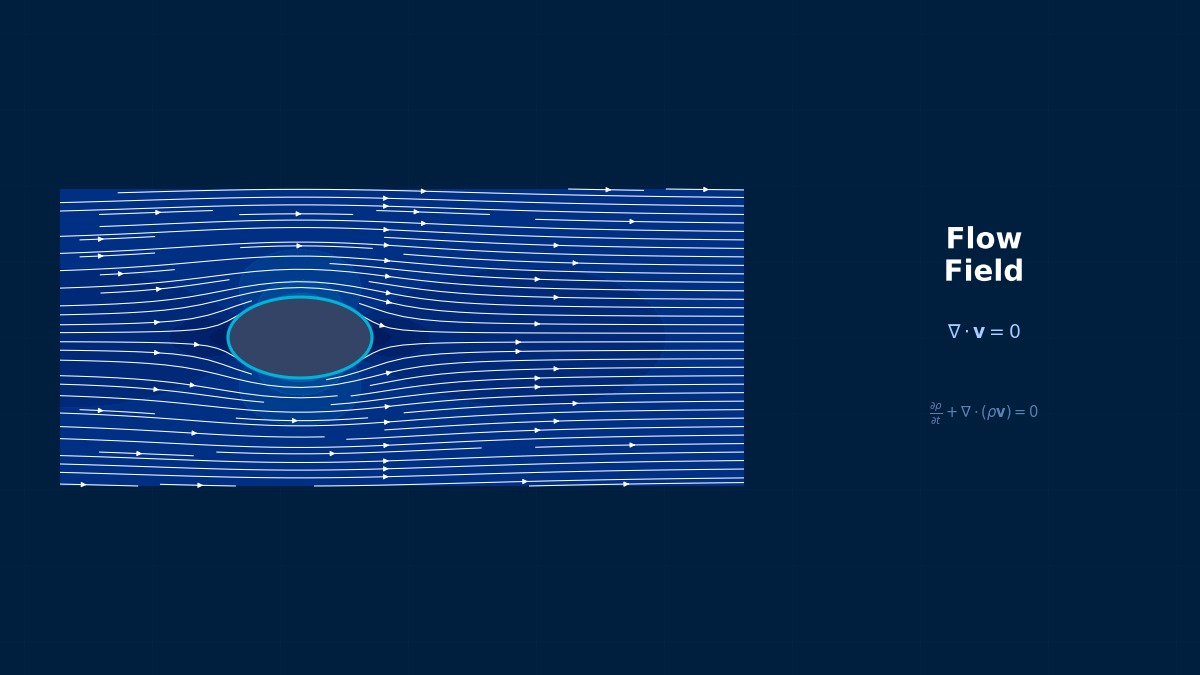
Incompressible Navier-Stokes Equations: Theoretical Foundations
Overview
Professor, the Navier-Stokes equations are the foundation of CFD, right? Could you please explain the incompressible case in detail?
They are the most fundamental and important equations solved in CFD. The incompressible NS equations describe viscous flow of Newtonian fluids. They consist of a set of the continuity equation and the momentum equations.
Governing Equations
The incompressible NS equations are the following two equations.
Continuity Equation (Mass Conservation):
Momentum Equation (Newton's Second Law):
Could you explain the physical meaning of each term?
It's easier to understand when written in component form (for the $x$ direction).
Reynolds Number
How is the Reynolds number related to the NS equations?
When you non-dimensionalize the equations using a characteristic velocity $U$ and characteristic length $L$, the Reynolds number appears as the sole parameter.
| Re Range | Flow Characteristics | Typical Examples |
|---|---|---|
| Re < 1 | Creep Flow (Stokes Flow) | Microorganism swimming, MEMS |
| 1 < Re < 2300 | Laminar Flow | Pipe flow (developed flow) |
| 2300 < Re < 4000 | Transition Region | Pipe flow (unstable) |
| Re > 4000 | Turbulent Flow | Most industrial flows |
Mathematical Properties of the Equations
The existence and uniqueness of solutions to the NS equations is an unsolved problem, right?
Exactly. The global existence and uniqueness of smooth solutions for the three-dimensional NS equations is one of the Clay Mathematics Institute's Millennium Prize Problems (with a $1 million prize). From an engineering perspective, we obtain solutions for finite time and finite domains via DNS (Direct Numerical Simulation), but a mathematical proof has not yet been established.
The nonlinearity of the equations originates from the convection term $(\mathbf{u}\cdot\nabla)\mathbf{u}$. This term is the source of complex phenomena such as turbulence, chaos, and vortex breakdown.
The $1 Million Prize Nobody Has Solved
For the incompressible Navier-Stokes equations, it hasn't even been mathematically proven that "a solution must always exist." It's one of the seven "Millennium Problems" selected by the Clay Mathematics Institute in 2000, and solving it earns you $1 million (about 150 million yen). The calculations engineers run daily in CFD are, strictly speaking, "numerically solving equations for which we don't even know if a solution truly exists"—a rather surreal situation. Moreover, of the remaining six problems, only one has been solved so far—Navier-Stokes remains uncharted territory for humanity.
Computational Methods for the Incompressible Navier-Stokes Equations
Spatial Discretization
How do you solve the NS equations numerically?
The Finite Volume Method (FVM) is mainstream in commercial CFD. The computational domain is divided into cells, and the integral form of the conservation laws is discretized for each cell.
Convection Term Discretization
The choice of scheme for the convection term directly affects accuracy and stability.
| Scheme | Accuracy | Stability | Numerical Diffusion | Application |
|---|---|---|---|---|
| 1st Order Upwind | $O(h)$ | Very Stable | Large | Initial calculations, when convergence is difficult |
| 2nd Order Upwind | $O(h^2)$ | Stable | Medium | General steady-state calculations |
| QUICK | $O(h^3)$ | Somewhat Unstable | Small | High-precision calculations |
| Central Differencing | $O(h^2)$ | Unstable (high Pe) | None | LES |
| Bounded CD | $O(h^2)$ | Stable | Minimal | Standard for LES |
Why use central differencing in LES?
Because numerical diffusion would artificially dampen the SGS eddies. In LES, physical eddies need to be preserved as much as possible, with dissipation occurring only via the SGS model. However, central differencing is prone to checkerboard instability, so Bounded Central Difference with limiters is practical.
Time Integration
Let's compare time integration schemes for unsteady calculations.
| Scheme | Accuracy | Stability | CFL Constraint |
|---|---|---|---|
| 1st Order Implicit (Backward Euler) | $O(\Delta t)$ | Unconditionally Stable | None |
| 2nd Order Implicit (BDF2) | $O(\Delta t^2)$ | Unconditionally Stable | None |
| Crank-Nicolson | $O(\Delta t^2)$ | Unconditionally Stable | Possible Oscillations |
| Explicit (RK4, etc.) | $O(\Delta t^4)$ | Conditionally Stable | $CFL < 1$ |
CFL Condition
I often hear about the CFL number, but what does it mean exactly?
The Courant-Friedrichs-Lewy number is an indicator of how many cells information travels in one timestep.
For explicit methods, $CFL < 1$ is a necessary condition for stability. Implicit methods have no constraint, but for time accuracy, $CFL < 5$ to 20 is recommended. In LES, it's common to maintain $CFL < 1$.
Linear Solvers
The choice of linear solver to solve the discretized system of equations is also important.
| Target Equation | Recommended Solver | Notes |
|---|---|---|
| Pressure (Poisson Equation) | AMG (Algebraic Multigrid) | Most difficult to converge, accounts for 50-80% of total computation time |
| Momentum | BiCGSTAB with ILU Preconditioning | Relatively easy to converge |
| Scalar (Temperature, etc.) | Gauss-Seidel or ILU | Linear problems |
The Secret Story of SIMPLE's Birth—The "Mind Game" Between Pressure and Velocity
The biggest hurdle for incompressible flow is that "there is no pressure equation." Trying to solve for velocity and pressure simultaneously makes the system of equations break down. In 1972, Patankar and Spalding published the algorithm "SIMPLE" that solved this difficult problem. The idea is an iterative loop: "First assume a pressure, solve for velocity, then correct the pressure from that and recalculate velocity." It seems like a simple concept, but without this algorithm, modern commercial CFD codes would hardly exist. Behind the "Iterations" screen you watch every day in Fluent, the wisdom of two people from half a century ago is at work.
Experience the theory firsthand with the interactive simulator for this field
All Simulators