Euler Buckling Analysis
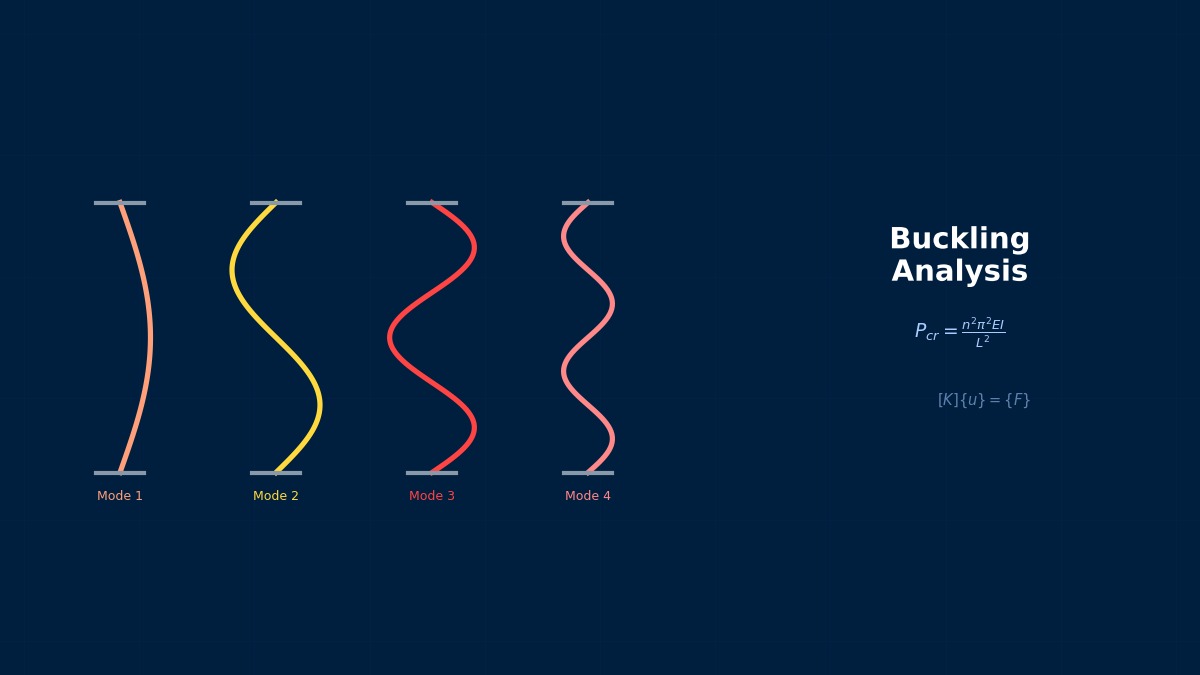
Theory and Physics
What is Buckling?
Does buckling happen suddenly, unlike tensile failure? I saw an aluminum can suddenly get crushed when stepped on and was curious.
That aluminum can is a perfect example of buckling. If you slowly press down on the can from directly above, it withstands the force without issue up to a certain point. But the moment you exceed the critical point, the side suddenly pops out sideways and it collapses instantly. Even though the material hasn't fractured, it's a phenomenon where the shape loses stability — this is buckling.
The structure collapses even though the material is fine, isn't that scary? Can't it be predicted with just stress calculations?
That's the point that's decisively different from tension and bending. For tension, you can judge based on "Does the stress exceed the yield point?", but buckling is a problem of geometric stability, so it can occur even when the stress is less than half the yield point. In 1757, Leonhard Euler was the first in the world to formulate this mathematically. That's why we still call it "Euler buckling" today.
1757!? A theory from over 270 years ago is still used in modern CAE?
Well, Euler was the pinnacle of mathematics at the time. He used calculus of variations to analytically determine "at what load a column becomes unstable." This formula is the starting point for buckling eigenvalue analysis in today's CAE. Let's first trace the derivation.
Derivation of the Governing Equation
How do you derive Euler's formula?
First, consider a column under axial force $P$ that is slightly deflected sideways. If the deflection is $y(x)$, then this deflection creates an additional moment $M = -Py$. Substituting this into the Euler-Bernoulli beam bending equation gives:
$EI$ is the bending stiffness, right? The equation looks simple, but...
This is a second-order linear ordinary differential equation. Setting $k^2 = P/(EI)$ gives $y'' + k^2 y = 0$. The general solution is:
Sine and cosine! It has the same form as the simple harmonic motion equation.
Exactly. Now apply the boundary conditions. For both ends pinned ($y(0) = 0$, $y(L) = 0$), we get $B = 0$ and $A\sin(kL) = 0$. We want a solution with deflection ($A \neq 0$), so:
$n = 1$ gives the smallest load, right? Does buckling occur at that load in real structures?
That's correct. Substituting back $k^2 = P/(EI)$, the minimum critical load is:
This is the famous Euler buckling load. $n = 2, 3, \ldots$ are higher-order modes, but in real structures, the lowest-order mode ($n=1$, a half-sine wave) is dominant.
Boundary Conditions and Effective Buckling Length
I understand the case with both ends pinned. But actual columns are bolted to foundations or connected to slabs at the top, right?
That's where the effective buckling length coefficient $K$ comes in. It converts the buckling length for actual boundary conditions into an "equivalent pinned-pinned column length." The general formula becomes:
| Boundary Condition | K Value | $P_{cr}$ Ratio | Practical Example |
|---|---|---|---|
| Both ends pinned | 1.0 | 1.0 (reference) | Idealized truss members |
| One end fixed, one end free (cantilever) | 2.0 | 0.25 | Flagpoles, free-standing columns |
| Both ends fixed | 0.5 | 4.0 | Columns between concrete walls |
| One end fixed, one end pinned | 0.7 | 2.04 | Steel frame columns with fixed base and beam connections |
For a cantilever with $K = 2.0$, $P_{cr}$ is a quarter of that for a pinned-pinned column of the same length!? Is the difference that big?
Because $P_{cr}$ is inversely proportional to $(KL)^2$. Cantilever columns require particular care in design. Conversely, for both ends fixed, $K = 0.5$, so $P_{cr}$ becomes four times higher for the same column. For example, in building steel columns, restraining the ends with horizontal beams or braces can reduce $K$ — meaning they become stronger against buckling.
But real bolt connections aren't "perfectly fixed" or "perfectly pinned," are they?
Sharp observation. Actual joints are "semi-rigid," and the $K$ value differs from the theoretical one. Therefore, design codes (like AIJ or Eurocode 3) instruct to take $K$ on the larger side for safety. In CAE, there are techniques to represent semi-rigid connections using rotational spring elements. Underestimating this point is dangerous.
Slenderness Ratio and Applicable Range
Don't thick, short columns buckle? I can't imagine a stocky column bending sideways when compressed.
That's a core question. It becomes clearer when rewritten in terms of critical stress:
Here, $r = \sqrt{I/A}$ is the radius of gyration of the cross-section, and $KL/r$ is the slenderness ratio. The larger the slenderness ratio, the lower $\sigma_{cr}$ becomes — meaning slender columns are more prone to buckling.
Then, for a very thick column (a column with a small slenderness ratio), $\sigma_{cr}$ would exceed the yield stress, right? Is that physically possible?
That's precisely the applicability limit of the Euler formula. For short columns where $\sigma_{cr} > \sigma_Y$ (yield stress), the material yields first before buckling occurs. The condition for Euler buckling to be valid is:
For steel ($E = 200$ GPa, $\sigma_Y = 250$ MPa), this is approximately $KL/r > 89$. For "intermediate columns" with a slenderness ratio smaller than this, Johnson's parabolic formula or tangent modulus theory must be used.
When doing buckling analysis in CAE, is it bad if we don't consider this distinction?
It's very bad. Linear buckling analysis (eigenvalue analysis) assumes Euler-type elastic buckling. If you only run linear buckling analysis on members with a small slenderness ratio, you get a buckling load higher than the actual one, leading to a dangerous assessment. In such cases, nonlinear buckling analysis (geometric nonlinearity + material nonlinearity) is necessary.
Effect of Initial Imperfections
Textbook columns are perfectly straight, but columns made in factories are slightly curved, right? Does that affect buckling?
It has a very significant effect. Real columns always have initial imperfections due to manufacturing errors, welding residual stresses, and deformation during transport. A perfect column theoretically remains straight up to $P_{cr}$, but with initial imperfections, deflection gradually increases as the load increases. If there is an initial deflection $y_0 = a_0 \sin(\pi x / L)$, the deflection under load $P$ is:
As $P$ approaches $P_{cr}$, the denominator goes to zero... the deflection diverges!
Yes. This is imperfection sensitivity. In real structures, excessive deflection or plasticity occurs before reaching $P_{cr}$, leading to collapse. That's why safety factors are applied in design, and in CAE, nonlinear analysis incorporating initial imperfections becomes important.
Specifically, how do you introduce initial imperfections?
There are two typical methods:
- Buckling Mode Method — Scaling the first mode shape from linear buckling analysis to a small amplitude (about $L/1000$ of the member length) and applying it as the initial shape.
- Design Code Method — Directly reflecting imperfection patterns based on fabrication tolerances (e.g., AIJ's $L/1000$, Eurocode's $L/500$) onto the geometry.
In Abaqus, you can easily incorporate the first mode as an initial imperfection with just the *IMPERFECTION keyword.
Theory Summary
I want to organize the key points from the theory so far.
There are four:
- Buckling is a stability problem, not material failure — A geometric instability phenomenon that occurs within the elastic range.
- $P_{cr} = \pi^2 EI / (KL)^2$ — Boundary conditions (the $K$ value) govern the buckling load.
- The applicable range is determined by the slenderness ratio — Using the Euler formula for short columns leads to a dangerous overestimation.
- Initial imperfections greatly influence real behavior — You must not blindly trust the theoretical $P_{cr}$ value for a perfect column.
So buckling is about "whether the shape is stable," not "whether the material can withstand it." It seems easy to overlook if you only focus on stress values.
That intuition is important to keep. Buckling analysis isn't just about outputting numbers; understanding why that structure becomes unstable from a physical perspective is the essence.
Euler's Genius and the Birth of Buckling Theory
The buckling load formula $P_{cr}=\pi^2 EI/(KL)^2$ published by Leonhard Euler in 1744 astonished scholars of the time. No one had anticipated that "the critical load depends entirely on the cross-sectional shape ($I$) and length ($L$), and not at all on the material strength." It is said that even Euler himself lacked confidence in the practical utility of this formula, yet it has been used continuously for over 270 years as the foundation for slender column design.
Numerical Methods and Implementation
FEM Formulation for Buckling Analysis
Now that I understand Euler's theoretical formula, how is this solved in FEM? Is it different from the usual $[K]\{u\} = \{F\}$?
It's fundamentally different. Ordinary static analysis just solves a system of equations, but buckling analysis becomes an eigenvalue problem:
Here, $[K]$ is the usual elastic stiffness matrix, $[K_\sigma]$ is the geometric stiffness matrix (stress stiffness matrix), $\lambda$ is the buckling load factor, and $\{\phi\}$ is the buckling mode shape.
Eigenvalue problems... they also came up in vibration analysis as $([K] - \omega^2 [M])\{\phi\} = \{0\}$. The forms are similar...
Mathematically, they have exactly the same structure. The mass matrix $[M]$ in vibration is simply replaced by the geometric stiffness matrix $[K_\sigma]$ in buckling. Grasping this correspondence will greatly speed up your understanding when reading solver manuals.
What exactly is $[K_\sigma]$? From the name, it seems different from the regular stiffness matrix.
The usual $[K]$ is determined by the material's elastic modulus and shape — it's independent of load. On the other hand, $[K_\sigma]$ depends on the current stress state. When compressive stress is present, the contribution of $[K_\sigma]$ becomes negative, acting to reduce the overall stiffness.
Ah, I see! As the compressive load increases, the structure becomes "softer," and at some point the overall stiffness becomes zero — that's the buckling point!
Perfect understanding. The $\lambda$ for which $[K] + \lambda [K_\sigma]$ becomes singular (its determinant becomes zero) is the buckling load factor. The critical load is the reference load $\{F_{ref}\}$ multiplied by $\lambda$.
Construction of the Geometric Stiffness Matrix
Related Topics
なった
詳しく
報告