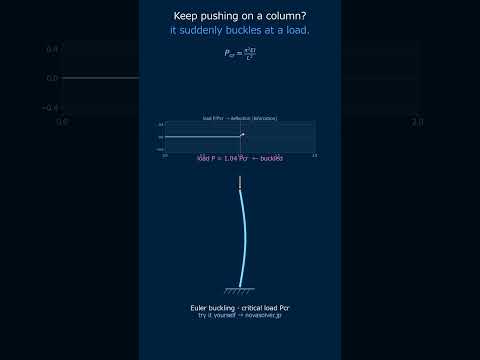
Quick answer The Euler buckling load is P_cr = π²EI/(KL)² (E = Young's modulus, I = second moment of area, K = effective-length factor, L = length). Buckling stress: σ_cr = π²E/λ², λ = KL/r; columns more slender than λ_c = π√(E/σ_Y) buckle elastically, shorter ones plastically (Johnson formula).
Change cross-section shape, end conditions, and column length to calculate critical buckling load in real time. Simultaneously visualize buckling mode shape and Pcr–L relationship.
Parameters
Young's Modulus E
GPa
Cross-Section Shape
Second Moment of Area I = —
Column Length L
m
End Condition
Results
—
Critical Load P_cr (kN)
—
Effective Length KL (m)
—
Moment of Inertia I (m⁴)
—
Slenderness Ratio KL/r
Buckling Mode Shape
Drag up/down to change column length L
P_cr vs L (log scale)
Buckling Animation
Real-time buckling mode shape visualization for current end conditions and cross-section (deformation exaggerated)
Saved Results Comparison
Label
P_cr (kN)
KL/r
I (m⁴)
Theory & Key Formulas
$$P_{cr} = \frac{\pi^2 E I}{(KL)^2}$$
Euler buckling load (N): $E$ = Young's modulus (Pa), $I$ = second moment of area (m⁴), $K$ = effective length factor, $L$ = column length (m).
Critical stress (Pa): slenderness ratio $\lambda = KL/r$, radius of gyration $r = \sqrt{I/A}$.
$$\lambda_c = \pi\sqrt{\frac{E}{\sigma_Y}}$$
Critical slenderness ratio: above this value elastic buckling governs; below it, inelastic buckling (Johnson formula) applies.
What is Euler Buckling?
🙋
What exactly is "buckling"? I know a column can break if you push down too hard, but isn't that just normal crushing?
🎓
Great question! Basically, buckling is a sudden sideways bending failure, not a crushing one. It happens to long, slender columns under compression. In practice, the column becomes unstable and bows out long before the material reaches its crushing strength. Try moving the "Column Length" slider in the simulator above from short to long—you'll see the critical load drop dramatically, showing why long columns are so vulnerable to buckling.
🙋
Wait, really? So the shape of the cross-section matters too? Does a solid round bar buckle at the same load as a thin-walled tube of the same diameter?
🎓
Exactly! The shape is crucial because it determines the "Area Moment of Inertia" (I), which measures resistance to bending. A thin-walled tube has most of its material far from the center, giving it a much higher I for the same amount of material. For instance, this is why bicycle frames use hollow tubes. In the simulator, switch between the cross-section shapes and watch how the critical load changes even if the cross-sectional area stays similar.
🙋
Okay, and what about the "End Conditions" option? Why does a pinned-pinned column have a different buckling load than a fixed-fixed one?
🎓
That's about how the ends are supported, which changes how the column can bend. A fixed end (like welded into a solid base) resists rotation, making the column stiffer and allowing it to carry more load before buckling. The "Effective Length Factor" (K) in the formula accounts for this. A common case is a flagpole (fixed at the base, free at the top) versus a table leg (pinned at both ends). Change the end condition in the simulator and you'll instantly see a different buckling mode shape and a new critical load value.
Physical Model & Key Equations
The Euler buckling formula calculates the critical axial load, $P_{cr}$, at which a perfectly straight, elastic column becomes unstable and buckles. It is derived from the differential equation for the beam's elastic curve under axial load.
$$P_{cr}= \frac{\pi^2 EI}{(KL)^2}$$
$P_{cr}$: Critical buckling load (N). $E$: Young's modulus of the material (Pa). $I$: Minimum area moment of inertia of the cross-section (m⁴). $L$: Actual length of the column (m). $K$: Effective length factor, which depends on end conditions.
The effective length, $KL$, is the length of an equivalent pinned-pinned column that buckles at the same load. The factor $K$ transforms the real column into this simpler model for analysis.
$$L_{effective} = KL$$
Typical K values: Pinned-Pinned: $K=1$. Fixed-Fixed: $K=0.5$. Fixed-Pinned: $K \approx 0.7$. Fixed-Free: $K=2$. The buckling mode shape you see in the simulator visualizes the deflection curve corresponding to each end condition.
Frequently Asked Questions
For shapes with the same second moment of area I (e.g., a square and a circle with the same area), the buckling load will also be the same. However, in actual design, the effects of material yield strength and local buckling must also be considered.
Because the end condition coefficient K becomes smaller (K=0.5 for fixed-fixed ends), the effective buckling length KL becomes shorter, and P_cr increases inversely proportional to K². Fixed ends restrain deformation, making buckling less likely.
Please verify that the units for Young's modulus E and cross-sectional dimensions are correct. In particular, since the second moment of area I is proportional to the fourth power of length, a mistake between mm and m can significantly change the value. The same applies to the column length L.
It schematically shows the deflection shape (sine wave) of the column when buckling occurs. The fundamental mode with n=1 occurs at the lowest load, and the position of nodes changes depending on the end conditions. In design, the fundamental mode is typically considered.
Real-World Applications
Structural Engineering & Building Design: Calculating the safe load for steel columns in skyscrapers and bridges is a primary application. Engineers must ensure service loads are well below the Euler critical load, applying large safety factors to account for imperfections and unexpected loads.
Aerospace & Aircraft Design: Aircraft fuselage stringers and wing spars are slender compression members highly susceptible to buckling. Using high-strength alloys and optimizing cross-sections (like I-beams or hat-sections) maximizes the moment of inertia $I$ to prevent buckling while minimizing weight.
Industrial Machinery & Presses: The long hydraulic pistons in industrial presses or the lead screws in machining equipment act as columns. Their design must consider the Euler load to prevent sudden failure during operation, which often dictates their minimum diameter for a given stroke length.
Consumer Product Design: From lightweight aluminum tent poles to telescoping camera tripod legs, the principles of Euler buckling dictate the wall thickness and locking mechanisms needed to prevent collapse under your gear's weight.
Common Misunderstandings and Points to Note
First, grasp the point that "buckling is not determined by material strength alone." Even if you use high-strength steel, a slender column will buckle easily. Conversely, even a brittle material like concrete will have its compressive strength become the limiting factor first if the column is thick and short. Try changing the "Material" in this tool from S45C to aluminum. Since Young's modulus E becomes about one-third, the calculated buckling load should also drop sharply to about one-third. The characteristic of buckling is that stiffness (Young's modulus), not material strength (yield point), is what matters.
Next, pay close attention to "the ideal versus reality of end conditions." If you select "Both ends fixed" in the design, the calculation shows it becomes very strong. However, in practice, welded or bolted joints rarely become perfect fixed ends. For example, even if a column base is anchored to a foundation with anchor bolts, some rotational flexibility remains. Therefore, in practical work, safety-conscious judgments like "the theoretical value is 0.5, but we estimate the effective K-factor as 0.65 or 0.8" following standards like JIS or AISC are essential. Use this tool to compare "Both ends fixed" and "One end fixed, one end pinned" and get a feel for the difference.
Finally, understand the frightening aspect that "buckling happens in an instant." Unlike plastic deformation such as yielding, buckling is a phenomenon where a stable state suddenly collapses. For instance, if you load a slender aluminum support column, at a certain limit point it will make a "crack!" sound and deflect significantly all at once. The critical load Pcr calculated by this tool is purely a theoretical "limit value," so the iron rule is that the actual allowable load must be considered by dividing it by a safety factor (default is 3 in this tool, for example). Try changing the safety factor to 2 or 4 and see how the allowable load changes.
Steel pipe column (E=200 GPa, outer diameter 60 mm, wall thickness 4 mm, length 3 m) with pinned ends (K=1.0). Moment of inertia I=5.24×10⁻⁶ m⁴, radius of gyration r=0.0293 m. Slenderness ratio KL/r=(1.0×3)/0.0293=102. Critical buckling load P_cr=π²(200×10⁹)(5.24×10⁻⁶)/(3)²=1,142 kN. Column buckles elastically in single sine-wave mode when axial load exceeds this threshold.
Practical Notes
For fixed-free cantilever columns, K=2.0 doubles effective length; use K=0.5 for fixed-fixed braced frames to resist buckling better
Hollow rectangular sections resist buckling better than solid bars of equal weight due to higher I; compare W310×52 beam (I=85.4×10⁻⁶ m⁴) versus solid steel rod
Always verify end-condition assumptions in field applications—partially restrained connections reduce actual K effectiveness
🎬 Watch it in motion
Euler Buckling | a slender column snaps sideways at once #Shorts
Why does a column suddenly snap? Euler buckling #Shorts
Example
Example: Buckling Load of a Steel Circular Tube Column
Calculate the buckling load of a steel circular tube (OD 60mm, wall thickness 3mm, length 2m).
Material: Steel (E = 206 GPa)
Second moment of area:I = π(D⁴−d⁴)/64 ≈ 2.73×10⁻⁷ m⁴