Plate Buckling
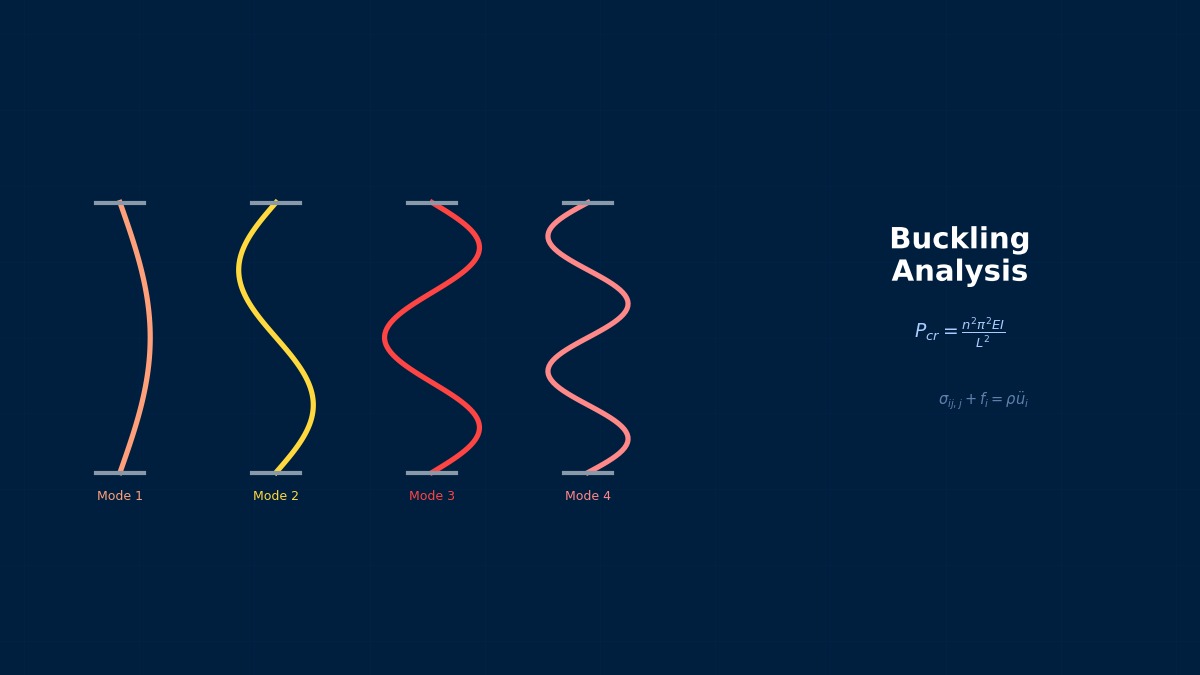
Plate Buckling: Theoretical Foundations
Differences from Column Buckling
Euler buckling was for a one-dimensional column. What's different about plate (2D) buckling?
There are two fundamental differences.
1. Plates can still carry load after buckling. Columns experience a sudden drop in load capacity after buckling, but plates can redistribute the load and carry additional load after buckling. This is called post-buckling strength.
2. Plate buckling is a two-dimensional problem. For columns, only deflection in one direction needs to be considered, but plates involve the interaction of in-plane biaxial stress states and out-of-plane deflection.
Being able to carry load even after buckling is very practical. I've heard aircraft skin panels are like that.
Exactly. Aircraft wing skin panels undergo local buckling at about 60-70% of the design load, but stiffeners (stringers, ribs) redistribute the load so the overall structure holds. Designs that don't utilize post-buckling strength become excessively heavy, so plate buckling theory is essential in aircraft design.
Governing Equation for Plate Buckling
What equation governs plate buckling?
Thin plate buckling is described by the von Kármán equations. For a rectangular plate under uniform compression:
Here $D = Et^3 / 12(1-\nu^2)$ is the plate's bending rigidity, $w$ is the out-of-plane deflection, and $N_x, N_y, N_{xy}$ are the in-plane stress resultants.
$D$ contains the cube of the plate thickness $t$! If the thickness doubles, the bending rigidity becomes 8 times... plate buckling is extremely sensitive to thickness.
Exactly. Buckling stress is proportional to the square of the plate thickness. Therefore, thickness is the most important parameter in the buckling design of thin plates.
Buckling Coefficient $k$
I saw the formula $\sigma_{cr} = k \cdot \pi^2 D / (b^2 t)$ in a textbook. What is $k$?
$k$ is the buckling coefficient, a dimensionless parameter determined by boundary conditions, loading conditions, and the aspect ratio $a/b$. The essence of plate buckling problems boils down to finding this $k$.
Typical $k$ values:
| Loading | Boundary Conditions | $k$ | Remarks |
|---|---|---|---|
| Uniform Compression | Four Edges Simply Supported | 4.0 | Base case ($a/b \geq 1$) |
| Uniform Compression | Loaded Edges Simply Supported + Unloaded Edges Fixed | 6.97 | Restraint effect of fixed edges |
| Uniform Compression | Loaded Edges Simply Supported + One Edge Free | 0.425 | Flange outstand plate buckling |
| Pure Shear | Four Edges Simply Supported | 5.34 + 4.0$(b/a)^2$ | Shear buckling |
| Pure Bending | Four Edges Simply Supported | 23.9 | Bending compression buckling |
There's almost a 10x difference between $k = 4.0$ and $k = 0.425$! Do boundary conditions have that much effect?
If one edge is free (unrestrained), that edge can deform freely, making buckling easier. The outstand of an H-section steel flange is exactly this case, resulting in a low value of $k = 0.425$. Conversely, the web with both edges fixed has $k = 6.97$ and is more resistant to buckling.
Buckling Mode Shape
What shape is the buckling mode of a plate?
The buckling displacement of a simply supported rectangular plate is:
Here $m$ is the number of half-waves in the loading direction. The buckling coefficient $k$ also changes with $m$:
The $m$ that minimizes $k$ is the actual buckling mode, right?
Yes. For a square plate ($a/b = 1$), $m = 1$ gives $k = 4.0$. For $a/b = 2$, $m = 2$ gives $k = 4.0$. Longer plates buckle with more half-waves.
No matter how long it gets, $k$ converges to $k = 4.0$!
Exactly. This is an important characteristic of plate buckling: buckling stress is determined solely by the width $b$ (it does not depend on the length $a$). Therefore, in plate buckling design, the "width/thickness ratio" $b/t$ becomes the most important parameter.
Concept of Effective Width
How does a plate carry load after it buckles?
When a plate buckles, the central part deflects and its stiffness decreases, but the areas near the supported edges still remain flat and can carry load. This "width of the portion that can still effectively carry load" is the effective width $b_e$.
von Kármán's effective width formula:
The effective width narrows as the applied stress increases... so as the load increases, the effective cross-section of the plate decreases.
Exactly. Design codes (Eurocode 3, AISI S100, etc.) are based on this effective width concept. Section properties are calculated using the effective width, not the full width, and stress checks are performed on this effective cross-section.
Summary
Let me organize the theory of plate buckling.
Key points:
- Plates can still carry load after buckling — fundamentally different from columns
- $\sigma_{cr} = k \pi^2 D / (b^2 t)$ — buckling coefficient $k$ is determined by boundary and loading conditions
- Plate thickness $t$ is dominant — $D \propto t^3$, so sensitivity to thickness is very high
- For long plates, $k$ is determined solely by width $b$ — $b/t$ is the key to design
- Effective width — a design concept representing load-carrying capacity after buckling
So plate buckling is more like "the load path changes" rather than "it breaks."
Good way to put it. Especially in aerospace and thin-walled steel structures, designs that "allow" buckling are standard, so understanding post-buckling strength and effective width is essential.
von Kármán and Navier's Analytical Solution for Lattice Buckling
The buckling stress σcr=kπ²E/(12(1-ν²)(b/t)²) for a simply supported rectangular plate (side lengths a×b) under uniformly distributed compression was obtained by Navier (1820s) using the double Fourier series method. The coefficient k varies with the side ratio a/b and boundary conditions; for a square with a/b=1, k=4, and as a/b increases, it fluctuates periodically around a minimum value of k≈4. This formula is the direct basis for the current local buckling checks in thin-walled girder design (AISC, EU codes).
Computational Methods for Plate Buckling
FEM for Plate Buckling Analysis
When analyzing plate buckling with FEM, are there any specific points to note?
Plate buckling has more FEM-specific issues compared to column buckling. The biggest challenge is element type selection.
Shell Element vs. Solid Element
Is it standard to use shell elements for plate buckling?
Basically, yes. For thin plate buckling analysis, shell elements are standard, and solid elements are used only in special cases.
| Characteristic | Shell Element | Solid Element |
|---|---|---|
| DOF Count (per same area) | Few | Many (elements needed in thickness direction too) |
| Bending Deformation Accuracy | High (faithful to theory) | Risk of shear locking |
| Buckling Waveform Representation | Natural | Depends on number of elements in thickness direction |
| Stress Distribution in Thickness Direction | Based on assumption | Can be calculated directly |
| Applicability to Thick Plates | Limited (approx. $b/t > 10$) | No limitation |
If solving plate buckling with solid elements, how many elements are needed in the thickness direction?
For buckling analysis with solid elements (especially for linear eigenvalue analysis), typically a minimum of 3-5 elements in the thickness direction is necessary to accurately capture the bending deformation and avoid membrane-dominated spurious modes. However, 8-10 elements is preferable for higher accuracy.
That's many more elements than with shell elements...
Exactly. That's why for thin plate buckling, shell elements are overwhelmingly preferred. However, for very thick plates or when you need direct stress distribution through the thickness (e.g., to evaluate local stress concentrations), solid elements become advantageous despite higher computational cost.
Are there any numerical tricks for improving convergence in plate buckling?
Yes, several important ones:
- Initial geometric imperfections: Real plates always have small manufacturing imperfections. For nonlinear post-buckling analysis, introducing 0.5–5% of plate thickness as initial deflection helps capture realistic post-buckling behavior.
- Mesh refinement in buckling regions: Refine the mesh, especially near edges and supports where stress gradients are high and buckling initiates.
- Aspect ratio control: Keep element aspect ratios reasonable (preferably 1:1 to 4:1). Highly distorted elements deteriorate bending accuracy.
- Eigenvalue solver settings: Use robust solvers (e.g., Lanczos) and request more eigenvalues than needed to identify spurious modes.
For post-buckling analysis beyond the first eigenvalue, nonlinear FEA with Riks or arc-length methods is required. This traces the load–deflection curve into the post-buckling regime.
Summary
FEM plate buckling summary?
Key points:
- Shell elements are the standard choice — lowest DOF count with high accuracy for thin plates ($b/t > 10$)
- Solid elements require 5–10 elements through thickness — more computational cost but necessary for thick plates or detailed stress analysis
- Mesh quality is critical: avoid distorted elements, refine near supports and stress concentrations
- Linear buckling (eigenvalue) gives first buckling load — nonlinear post-buckling requires arc-length methods
- Include geometric imperfections for realistic post-buckling — 0.5–5% of plate thickness is typical
After FEM plate buckling analysis, always perform a sanity check: compute the theoretical critical stress $\sigma_{cr} = k \pi^2 E / (12(1-\nu^2)(b/t)^2)$ from first principles and compare to the FEM eigenvalue. If they differ by more than 5–10%, investigate mesh quality, element formulation, boundary condition implementation, and whether the mode shape makes physical sense.