Hashin Failure Criterion
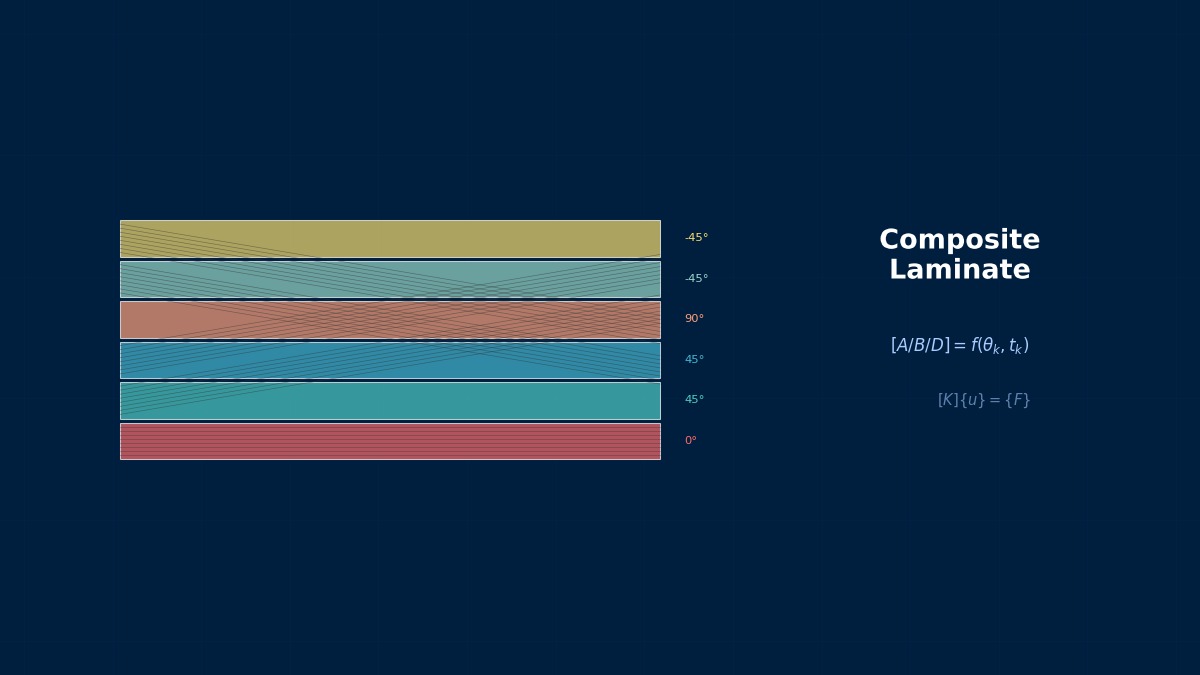
Hashin Failure Criterion: Theoretical Foundations
What is the Hashin Criterion?
Professor, how is the Hashin criterion different from Tsai-Wu?
The biggest difference is that it distinguishes between failure modes. Tsai-Wu gives a binary "failed/not failed" judgment, but the Hashin criterion (1980) identifies four independent failure modes.
Four Failure Modes
The four modes of the Hashin criterion:
1. Fiber Tensile Failure (Fiber Tension)
2. Fiber Compressive Failure (Fiber Compression)
3. Matrix Tensile Failure (Matrix Tension)
4. Matrix Compressive Failure (Matrix Compression)
It distinguishes between fiber and matrix failure, and further separates tensile and compressive failure. So it uses four equations to judge the four modes.
Correct. That is the greatest advantage of the Hashin criterion. If you know the failure mode, it becomes clear which strength needs to be improved. If it's fiber breakage, increase the fiber volume; if it's matrix cracking, change the matrix resin... the countermeasures become specific.
Handling Progressive Damage
Can the Hashin criterion be used for progressive damage analysis?
Yes. When the failure index for each mode exceeds 1, reduce the stiffness corresponding to that mode:
- Fiber failure → Reduce $E_1$
- Matrix cracking → Reduce $E_2, G_{12}$
- Combination of both → Reduce all stiffness
Abaqus's Built-in Hashin Damage implements failure judgment + stiffness reduction + energy dissipation as an integrated package. It is the de facto standard for progressive damage analysis of composites.
Tsai-Wu doesn't have this capability, right?
Tsai-Wu mixes all modes in one equation, so "which stiffness to reduce" cannot be determined. The Hashin criterion, which can separate modes, forms the foundation for progressive damage analysis.
Limitations of the Hashin Criterion
The Hashin criterion also has limitations:
| Limitation | Explanation |
|---|---|
| Fiber compression mode is too simple | In reality, kink bands (local fiber buckling) dominate |
| Does not consider fracture plane angle in matrix compression | The Puck or LaRC criteria are more accurate |
| Cannot handle delamination | Requires a separate CZM (Cohesive Zone Model) |
So there's still room for improvement even with Hashin.
The Hashin criterion is the "pioneer of mode separation," but the physical description of each mode is still rough. The LaRC05 criterion (NASA Langley Research Center, 2005) is a newer criterion that improves upon Hashin's limitations.
Summary
Let me organize the Hashin criterion.
Key points:
- Distinguishes four failure modes — Fiber tension/compression, Matrix tension/compression
- Compatible with progressive damage — Allows mode-specific stiffness reduction
- Standard implementation in Abaqus — Built-in Hashin Damage
- Physically more accurate than Tsai-Wu — However, calculations are more complex
- Has limitations — Kink bands in fiber compression, fracture plane angle in matrix compression
The distinction in usage is clear now: Tsai-Wu for screening, Hashin for detailed evaluation.
Exactly. Use Tsai-Wu for rough estimation in the initial design stage, and Hashin (or Puck/LaRC) for precise evaluation in detailed design. A step-by-step approach is practical.
Hashin Discovers Biaxial Interaction in CFRP Failure
The Hashin failure criterion was developed by Zvi Hashin (Technion University) between 1973 and 1980. Because the conventional Maximum Stress criterion was inaccurate for composite failure under multiaxial stress fields, he defined four independent modes—fiber rupture, matrix rupture, fiber compression, and matrix compression—each with its own interaction equation. It was later evaluated in the WWFE (World Wide Failure Exercise, 2002–2004) as the most accurate criterion for CFRP design.
Computational Methods for Hashin Failure Criterion
Abaqus Hashin Damage Model
Please teach me how to set up the Hashin damage model in Abaqus.
Abaqus's Built-in Hashin Damage is set up in two stages.
Step 1: Damage Initiation Criterion
```
*DAMAGE INITIATION, CRITERION=HASHIN
X_t, X_c, Y_t, Y_c, S_L, S_T, alpha
```
7 parameters: Fiber tensile/compressive strength, Matrix tensile/compressive strength, Longitudinal/transverse shear strength, $\alpha$ (shear stress contribution coefficient).
Step 2: Damage Evolution Law
```
*DAMAGE EVOLUTION, TYPE=ENERGY
G_ft, G_fc, G_mt, G_mc
```
4 fracture energies: Fracture energy ($G_c$) for fiber tension/compression, matrix tension/compression.
So fracture energy is needed. Strength values alone aren't enough?
In progressive damage, mesh dependency becomes a problem. Using fracture energy allows results independent of mesh size. It's the same concept as $G_c$ (Energy Release Rate) in fracture mechanics.
Hashin Implementation by Solver
| Feature | Abaqus | Nastran | Ansys |
|---|---|---|---|
| Hashin Failure Judgment | ○ (Standard) | △ (USDFLD) | ○ (ACP Post) |
| Progressive Damage | ○ (DAMAGE EVOLUTION) | △ (SOL 400 + User) | △ (ACP + APDL) |
| Fracture Energy Method | ○ | — | Limited |
| Element Deletion | ○ (STATUS) | ○ (PARAM,ERODEL) | ○ (EKILL) |
Abaqus is overwhelmingly well-equipped.
Hashin-based progressive damage analysis is de facto standard in Abaqus. In papers, "Hashin damage" almost always refers to Abaqus's implementation. Equivalent functionality is possible in Nastran or Ansys via user subroutines or scripts, but it's labor-intensive.
Mesh Dependency and Regularization
Please explain regularization using fracture energy.
When damage localizes (concentrates in one element), the energy dissipation becomes dependent on element size. Use the characteristic length to normalize the fracture energy by element size:
$L_c$ is the element's characteristic length (roughly the element size). This ensures dissipated energy remains constant even when the mesh is changed.
Smaller element size leads to larger failure strain, larger size leads to smaller strain. Energy is conserved.
Perfect understanding. However, if elements are extremely large (characteristic length > $2G_c/\sigma_c^2 \cdot E$), snap-back occurs and numerical instability arises. Be mindful of the upper limit for mesh size.
Summary
Let me organize the numerical methods for the Hashin criterion.
Key points:
- Abaqus Standard (implicit method) — Handles nonlinear damage evolution smoothly; suitable for quasi-static analysis
- Abaqus Explicit — Better for dynamic failure and impact; faster convergence but requires energy tuning
- Fracture energy is essential — Regularizes mesh dependency; typically 50–500 J/m² for CFRP
- Element deletion strategy — After damage > 0.99, element can be deleted to prevent spurious stiffness
- Time integration matters — For explicit, use automatic time stepping; monitor energy balance to ensure stability