Analysis of Sandwich Panels
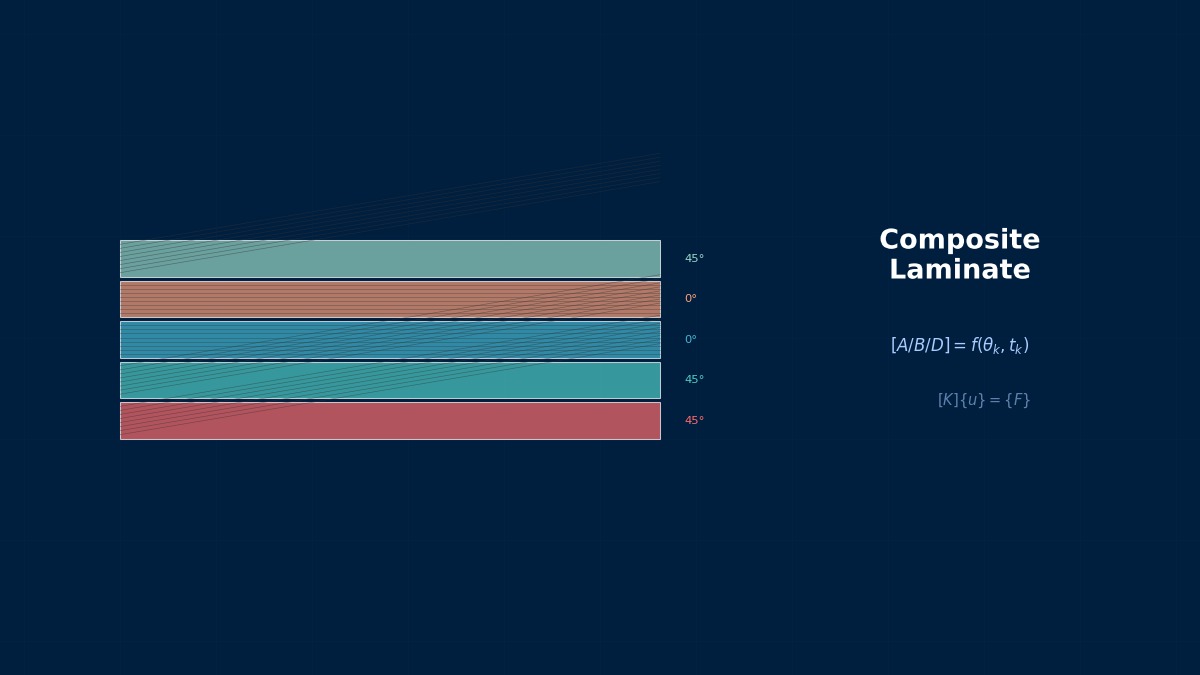
Analysis of Sandwich Panels: Theoretical Foundations
What is a Sandwich Structure?
Professor, a sandwich panel is a structure where a core is sandwiched between two face sheets, right?
Correct. It's a combination of thin, high-stiffness face sheets and a lightweight core that resists shear. It's analogous to an I-beam: the flanges correspond to the face sheets, and the web corresponds to the core. It achieves high bending stiffness with low weight.
Where are they used?
Mechanics of Sandwich Structures
Bending stiffness of a sandwich panel:
The first term is dominant, right? The farther the face sheets are from the neutral axis, the higher the bending stiffness.
It's the same principle as an I-beam. The distance $d$ between the face sheets and the core determines the bending stiffness. Doubling the core thickness makes the bending stiffness four times greater.
Shear in Core Materials
The most important characteristic of sandwich structures is shear deformation of the core. Because core materials are orders of magnitude softer than face sheets, shear deformation can account for the majority of the total deflection.
Ratio of shear deflection to bending deflection:
$E_f/G_c$ can be 100 or more... so shear deflection can be several times greater than bending deflection.
That's why Kirchhoff plate theory cannot be used for sandwich panels. It is essential to use Mindlin plate theory (including shear deformation) or higher-order theories. Solving a sandwich beam with Euler-Bernoulli beam theory is also incorrect.
Failure Modes of Sandwich Structures
Sandwich panels have inherent failure modes:
| Failure Mode | Cause | Severity |
|---|---|---|
| Face sheet yield/failure | Excessive bending stress | High |
| Core shear failure | Exceeding core shear strength | High |
| Face sheet buckling (dimpling) | Local buckling of face between cell walls | Medium |
| Face sheet wrinkling | Short-wavelength buckling of entire face | High |
| Core crushing | Core collapses under concentrated load | Medium |
| Face-core debonding | Adhesive failure, impact damage | High (BVID) |
There are that many failure modes?
Sandwich structures are lightweight but have complex failure modes. Design must consider all modes.
Summary
Let me organize the theory of sandwich panels.
Key points:
- Combination of face sheets + core — Lightweight with high bending stiffness
- Shear deformation of the core is dominant — Kirchhoff plate theory cannot be used. Mindlin or higher is mandatory.
- Six inherent failure modes — Face failure, core shear, buckling, debonding
- Impact damage (BVID) is the most dangerous — Debonding at the face-core interface
- $D \propto d^2$ — Doubling core thickness quadruples bending stiffness
So, sandwich structures are "complex failure modes as the price for being lightweight"?
It's a trade-off between performance and complexity. Sandwich design requires comprehensive checking of all failure modes, which is difficult without the aid of FEM.
The "Engineering Analogy" of Sandwich Structures
Sandwich structures are likened to a jumbo (large sandwich). The outer skin is the bread, the core (honeycomb, etc.) is the filling. With good design, a dramatic increase in bending stiffness can be achieved with only a slight increase in total weight. Doubling the skin-core distance d increases bending stiffness eightfold (Ei×I ∝ d²). When used in aircraft floor structures, structures that are lighter than solid aluminum plates and 3 to 10 times stiffer can be realized.
Computational Methods for Analysis of Sandwich Panels
Modeling Sandwich Structures in FEM
How do you model a sandwich panel in FEM?
Three approaches:
| Method | Model | Accuracy | Cost |
|---|---|---|---|
| Equivalent Shell | A single shell element. Stiffness expressed via ABD matrix. | Medium (global behavior) | Low |
| Layered Shell | Shell element + layup definition (face + core + face). | Medium ~ High | Medium |
| 3D Solid | Model faces and core separately: faces as shells, core as solids. | High | High |
The equivalent shell is the simplest.
Simple, but cannot evaluate core shear failure or local buckling. Use only for estimating overall deflection or buckling load.
The recommended practical approach is layered shell. Define face sheets and core as separate layers and set each layer's material properties correctly. Core shear stiffness is automatically considered.
Nastran
```
PCOMP, 1, , , , ,
, 1, 0.5, 0., YES, $ Face 1 (CFRP)
, 2, 20., 0., YES, $ Core (Honeycomb)
, 1, 0.5, 0., YES $ Face 2 (CFRP)
```
Abaqus
```
*SHELL SECTION, COMPOSITE
0.5, 3, CFRP, 0.
20., 3, CORE, 0.
0.5, 3, CFRP, 0.
```
What material properties are needed for the core material?
Key properties for core materials (honeycomb, foam):
| Property | Honeycomb (Nomex) | PVC Foam |
|---|---|---|
| $E_c$ (out-of-plane compression) | 130~300 MPa | 50~150 MPa |
| $G_{xz}$ (out-of-plane shear) | 30~80 MPa | 20~50 MPa |
| $G_{yz}$ (out-of-plane shear) | 15~40 MPa | 20~50 MPa |
| Crushing strength | 1~5 MPa | 0.5~3 MPa |
Honeycomb has different shear stiffness depending on direction. $G_{xz} \neq G_{yz}$.
Honeycomb has different shear properties in the L-direction (ribbon direction) and W-direction (expansion direction). It must be set as orthotropic. Foam cores are generally isotropic.
Detailed Modeling of the Core
When is a 3D solid model used?
The standard approach is to model the core with solid elements and the faces with shell elements, then connect the interface (TIE constraint or CZM).
Summary
Let's review the three FEM approaches for sandwich structures.
Approach selection guide:
- Equivalent shell — Quick estimate, global behavior only. No local failure analysis.
- Layered shell (recommended) — Practical balance. Includes core shear deformation. Fast and moderately accurate.
- 3D solid — For detailed analysis. Required for impact, edge effects, and local phenomena. High computational cost.
For most design work, the layered shell approach seems sufficient?
Yes. For the design phase, use layered shell. For certification and detailed validation, consider 3D models only at critical locations.