Extended Heat Transfer Surface (Fin)
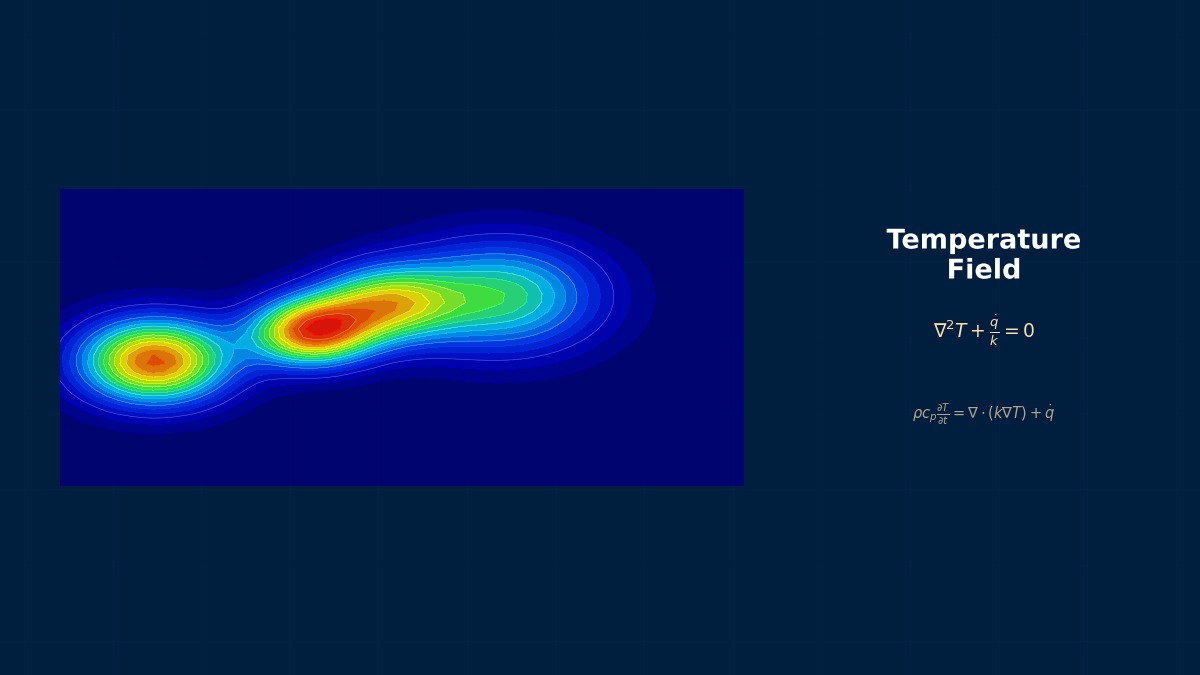
Extended Heat Transfer Surface (Fin): Theoretical Foundations
Fundamentals of Extended Heat Transfer Surfaces
Professor, why are heat sink fins effective?
From the basic convective heat transfer equation $q = hA(T_s - T_\infty)$, when it's difficult to increase $h$, the strategy of an Extended Surface is to increase the area $A$. Insufficient heat dissipation from the base surface alone is achieved by expanding the surface area 10 to 100 times with fins.
So it's simply about increasing the area.
However, since the temperature decreases towards the fin tip, the entire surface does not dissipate heat at the base temperature. Its effectiveness is evaluated by the fin efficiency $\eta_f$.
Governing Equation for Fins
The temperature distribution in a straight fin of uniform cross-section, from energy conservation, is
where $\theta = T(x) - T_\infty$, $m = \sqrt{hP/(kA_c)}$. $P$ is the fin perimeter, $A_c$ is the fin cross-sectional area.
The general solution is $\theta(x) = C_1 e^{mx} + C_2 e^{-mx}$, where the constants are determined by the boundary conditions.
$m$ is the fin parameter. A larger $m$ means the temperature drops more sharply.
Correct. $m$ represents the "slenderness" of the fin. Thinner and longer fins (small $A_c$, large $P$) have a larger $m$ and a lower tip temperature.
Boundary Conditions and Solutions
| Tip Condition | Temperature Distribution | Heat Dissipation |
|---|---|---|
| Adiabatic Tip | $\theta = \theta_b \frac{\cosh m(L-x)}{\cosh mL}$ | $q = \sqrt{hPkA_c}\,\theta_b \tanh mL$ |
| Prescribed Tip Temperature | Linear combination of hyperbolic functions | Equation depending on the case |
| Convective Tip | Approximated using corrected length $L_c = L + A_c/P$ | Apply adiabatic tip formula with $L_c$ |
| Infinite Fin | $\theta = \theta_b e^{-mx}$ | $q = \sqrt{hPkA_c}\,\theta_b$ |
In practice, is the adiabatic tip approximation used often?
Heat dissipation from the tip is only a few percent of the total, so the adiabatic tip approximation using the corrected length $L_c$ provides sufficient accuracy.
History of Fin Development
The concept of extended heat transfer surfaces (fins) was systematized by Alfred Harper in 1922. Now adopted even in Intel CPU coolers, it forms the core technology that dramatically increases heat dissipation by expanding the surface area up to 10 times.
Computational Methods for Extended Heat Transfer Surface (Fin)
Fin Efficiency
What exactly does fin efficiency represent?
The fin efficiency $\eta_f$ is the ratio of the actual heat dissipation to the maximum possible heat dissipation if the entire fin surface were at the base temperature.
$$\eta_f = \frac{q_{\text{actual}}}{q_{\text{max}}} = \frac{q_{\text{actual}}}{hA_f \theta_b}$$
For a straight fin with an adiabatic tip, $\eta_f = \tanh(mL)/(mL)$. Fin efficiency is over 90% for $mL < 1$ and drops sharply for $mL > 3$.
So $mL$ is the key parameter for fin design.
$mL \approx 1$ is considered the optimal point for cost-effectiveness. Making it longer beyond this doesn't increase heat dissipation much relative to the material used.
FEM Analysis of Fins
Fins can sometimes be modeled with shell or beam elements due to their thin structure, but solid elements are typically used for thermal analysis.
Approach Advantages Disadvantages 3D Solid Highest accuracy Large number of elements 2D Cross-section Efficient analysis of repeating structures Ignores 3D effects 1D Analytical Solution Fast, easy parameter study Ignores 2D/3D heat flow
If a heat sink has 100 fins, do we model all of them?
Using symmetry, a model of just one fin suffices. Set symmetry planes at the fin pitch and apply adiabatic conditions to those planes. Software like FloTHERM or Icepak have features to automatically generate fin arrays as parametric models.
Overall Fin Efficiency
The overall performance of a heat sink is evaluated by the overall efficiency $\eta_o$, which combines fin efficiency and the base surface.
$$\eta_o = 1 - \frac{A_f}{A_t}(1 - \eta_f)$$
$A_f$ is the total fin surface area, $A_t$ is the total surface area (Fin + exposed base area).
So the exposed base area is treated as having 100% fin efficiency.
Exactly. Using the overall efficiency, the total heat dissipation can be expressed concisely as $q = \eta_o h A_t \theta_b$.
Coffee Break Trivia
Fin Efficiency Calculation Procedure
Fin efficiency η is expressed by the hyperbolic function tanh(mL)/(mL). m is the fin parameter √(hP/kA). For an aluminum pin fin (k=237 W/m·K), efficiency over 95% can be achieved, and similarly high efficiency is possible with copper (k=401 W/m·K).
What exactly does fin efficiency represent?
The fin efficiency $\eta_f$ is the ratio of the actual heat dissipation to the maximum possible heat dissipation if the entire fin surface were at the base temperature.
For a straight fin with an adiabatic tip, $\eta_f = \tanh(mL)/(mL)$. Fin efficiency is over 90% for $mL < 1$ and drops sharply for $mL > 3$.
So $mL$ is the key parameter for fin design.
$mL \approx 1$ is considered the optimal point for cost-effectiveness. Making it longer beyond this doesn't increase heat dissipation much relative to the material used.
Fins can sometimes be modeled with shell or beam elements due to their thin structure, but solid elements are typically used for thermal analysis.
| Approach | Advantages | Disadvantages |
|---|---|---|
| 3D Solid | Highest accuracy | Large number of elements |
| 2D Cross-section | Efficient analysis of repeating structures | Ignores 3D effects |
| 1D Analytical Solution | Fast, easy parameter study | Ignores 2D/3D heat flow |
If a heat sink has 100 fins, do we model all of them?
Using symmetry, a model of just one fin suffices. Set symmetry planes at the fin pitch and apply adiabatic conditions to those planes. Software like FloTHERM or Icepak have features to automatically generate fin arrays as parametric models.
The overall performance of a heat sink is evaluated by the overall efficiency $\eta_o$, which combines fin efficiency and the base surface.
$A_f$ is the total fin surface area, $A_t$ is the total surface area (Fin + exposed base area).
So the exposed base area is treated as having 100% fin efficiency.
Exactly. Using the overall efficiency, the total heat dissipation can be expressed concisely as $q = \eta_o h A_t \theta_b$.
Fin Efficiency Calculation Procedure
Fin efficiency η is expressed by the hyperbolic function tanh(mL)/(mL). m is the fin parameter √(hP/kA). For an aluminum pin fin (k=237 W/m·K), efficiency over 95% can be achieved, and similarly high efficiency is possible with copper (k=401 W/m·K).
Extended Heat Transfer Surface (Fin) in Practice
Heat Sink Design Guidelines
When designing heat sink fins, what should be the basis?
Let's organize the design parameters and their effects.
| Parameter | When Increased | Trade-off |
|---|---|---|
| Fin Height | Increased area improves heat dissipation | Increased $mL$ reduces fin efficiency |
| Number of Fins | Increased area improves heat dissipation | Narrower flow channels increase pressure drop |
| Fin Thickness | Increased $A_c$ improves fin efficiency | Increased weight, reduced flow area |
| Fin Pitch | — | Optimum value exists (6–12mm for natural convection) |
So there's an optimal fin pitch.
For natural convection, if it's too narrow, air cannot flow; if too wide, area is insufficient. The Bar-Cohen and Rohsenow optimal pitch correlation is
$L$ is the fin height, $\text{Ra}_L$ is the Rayleigh number.
Material Selection
| Material | $k$ [W/(m K)] | Density [kg/m$^3$] | Application |
|---|---|---|---|
| Copper C1100 | 398 | 8,960 | High-performance heat sinks |
| Aluminum A6063 | 200 | 2,700 | General-purpose heat sinks |
| Aluminum A1050 | 230 | 2,710 | Die-cast fins |
| Graphite | 150–400 (in-plane) | 2,200 | Thin heat spreader sheets |
Copper and aluminum have about a 2x difference in $k$, but density differs by more than 3x.
Aluminum excels in heat dissipation per unit weight. Aluminum is mainstream in aerospace and automotive applications, while copper is used in cases with relaxed weight constraints like data center server cooling.
Manufacturing Methods and Shape Constraints
Fin shape is constrained by the manufacturing method.
| Manufacturing Method | Typical Fin Shape | Constraints / Notes |
|---|