Extended Surface Heat Transfer (Fins) — Comprehensive Analysis
Category: 熱解析 | Integrated 2026-04-06
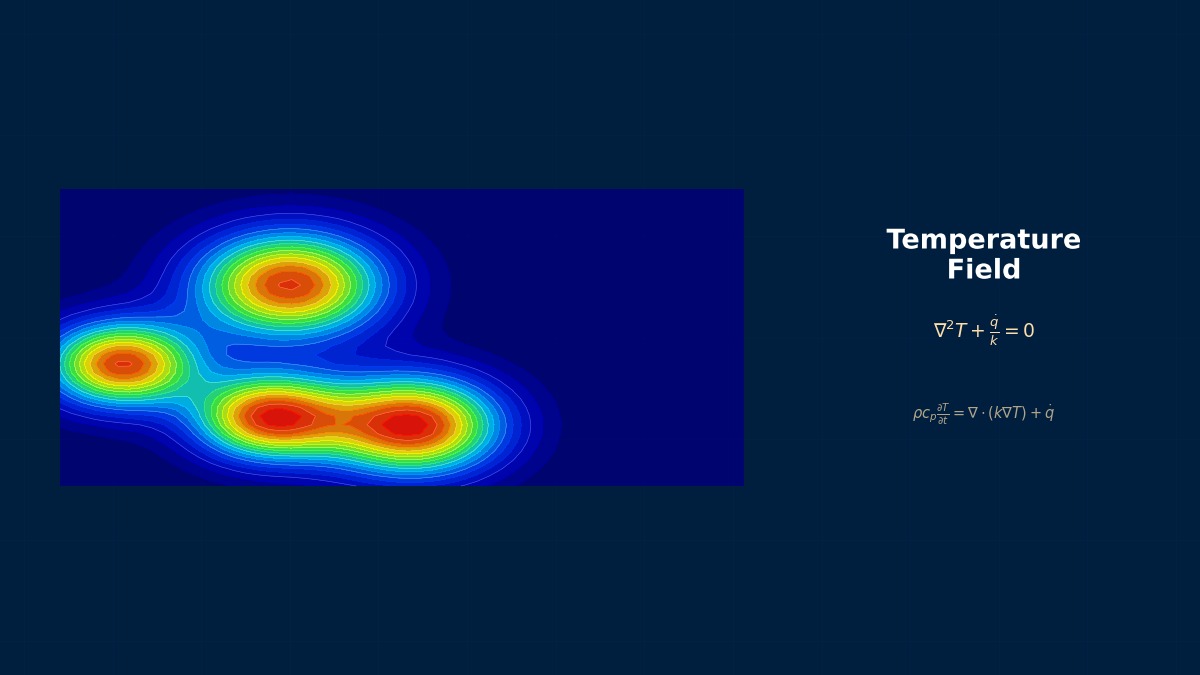
CAE visualization for extended surfaces theory - technical simulation diagram
拡大伝熱面の総合評価

Theory and Physics

Fin Array Performance Evaluation

🧑‍🎓

Professor, I understand the efficiency of a single fin, but how do you evaluate the overall performance of a fin array?


🎓

It is evaluated by the Overall Surface Efficiency $\eta_o$. It represents the effective heat dissipation capability combining the fin surfaces and the exposed base surface.


$$\eta_o = 1 - \frac{N A_f}{A_t}(1 - \eta_f)$$

Here, $N$ is the number of fins, $A_f$ is the area of one fin, $A_t = N A_f + A_b$ is the total surface area, and $A_b$ is the exposed base area.


🧑‍🎓

If $\eta_f = 1$, then $\eta_o = 1$, right?


🎓

Correct. The worse the fin efficiency, the lower $\eta_o$ becomes. For practical heat sinks, $\eta_o$ is typically around 0.7 to 0.9.


Overall Thermal Resistance

🎓

The total thermal resistance of a heat sink is:


$$R_{\text{hs}} = R_{\text{spread}} + R_{\text{base}} + \frac{1}{\eta_o h A_t}$$

$R_{\text{spread}}$ is the spreading resistance (occurs when the heat source is smaller than the base), and $R_{\text{base}}$ is the conduction resistance through the base thickness.


🧑‍🎓

What is spreading resistance?


🎓

When a CPU die (e.g., 30mm square) is mounted at the center of a heat sink base (e.g., 60mm square), this is the resistance encountered as heat spreads laterally within the base. It can be estimated using the Song-Lee-Au formula.


$$R_{\text{spread}} = \frac{1}{\sqrt{\pi} \, k_{\text{base}} \, a} \cdot \Psi(\epsilon, \tau, \text{Bi})$$

$a$ is the equivalent radius of the heat source, and $\Psi$ is a function of base thickness and the Biot number.


Fin Effectiveness

🎓

Separate from fin efficiency, fin effectiveness $\varepsilon_f$ is also an important metric.


$$\varepsilon_f = \frac{q_f}{h A_c \theta_b}$$

It represents the heat dissipation multiplier compared to the case without fins (heat dissipation only from the fin root area $A_c$). It is generally considered that there is no benefit to adding fins unless $\varepsilon_f > 2$.


🧑‍🎓

So fin efficiency and effectiveness are different things. It's easy to confuse them.


🎓

Efficiency is "what percentage of the fin area is effective," while effectiveness is "how many times the heat dissipation increased by adding the fin." One can be high while the other is low.

Coffee Break Yomoyama Talk

Classification System for Various Fin Types

Extended heat transfer surfaces are classified into four major shapes: pin, rectangular, triangular, and annular. The NTU-ε method compiled by Kays and London in "Compact Heat Exchangers" in the 1980s became the foundation for design and is still standardly referenced in aerospace and chemical plant fields.

Physical Meaning of Each Term
  • Heat Storage Term $\rho c_p \partial T/\partial t$: Rate of thermal energy storage per unit volume. 【Everyday Example】 An iron frying pan is slow to heat up and cool down, while an aluminum pot heats up and cools down quickly—this is due to the difference in the product of density $\rho$ and specific heat $c_p$ (Heat Capacity). Objects with large heat capacity experience slower temperature changes. Water has a very high specific heat (4,186 J/(kg·K)), which is why temperatures near the ocean are more stable than inland. In unsteady analysis, this term determines the rate of temperature change over time.
  • Heat Conduction Term $\nabla \cdot (k \nabla T)$: Heat conduction based on Fourier's law. Heat flux proportional to the temperature gradient. 【Everyday Example】 Putting a metal spoon in a hot pot causes the handle to become hot—because metals have high thermal conductivity $k$, heat transfers quickly from the high-temperature side to the low-temperature side. A wooden spoon doesn't get hot because its $k$ is small. Insulation materials (e.g., glass wool) have extremely small $k$, making heat transfer difficult even with a temperature gradient. This term mathematically expresses the natural tendency of "heat flowing where there is a temperature difference."
  • Convection Term $\rho c_p \mathbf{u} \cdot \nabla T$: Heat transport accompanying fluid motion. 【Everyday Example】 Feeling cool when a fan blows on you is because the wind (fluid flow) carries away the warm air near your skin and supplies fresh, cool air—this is forced convection. The ceiling area of a room becoming warm with heating is due to natural convection where heated air rises due to buoyancy. The fan in a PC's CPU cooler also dissipates heat via forced convection. Convection is an order of magnitude more efficient heat transport method than conduction.
  • Heat Source Term $Q$: Internal Heat Generation (Joule heat, chemical reaction heat, radiation absorption, etc.). Unit: W/m³. 【Everyday Example】 A microwave oven heats food via microwave absorption inside the food (volumetric heating). The heater wire in an electric blanket warms up via Joule heating ($Q = I^2 R / V$). Heat generation during lithium-ion battery charging/discharging and friction heat from brake pads are also considered as heat sources in analysis. Unlike boundary conditions where heat is supplied externally to a "surface," the heat source term represents energy generation "inside" the material.
Assumptions and Applicability Limits
  • Fourier's Law: Linear relationship where heat flux is proportional to temperature gradient (non-Fourier heat conduction is needed for extremely low temperatures or ultra-short pulse heating)
  • Isotropic Thermal Conductivity: Thermal conductivity is independent of direction (anisotropy must be considered for composite materials or single crystals)
  • Temperature-Independent Material Properties (Linear Analysis): Assumption that material properties do not depend on temperature (temperature dependence is needed for large temperature differences)
  • Treatment of Thermal Radiation: View factor method for surface-to-surface radiation; DO method or P1 approximation for participating media
  • Non-Applicable Cases: Consideration of latent heat is necessary for phase change (melting/solidification). Thermal-stress coupling is essential for extreme temperature gradients
Dimensional Analysis and Unit Systems
VariableSI UnitNotes / Conversion Memo
Temperature $T$K (Kelvin) or CelsiusBe careful not to confuse absolute and Celsius temperatures. Always use absolute temperature for radiation calculations.
Thermal Conductivity $k$W/(m·K)Steel: ~50, Aluminum: ~237, Air: ~0.026
Heat Transfer Coefficient $h$W/(m²·K)Natural Convection: 5–25, Forced Convection: 25–250, Boiling: 2,500–25,000
Specific Heat $c_p$J/(kg·K)Distinguish between constant pressure and constant volume specific heat (important for gases)
Heat Flux $q$W/m²Neumann condition as a boundary condition

Numerical Methods and Implementation

Efficiency of Various Fin Shapes

🧑‍🎓

Does the cross-sectional shape of a fin change its efficiency?


🎓

It changes significantly. Let's compare the efficiency of typical fin shapes.


Fin ShapeEfficiency FormulaMaterial UsageManufacturability
Rectangular$\eta_f = \tanh(mL_c)/(mL_c)$BaselineEasy
Triangular$\eta_f = I_1(2mL)/(mL \cdot I_0(2mL))$−50%Somewhat Difficult
ParabolicBessel Functions−67%Difficult
Annular (Disk)Modified Bessel FunctionsCase DependentEasy
🧑‍🎓

So triangular fins use half the material.


🎓

Triangular fins, which are thick at the root and thin at the tip, have good efficiency due to material distribution matching the temperature profile. The tip area of a rectangular fin is at a lower temperature and contributes little to heat dissipation, making it wasteful.


Analysis of Annular Fins

🎓

Annular fins (annular fins) attached to pipes or cylinder outer surfaces are solved using Bessel functions.


$$\eta_f = \frac{2r_1}{m(r_2^2 - r_1^2)} \cdot \frac{K_1(mr_1)I_1(mr_2) - I_1(mr_1)K_1(mr_2)}{K_0(mr_1)I_1(mr_2) + I_0(mr_1)K_1(mr_2)}$$

$r_1$ is the inner radius (root), $r_2$ is the outer radius (tip). $I_0, I_1, K_0, K_1$ are modified Bessel functions.


🧑‍🎓

Bessel functions are tough for manual calculation.


🎓

Using efficiency charts (Fig. 3.20 in the Incropera textbook) is practical. You read from the graph using two parameters: $r_2/r_1$ and $mL_c$. In Python, you can calculate directly using scipy.special.iv/kv.


Comparison with CHT Analysis

🎓

Analytical solutions are based on the assumption that $h$ is uniform. In actual fin arrays, $h$ varies significantly due to flow development and vortex generation. Conjugate Heat Transfer (CHT) analysis with CFD, which automatically calculates local $h$, often results in 10–20% lower heat dissipation than analytical solutions.


🧑‍🎓

So analytical solutions are optimistic estimates.


🎓

That's why a two-step approach is practical: initial design using analytical solutions, and final verification using CHT analysis.

Coffee Break Yomoyama Talk

Analytical Methods for Annular Fins

The efficiency of an annular fin is given by a formula containing Bessel functions I₀, I₁, K₀, K₁. When the outer/inner radius ratio r₂/r₁ is 2.0, efficiency decreases by about 5–8% compared to a rectangular fin. It can be calculated with a few lines of code using MATLAB's besselj function.

Linear Elements vs. Quadratic Elements

In heat conduction analysis, linear elements often provide sufficient accuracy. Quadratic elements are recommended for regions with steep temperature gradients (e.g., thermal shock).

Heat Flux Evaluation

Calculated from the temperature gradient within an element. Smoothing may be required, similar to nodal stresses.

Convection-Diffusion Problem

Upwind stabilization (e.g., SUPG) is needed when the Peclet number is high (convection-dominated). Not required for pure heat conduction problems.

Time Step for Unsteady Analysis

Set a time step sufficiently small relative to the characteristic thermal diffusion time $\tau = L^2 / \alpha$ ($\alpha$: Thermal Diffusivity). Automatic time step control is effective for rapid temperature changes.

Nonlinear Convergence

Nonlinearity due to temperature-dependent material properties is often mild, and Picard iteration (direct substitution method) is often sufficient. Newton's method is recommended for strong nonlinearity from radiation.

Steady-State Analysis Convergence Criterion

Convergence is judged when the temperature change at all nodes falls below a threshold (e.g., $|\Delta T| / T_{max} < 10^{-5}$).

Analogy for Explicit and Implicit Methods

Explicit method is like "predicting the next step using only current information, like a weather forecast"—fast to compute but unstable with large time steps (misses storms). Implicit method is like "prediction considering future states"—stable even with large time steps but requires solving equations at each step, which is more work. For problems without rapid temperature changes, using the implicit method with larger time steps is more efficient.

Practical Guide

Heat Sink Selection Flow

🧑‍🎓

In practice, what steps do you follow to select a heat sink?


🎓

The standard flow is as follows.


1. Determine Heat Generation: Confirm TDP (Thermal Design Power)

2. Confirm Allowable Temperature: Junction temperature upper limit (e.g., $T_j \leq 105$°C)

3. Calculate Allowable Thermal Resistance: $R_{\text{hs}} \leq (T_j - T_a)/Q - R_{jc} - R_{\text{TIM}}$

4. Select Heat Sink Candidates: Choose from catalog those with $R_{\text{hs}}$ below the calculated value

5. CFD Verification: Verify reflecting the implementation environment (airflow speed, adjacent components)


🧑‍🎓

$R_{jc}$ is the package thermal resistance, right?


🎓

Correct. $R_{jc}$ (junction-to-case) is listed in the IC manufacturer's datasheet. $R_{\text{TIM}}$ (Thermal Interface Material) is typically around 0.1 to 0.5 K/W.


Comparison with Measured Data

🎓

Wind tunnel testing is the most reliable method for verifying heat sink performance.


Measurement ItemMeasurement MethodAccuracy
Thermal ResistanceHeater + Thermocouple$\pm$5%
Temperature DistributionThermography$\pm$2℃
Airflow DistributionHot-wire Anemometer$\pm$3%
Pressure LossDifferential Pressure Gauge$\pm$1 Pa
🧑‍🎓
関連シミュレーター

この分野のインタラクティブシミュレーターで理論を体感しよう

シミュレーター一覧

関連する分野

この記事の評価
ご回答ありがとうございます!
参考に
なった
もっと
詳しく
誤りを
報告
参考になった
0
もっと詳しく
0
誤りを報告
0
Written by NovaSolver Contributors
Anonymous Engineers & AI — サイトマップ