Mixed Convection (Combined Convection) — Flow Regime Determination by Richardson Number
Mixed Convection (Combined Convection): Theoretical Foundations
Overview — What is Mixed Convection?
Professor, is mixed convection a state where both forced convection and natural convection are effective? I'm not sure where the boundary lies between situations where you can consider only one or the other...
That's correct. "Mixed convection" or "combined convection" is a state where forced flow (from fans or pumps) and buoyancy-driven flow (due to density differences from temperature variations) are simultaneously effective.
The key point is that there exists a zone where assuming only forced convection or only natural convection leads to significant errors. For example, in fan cooling of electronics, buoyancy effects cannot be ignored in low-speed regions where fan velocity is weak. Conversely, in data center hot aisles, server exhaust heat creates rising air currents that interfere with the forced airflow from the HVAC system.
I see... So is there a numerical method to determine "which one is dominant"?
Yes, there is. It's the Richardson number (Ri). It is defined as $\mathrm{Ri} = \mathrm{Gr}/\mathrm{Re}^2$. It's a dimensionless number representing the ratio of buoyancy effects to inertial effects; this single value determines the character of the flow.
Flow Regime Determination by Richardson Number
Please tell me the specific criteria for the Richardson number!
The definition of the Richardson number and the classification of flow regimes are as follows:
Here, $g$ is gravitational acceleration, $\beta$ is the volumetric expansion coefficient, $T_s$ is the wall temperature, $T_\infty$ is the freestream temperature, $L$ is the characteristic length, and $U_\infty$ is the freestream velocity.
| Richardson Number Range | Flow Regime | Dominant Heat Transfer Mechanism | Typical Scenarios |
|---|---|---|---|
| $\mathrm{Ri} < 0.1$ | Forced Convection Dominant | Inertial Force >> Buoyancy | High-speed fan cooling, wind tunnel experiments |
| $0.1 \leq \mathrm{Ri} \leq 10$ | Mixed Convection Regime | Inertial Force ≒ Buoyancy | Low-speed fan cooling, data centers, HVAC |
| $\mathrm{Ri} > 10$ | Natural Convection Dominant | Buoyancy >> Inertial Force | Passive heat dissipation, natural ventilation, temperature stratification in buildings |
So the area around $\mathrm{Ri} \approx 1$ is the most troublesome, right? Are there any specific numerical examples?
For example, consider the area near a server rack exhaust vent. Let's assume exhaust temperature $T_s = 60\,^\circ\mathrm{C}$, ambient temperature $T_\infty = 25\,^\circ\mathrm{C}$, exhaust vent height $L = 0.5\,\mathrm{m}$, and HVAC supply air velocity $U_\infty = 0.8\,\mathrm{m/s}$. Using the volumetric expansion coefficient for air $\beta \approx 1/T_\mathrm{avg} \approx 1/316\,\mathrm{K}^{-1}$:
$\mathrm{Ri} = \dfrac{9.81 \times (1/316) \times 35 \times 0.5}{0.8^2} \approx \dfrac{0.543}{0.64} \approx 0.85$
Since $\mathrm{Ri} \approx 0.85$, it's precisely in the mixed convection regime. Calculating with only forced convection equations would underestimate heat transfer, and using only natural convection would miss the influence of flow velocity.
Nusselt Number Correlation
How do you calculate the Nu number for mixed convection? Do you just add the forced convection Nu and the natural convection Nu?
It's not simple addition; you use the Churchill-Usagi correlation. It takes the form of a power sum:
Where:
- $n$ is the correlation exponent. $n = 3$ is the most widely used (Incropera's textbook, Morgan's ASME review, etc.). Some literature recommends $n = 4$ (Chen's vertical flat plate).
- $+$ (Plus): Aiding flow — buoyancy and forced flow are in the same direction.
- $-$ (Minus): Opposing flow — buoyancy and forced flow are in opposite directions.
Wait, $n = 3$ means it's not a simple sum but the cube root of the sum of cubes? Why does it take this form?
Physically speaking, the boundary layers for forced and natural convection do not develop independently; they interfere with each other. Simple addition ($n=1$) overestimates this interference effect. $n=3$ is the "empirically optimal value" that best matches experimental data, systematized by Churchill in 1977.
Writing it concretely:
Does this formula asymptotically approach $\mathrm{Nu} \to \mathrm{Nu}_{\mathrm{forced}}$ when $\mathrm{Ri} \ll 1$ (forced convection dominant)?
Yes, it does. If $\mathrm{Nu}_{\mathrm{natural}} \ll \mathrm{Nu}_{\mathrm{forced}}$, then even when cubed it's almost zero, so $\mathrm{Nu}_{\mathrm{mixed}} \approx \mathrm{Nu}_{\mathrm{forced}}$. Conversely, if $\mathrm{Ri} \gg 1$, then $\mathrm{Nu}_{\mathrm{mixed}} \approx \mathrm{Nu}_{\mathrm{natural}}$. In other words, this correlation has the correct asymptotic behavior at both limits. That's the excellent point of Churchill's correlation.
Aiding flow vs. Opposing flow
I'm curious about the "$\pm$" in the earlier formula. What's the concrete difference between aiding flow and opposing flow?
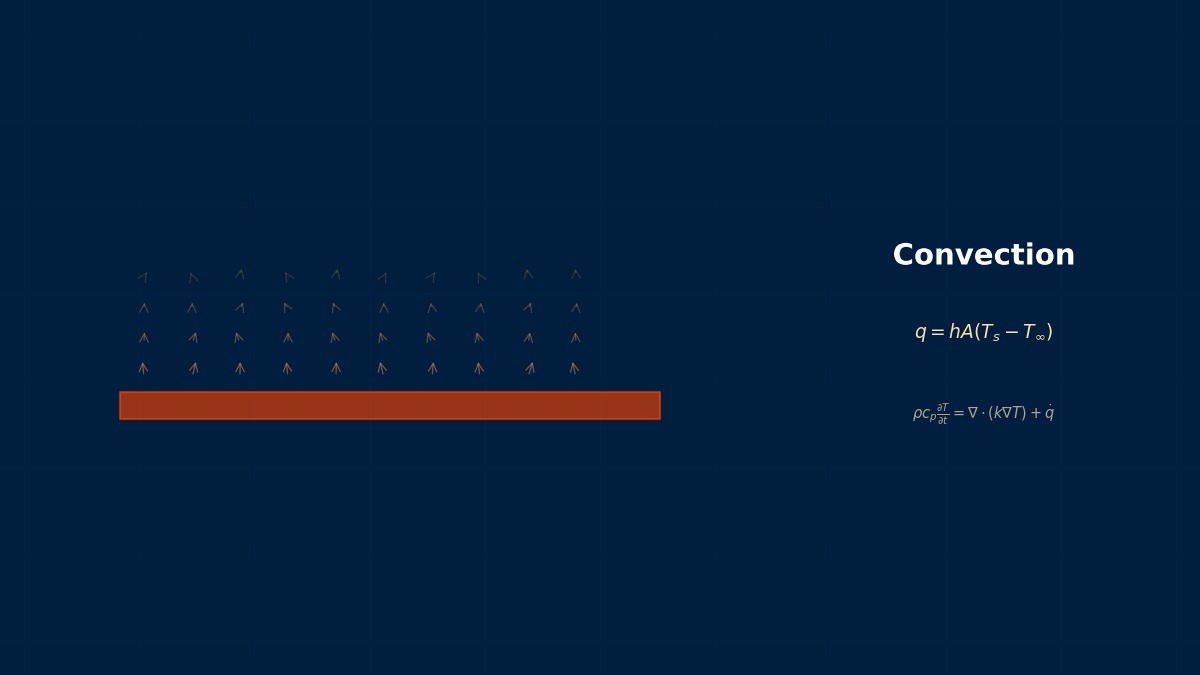
It's easy to understand by considering a heated vertical wall. Near the wall, a buoyant flow of warmed fluid rising is generated.
- Aiding flow: When the forced flow blows from bottom to top, it's in the same direction as the buoyant flow → the boundary layer thins and Nu increases.
- Opposing flow: When the forced flow blows from top to bottom, it's opposite to the buoyant flow → the boundary layer thickens and Nu decreases; in the worst case, separation or reverse flow occurs.
- Transverse flow: When the forced flow is horizontal, it's orthogonal to buoyancy → three-dimensional secondary flows are generated.
Does separation occur in opposing flow? That's bad in practice, right?
It's very bad. For example, if you design a vertical electronic board with airflow from top to bottom, a recirculation zone can form in the lower part of the board (where temperature is higher) due to the competition between buoyancy and forced flow, leading to localized hot spots. In an actual analysis of an automotive ECU I handled in the past, there was a case where an IC in the center of the board experienced thermal runaway when configured for opposing flow. Simply changing the design to an aiding configuration improved $\Delta T$ by over 15K.
Governing Equations (Boussinesq Approximation)
What do the governing equations for mixed convection look like? How are they different from the ordinary Navier-Stokes equations?
The basics are the Navier-Stokes equations, but the key point is adding a buoyancy term to the momentum equation. The most widely used is the Boussinesq approximation, where density variation appears only in the buoyancy term, and density is considered constant elsewhere. It's valid for small temperature differences ($\beta \Delta T \ll 1$).
Continuity Equation:
Momentum Equation (Boussinesq Approximation):
Energy Equation:
The last term in the momentum equation, $\rho_0 \beta (T - T_0) \mathbf{g}$, is the buoyancy term, right? So a force is generated in the direction of gravity when there's a temperature difference.
Exactly. Let me mention three important points to note:
- Applicability limit of the Boussinesq approximation: A guideline is $\beta \Delta T < 0.1$. For air, if $\Delta T > 30\,\mathrm{K}$, you should consider a non-Boussinesq model (variable density model).
- Gravity direction setting errors: If you set the gravity vector direction incorrectly in a CFD solver, the buoyancy direction reverses, yielding completely meaningless results. It's an incredibly common beginner mistake.
- Choice of reference temperature $T_0$: It's common to use inlet or ambient temperature. An inappropriate reference temperature distorts the magnitude of the buoyancy term.
Origin of the Name "Richardson Number"
The Richardson number is named after the British mathematician and meteorologist Lewis Fry Richardson (1881-1953). In the 1920s, he proposed the concept of "the ratio of buoyancy effects to flow shear effects" to evaluate atmospheric stability. Originally born in a meteorological context, it was later adopted in engineering heat and fluid fields and is now widely used as the governing parameter for mixed convection. Incidentally, Richardson was also the first person to implement the idea of "performing weather forecasting by numerical calculation" and is considered the father of modern numerical weather prediction.
Computational Methods for Mixed Convection (Combined Convection)
Discretization Strategy
When solving mixed convection with CFD, are there any particular things to be careful about regarding discretization?
In mixed convection, the momentum and energy equations are strongly coupled through the buoyancy term. Therefore, the points for discretization are more severe than in ordinary CFD:
- Spatial Discretization: Use at least second-order or higher schemes (2nd-order upwind, QUICK, MUSCL, etc.) for the convection term. First-order upwind difference has excessive numerical diffusion, which smears out the delicate flow patterns caused by buoyancy.
- Pressure-Velocity Coupling: SIMPLE family (SIMPLE, SIMPLEC) is standard. When buoyancy is strong, a Coupled Solver is often more stable.
- Temporal Discretization: For unsteady analysis (often oscillatory in opposing flow), second-order implicit methods are recommended. Keep the CFL number below 1.
Is first-order upwind no good? In structural FEM, lower-order elements are somewhat usable...
The convection term in CFD is completely different in nature from those in structures. The numerical diffusion of first-order upwind is proportional to mesh coarseness, so buoyant plumes (rising currents) become blurred and disappear. If you get a result like "buoyancy effects appear to be zero even though there's a fan," first suspect the discretization scheme.
Turbulence Model Selection
Which turbulence model should I use? Is the standard k-ε okay?
To conclude, standard k-ε is not recommended. In mixed convection, the generation and suppression of turbulence by buoyancy are important, but the treatment of the buoyancy term in standard k-ε is insufficient. The recommended order is as follows:
| Turbulence Model | Suitability for Mixed Convection | Computational Cost | Notes |
|---|---|---|---|
| SST k-ω | Good | Medium | Relatively good at capturing buoyancy effects near walls |
| Realizable k-ε + Buoyancy Correction | Good | Medium | Enabling "Full Buoyancy Effects" in Fluent is mandatory |
| k-ε-v²-f (V2F) | Excellent | Medium–High | Captures near-wall anisotropy. Available in STAR-CCM+ |
| RSM (Reynolds Stress Model) | Excellent | High | Accurately reproduces anisotropy of buoyant turbulence. Convergence can be somewhat difficult |
| LES | Highest Accuracy | Very High | For research purposes or final verification |
What is "Full Buoyancy Effects" in Fluent? Is it off by default?
Yes, it's off by default. When this setting is turned on, a buoyancy-induced turbulence production term $G_b = -\beta g_i \dfrac{\mu_t}{\mathrm{Pr}_t} \dfrac{\partial T}{\partial x_i}$ is added to the turbulent kinetic energy equation (k-equation). This is a setting that must be enabled for mixed convection. If you run the analysis with it off, the enhancement/suppression of turbulence by buoyancy is completely ignored, leading to significant errors, especially in opposing flow.
Convergence Techniques
Mixed convection seems difficult to converge. Are there any tips?
Mixed convection is indeed difficult to converge. Because buoyancy and inertia are competing, the solution tends to oscillate. Here are some effective techniques in practice:
- Initial Condition Strategy: First, converge a solution for forced convection only without buoyancy ($g=0$), then use that as the initial condition and gradually turn on gravity (increase $g$ stepwise using under-relaxation).
- Under-relaxation Factors: Lower momentum from 0.5→0.3, pressure from 0.3→0.2. Keep energy relatively high at 0.8–0.9.
- Steady → Unsteady Switch: In opposing flow, there are cases where only an unsteady solution exists inherently. If it doesn't converge in steady state, don't hesitate to switch to unsteady analysis.
- Residual Monitoring Points: Don't just monitor overall residuals; also monitor "wall Nu" and "velocity profiles at specific cross-sections" to confirm physical convergence.
Mixed Convection (Combined Convection) in Practice
Mixed Convection Cooling of Electronic Devices
Related Topics
Get a feel for theory using interactive simulators in this field
Natural Convection Simulator Reynolds Number Calculator Thermal Analysis Tools List