Grashof Number and Rayleigh Number Correlation
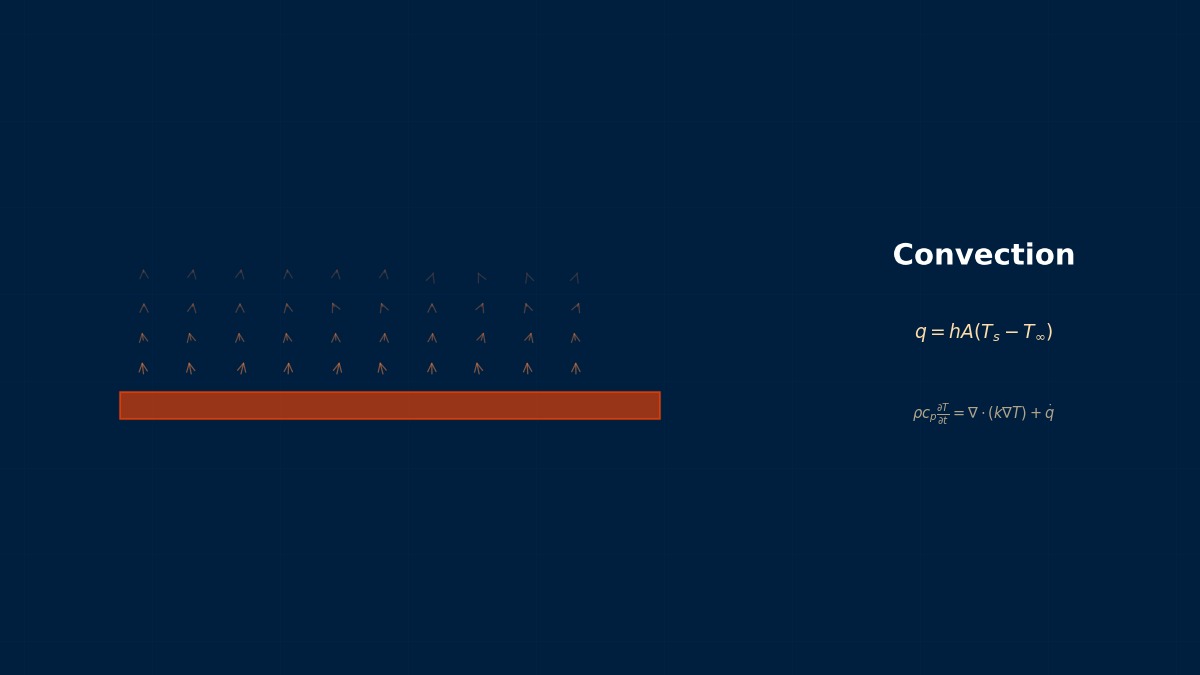
Theoretical Foundations of Grashof Number and Rayleigh Number Correlation
Overview
Teacher! Today we're talking about Grashof number and Rayleigh number correlation, right? What are they?
Governing parameters of natural convection. Fundamental dimensionless numbers used for flow transition judgment and heat transfer rate correlation equations.
Governing Equations
Discretization Methods
How do we actually solve these equations on a computer?
We use spatial discretization by Finite Element Method (FEM). Assemble element stiffness matrices and construct global stiffness equations.
We convert to weak form (variational form) and use Galerkin method formulation with test functions and shape functions. The choice of element type (low-order vs. higher-order elements, full integration vs. reduced integration) is directly linked to the trade-off between solution accuracy and computational cost.
Matrix Solution Algorithm
What exactly is matrix solution algorithm?
Direct methods (LU decomposition, Cholesky decomposition) or iterative methods (CG method, GMRES method) solve the simultaneous equations. For large-scale problems, preconditioned iterative methods are effective.
| Solver | Classification | Memory Usage | Applicable Scale |
|---|---|---|---|
| LU Decomposition | Direct Method | O(n²) | Small to Medium |
| Cholesky Decomposition | Direct Method (Symmetric Positive Definite) | O(n²) | Small to Medium |
| PCG Method | Iterative Method | O(n) | Large Scale |
| GMRES Method | Iterative Method | O(n·m) | Large Scale, Non-symmetric |
| AMG Preconditioning | Preconditioning | O(n) | Ultra-Large Scale |
So if we cut corners on the finite element method, we'll suffer the consequences later. I'll remember that!
Implementation in Commercial Tools
What software can I use for Grashof number and Rayleigh number correlation?
| Tool Name | Developer/Current | Primary File Format |
|---|---|---|
| Ansys Fluent | ANSYS Inc. | .cas, .dat, .msh, .jou |
| Simcenter STAR-CCM+ | Siemens Digital Industries Software | .sim, .java, .csv |
| COMSOL Multiphysics | COMSOL AB | .mph |
| Ansys Mechanical (formerly ANSYS Structural) | ANSYS Inc. | .cdb, .rst, .db, .ans, .mac |
Vendor Genealogy and Product Integration History
Is the history of each software quite dramatic?
Ansys Fluent
Next is the story of Ansys Fluent. What's it about?
Developed by Fluent Inc. Acquired by Ansys in 2006. Unstructured grid-based general-purpose CFD solver.
Current affiliation: ANSYS Inc.
Simcenter STAR-CCM+
Next is the story of Simcenter STAR. What's it about?
Developed by CD-adapco. Acquired by Siemens in 2016 and integrated into the Simcenter brand. Polyhedral mesh is a distinguishing feature.
Current affiliation: Siemens Digital Industries Software
Now I finally understand why the history of development is important!
COMSOL Multiphysics
Tell me about "COMSOL Multiphysics"!
Founded in Sweden in 1986. Started as FEMLAB with MATLAB integration, later renamed to COMSOL. Strong in multiphysics.
Current affiliation: COMSOL AB
Wow, the story of software development is super interesting! Tell me more.
File Formats and Interoperability
What are the precautions when exchanging data between different software?
| Format | Extension | Type | Overview |
|---|---|---|---|
| STEP | .stp/.step | Neutral CAD | ISO 10303-compliant 3D CAD data exchange format. Geometry + PMI support. |
| CGNS | .cgns | CFD Data | CFD General Notation System. Standard CFD result exchange format. |
| VTK | .vtk/.vtu | Visualization | Visualization Toolkit format. Used by ParaView etc. |
When converting models between different solvers, you need to pay attention to element type correspondence, material model compatibility, and differences in how loads and boundary conditions are expressed. In particular, solver-specific elements (cohesive elements, user-defined elements, etc.) often cannot be directly converted between solvers.
I see... file formats look simple on the surface, but they're actually very deep.
Practical Considerations
Is there "on-the-job wisdom" that isn't in textbooks?
Mesh convergence verification, boundary condition validity testing, and material parameter sensitivity analysis are really important.
You're on the right track! Hands-on practice is the best learning. Ask me anything if you have questions.
Origin of the Grashof Number Naming
The Grashof number (Gr) is named after German mechanical engineer Franz Grashof (1826–1893), but he himself did not derive the dimensionless number for natural convection. The naming was adopted in the 1930s by Wilhelm Nusselt to honor his achievements. Grashof is remembered as the first president of the German Association of Engineers (VDI) and contributed to engineering standardization.
Numerical Solution Methods for Grashof Number and Rayleigh Number Correlation
Numerical Method Details
Specifically, what algorithm solves Grashof number and Rayleigh number correlation?
My senior told me "do Grashof number and Rayleigh correlation properly," and now I understand what they meant.
Discretization Formulation
We approximate unknowns using shape functions $N_i$:
Expressed as an equation:
Discrete Governing Equations
Expressed as an equation:
Hmm, just the equations don't make it clear... What do they represent?
Discretizing the governing equations of the continuum yields the following system of algebraic equations:
Here $[K]$ is the global stiffness matrix (or equivalent system matrix), $\{u\}$ is the vector of unknown nodal variables, and $\{F\}$ is the force vector.
Ah, I see! That's how discretizing the governing equations of the continuum works.
Element Technology
I've heard of "element technology" but I might not fully understand it...
| Element Type | Order | Nodes (3D) | Accuracy | Computational Cost |
|---|---|---|---|---|
| Tetrahedron, Linear | Linear | 4 | Low (Shear Locking) | Low |
| Tetrahedron, Quadratic | Quadratic | 10 | High | Medium |
| Hexahedron, Linear | Linear | 8 | Medium | Medium |
| Hexahedron, Quadratic | Quadratic | 20 | Very High | High |
| Prism | Linear/Quadratic | 6/15 | Medium–High | Medium |
Integration Scheme
What exactly is integration scheme?
Now I finally understand why element type is important!
Convergence and Stability
What should I check first if convergence fails?
Convergence rate: Error decreases at $O(h^2)$ order for quadratic elements (for smooth solutions)
I see... mesh refinement looks simple but it's actually very deep.
Solver Settings Recommendations
Specifically, what algorithm solves Grashof number and Rayleigh number correlation?
| Parameter | Recommended Value | Remarks |
|---|---|---|
| Iterative method convergence criterion | $10^{-6}$ | Residual norm standard |
| Preconditioning method | ILU(0) or AMG | Depends on problem size |
| Maximum iterations | 1000 | Review settings if non-convergent |
| Memory mode | In-core | If possible |
Linear vs Quadratic Elements
For heat conduction analysis, linear elements often provide sufficient accuracy. Quadratic elements are recommended for regions with steep temperature gradients (thermal shock, etc.).
Heat Flux Evaluation
Computed from temperature gradients within elements. Like nodal stress, smoothing may be necessary.
Convection-Diffusion Problem
For high Peclet numbers (convection-dominated), upwind stabilization (SUPG etc.) is necessary. Not needed for pure heat conduction problems.
Unsteady Analysis Time Stepping
Use time steps much smaller than the characteristic thermal diffusion time $\tau = L^2 / \alpha$ ($\alpha$: thermal diffusivity). Automatic time stepping is effective for rapid temperature changes.
Nonlinear Convergence
Nonlinearity from temperature-dependent material properties is usually mild, often sufficient with Picard iteration (direct substitution). Newton's method is recommended for strong nonlinearity like radiation.
Steady-State Convergence Criterion
Judge convergence when all nodal temperature changes fall below threshold (e.g., $|\Delta T| / T_{max} < 10^{-5}$).
Practical Application of Grashof Number and Rayleigh Number Correlation
Practical Guide
Teacher, tell me about the "practical guide"!
We'll explain the practical analysis workflow and precautions for Grashof number and Rayleigh number correlation.
My senior told me "do Grashof number and Rayleigh correlation properly," and now I understand what they meant.
Analysis Workflow
Teach me step by step! Where do I start?
1. Pre-processing
- Import and simplify CAD data
- Define material properties
- Generate mesh (decide element type and size)
- Set boundary conditions and load conditions
2. Solving
- Configure solver (method, convergence criteria, output control)
- Submit and run job
- Monitor convergence
3. Post-processing
- Visualize results (displacement, stress, other physical quantities)
- Verify and validate results
- Create reports
Mesh Generation Best Practices
How do you judge if a mesh is good or bad?
Element Quality Metrics
Tell me about "element quality metrics"!
| Metric | Ideal Value | Acceptable Range | Impact |
|---|---|---|---|
| Aspect Ratio | 1.0 | < 5.0 | Accuracy Reduction |
| Jacobian Ratio | 1.0 | > 0.3 | Element Distortion |
| Warping | 0° | < 15° | Accuracy Reduction |
| Skewness | 0° | < 45° | Convergence Degradation |
| Taper Ratio | 0 | < 0.5 | Accuracy Reduction |
Mesh Density Determination
What exactly is mesh density determination?
Boundary Condition Setting Guidelines
I heard that if you get boundary conditions wrong here, everything fails...
Ah, I see! That's how over-constraint works.
Commercial Tool-Specific Implementation Procedures
There are many different software tools, right? Tell me the characteristics of each!
| Tool Name | Developer/Current | Primary File Format |
|---|---|---|
| Ansys Fluent | ANSYS Inc. | .cas, .dat, .msh, .jou |
| Simcenter STAR-CCM+ | Siemens Digital Industries Software | .sim, .java, .csv |
| COMSOL Multiphysics | COMSOL AB | .mph |
| Ansys Mechanical (formerly ANSYS Structural) | ANSYS Inc. | .cdb, .rst, .db, .ans, .mac |
Ansys Fluent
Next is the story of Ansys Fluent. What's it about?
Developed by Fluent Inc. Acquired by Ansys in 2006. Unstructured grid-based general-purpose CFD solver.
Current affiliation: ANSYS Inc.
Simcenter STAR-CCM+
Next is the story of Simcenter STAR. What's it about?
Developed by CD-adapco. Acquired by Siemens in 2016 and integrated into the Simcenter brand. Polyhedral mesh is a distinguishing feature.
Current affiliation: Siemens Digital Industries Software
Your explanations are clear! That confusion about tool names is cleared up.
Common Failures and Countermeasures
What are the common failure patterns for beginners? I want to know in advance!
| Symptom | Cause | Countermeasure |
|---|---|---|
| Convergence failure | Poor mesh quality, inappropriate boundary conditions | Improve mesh, review constraints |
| Abnormally large stress | Stress singularities, mesh dependency | Avoid singularities, local mesh refinement |
| Unrealistic displacement | Material constant error, unit system inconsistency | Check input data |
| Excessive computation time | Unnecessary refinement, inefficient solver | Optimize mesh, parallel computing |
Quality Assurance Checklist
Is there "on-the-job wisdom" that isn't in textbooks?
You're on the right track! Hands-on practice is the best learning. Ask me anything if you have questions.
Natural Air Cooling Design of Power Converters
Three-phase inverter (50kW output, 1.2kW loss) aluminum enclosure natural cooling design calculates Ra = Gr·Pr from Gr = gβΔTL³/ν². Fujielectric's 2021 EV charger (50kW) design with enclosure height 0.6m and ΔT=35°C estimated Ra ≈ 5×10^8 (laminar boundary), yielding Nu ≈ 65 and h ≈ 4.2 W/m²K.
Grashof Number and Rayleigh Number Correlation: Software & Solver Comparison for Grashof Number and Rayleigh Number Correlation
Commercial Tool Comparison
There are many different software tools, right? Tell me the characteristics of each!
We'll detail feature comparisons and historical background of major commercial CAE tools supporting Grashof number and Rayleigh number correlation.
My senior told me "do Grashof number and Rayleigh correlation properly," and now I understand what they meant.
Supported Tools List
What software can I use for Grashof number and Rayleigh number correlation?
| Tool Name | Developer/Current | Primary File Format |
|---|---|---|
| Ansys Fluent | ANSYS Inc. | .cas, .dat, .msh, .jou |
| Simcenter STAR-CCM+ | Siemens Digital Industries Software | .sim, .java, .csv |
| COMSOL Multiphysics | COMSOL AB | .mph |
| Ansys Mechanical (formerly ANSYS Structural) | ANSYS Inc. | .cdb, .rst, .db, .ans, .mac |
Ansys Fluent
Next is the story of Ansys Fluent. What's it about?
Developed by Fluent Inc. Acquired by Ansys in 2006. Unstructured grid-based general-purpose CFD solver.
Current affiliation: ANSYS Inc.
Simcenter STAR-CCM+
Next is the story of Simcenter STAR. What's it about?
Developed by CD-adapco. Acquired by Siemens in 2016 and integrated into the Simcenter brand. Polyhedral mesh is a distinguishing feature.
Current affiliation: Siemens Digital Industries Software
Now I finally understand why the history of development is important!
COMSOL Multiphysics
Tell me about "COMSOL Multiphysics"!
Founded in Sweden in 1986. Started as FEMLAB with MATLAB integration, later renamed to COMSOL. Strong in multiphysics.
Current affiliation: COMSOL AB
Ansys Mechanical (formerly ANSYS Structural)
Tell me about "Ansys Mechanical"!
Developed in 1970 by Swanson Analysis Systems Inc. (SASI). APDL (Ansys Parametric Design Language) based.
Current affiliation: ANSYS Inc.
Ah, I see! That's how software development history works.
Feature Comparison Matrix
Budget and time are limited. What's the best value?
| Feature | Fluent | Star-CCM+ | COMSOL | Ansys Mechanical |
|---|---|---|---|---|
| Basic Functions | ◎ | ◎ | ◎ | ◎ |
| Advanced Features | ◎ | ◎ | ◎ | △ |
| Automation/Scripting | ◎ | ◎ | ◎ | ◎ |
| Parallel Computing | ◎ | ◎ | ◎ | ◎ |
| GPU Support | △ | △ | △ | ◎ |
Conversion Risks
What exactly is conversion risk?
Ah, I see! That's how model conversion between different tools works.
Licensing Models
I've heard of "licensing models" but I might not fully understand...
| Tool | License Type | Characteristics |
|---|---|---|
| Commercial FEA | Node-lock/Floating | High cost but official support |
| OpenFOAM | GPL | Free but commercial support costs |
| COMSOL | Node-lock/Floating | Purchase by module |
| Code_Aster | GPL | Open-source solver developed by EDF |
Selection Guidelines
In the end, which should I choose? Give me a decision framework.
For selecting tools for Grashof number and Rayleigh number correlation, consider:
You're on the right track! Hands-on practice is the best learning. Ask me anything if you have questions.
COMSOL Ra Number Auto-calculation
COMSOL Multiphysics 6.2 (released 2023) features automatic calculation and visualization of dimensionless parameters Ra, Gr, Pr in the Heat Transfer Module's natural convection interface post-processing screen. ABB Group reports using COMSOL for transformer insulating oil natural convection analysis with Ra distribution mapping, improving hotspot detection accuracy by 40% vs. traditional thermal circuit models.
Advanced Research on Grashof Number and Rayleigh Number Correlation
Advanced Topics and Research Trends
How will the Grashof number and Rayleigh number correlation field evolve in the future?
Let's explore the latest research trends and advanced methods in Grashof number and Rayleigh number correlation.
My senior told me "do Grashof number and Rayleigh correlation properly," and now I understand what they meant.
Latest Numerical Methods
Next is the story of latest numerical methods. What's it about?
Hmm, just the equations don't make it clear... What do they represent?
High Performance Computing (HPC) Support
| Parallelization Method | Overview | Target Solvers |
|---|---|---|
| MPI (Domain Decomposition) | Distributed memory type. Standard for large-scale problems | All major solvers |
| OpenMP | Shared memory type. Intra-node parallelization | Many solvers |
| GPU (CUDA/OpenCL) | GPGPU utilization. Especially effective for explicit methods | LS-DYNA, Fluent, etc. |
| Hybrid MPI+OpenMP | Inter-node + intra-node parallelization | Large-scale HPC environments |
Grashof Number and Rayleigh Number Correlation: Common Issues & Debugging for Grashof Number and Rayleigh Number Correlation
Troubleshooting
My senior told me "do Grashof number and Rayleigh correlation properly," and now I understand what they meant.
Common Errors and Countermeasures
Has my senior ever done all-night debugging on Grashof number and Rayleigh correlation? (Laughs)
1. Convergence Failure
What exactly is convergence failure?
Symptom: Solver terminates abnormally without converging within specified iterations
Possible Causes:
- Poor mesh quality (excessively distorted elements)
- Inappropriate material parameters
- Unsuitable initial conditions
- Nonlinearity too strong (insufficient load steps)
Countermeasures:
- Check mesh quality (aspect ratio, Jacobian)
- Verify material parameter units
- Divide load into multiple steps (increase substeps)
- Relax convergence criteria (watch for accuracy loss)
So if you cut corners on convergence failure, you'll suffer later. I'll remember that!
2. Non-Physical Results
Next is non-physical results story. What's it about?
Symptom: Stress/displacement/temperature unrealistically large
Possible Causes:
- Boundary condition error
- Unit system inconsistency (SI vs. engineering units)
- Inappropriate element type selection
- Stress singularities present
Countermeasures:
- Check reaction force sum (force balance)
- Verify unit system consistency
- Reconsider element type appropriateness
- Eliminate or use submodeling for singularities
My senior told me "handle convergence failure properly," and now I understand what they meant.
3. Excessive Computation Time
What exactly is excessive computation time?
Symptom: Computation takes many times longer than expected
Countermeasures:
- Optimize mesh density distribution
- Leverage symmetry (1/2, 1/4 models)
- Optimize solver settings (iterative method, preconditioner selection)
- Utilize parallel computing
4. Memory Insufficiency
Tell me about "memory insufficiency"!
Symptom: Out of Memory error
My senior told me "handle convergence failure properly," and now I understand what they meant.
Countermeasures:
- Use out-of-core solver
- Reduce mesh size
- Verify 64-bit solver usage
- Increase memory allocation
Wow, the convergence failure discussion is super interesting! Tell me more.
Typical Nastran Errors
What exactly is typical errors?
Typical Abaqus Errors
Tell me about "typical errors"!
So if tool setup is done correctly, we're mostly fine?
When "Analysis Doesn't Match" Expectation
- Take a deep breath—Panicking and randomly changing settings makes problems worse
- Create minimal reproduction case—Reproduce the Grashof and Rayleigh correlation problem in simplest form. "Subtraction debugging" is most efficient
- Change one thing at a time—Multiple changes obscure what matters. Same as scientific experiments: "controlled experiments" principle
- Return to physics—If results are non-physical (like objects floating against gravity), suspect fundamental input data errors
Related Topics
Details
Error