Natural Convection from a Horizontal Plate
Natural Convection from a Horizontal Plate: Theoretical Foundations
Overview — The Decisive Difference Between Top and Bottom Surfaces
Is natural convection on a horizontal plate really that different between upward-facing and downward-facing orientations?
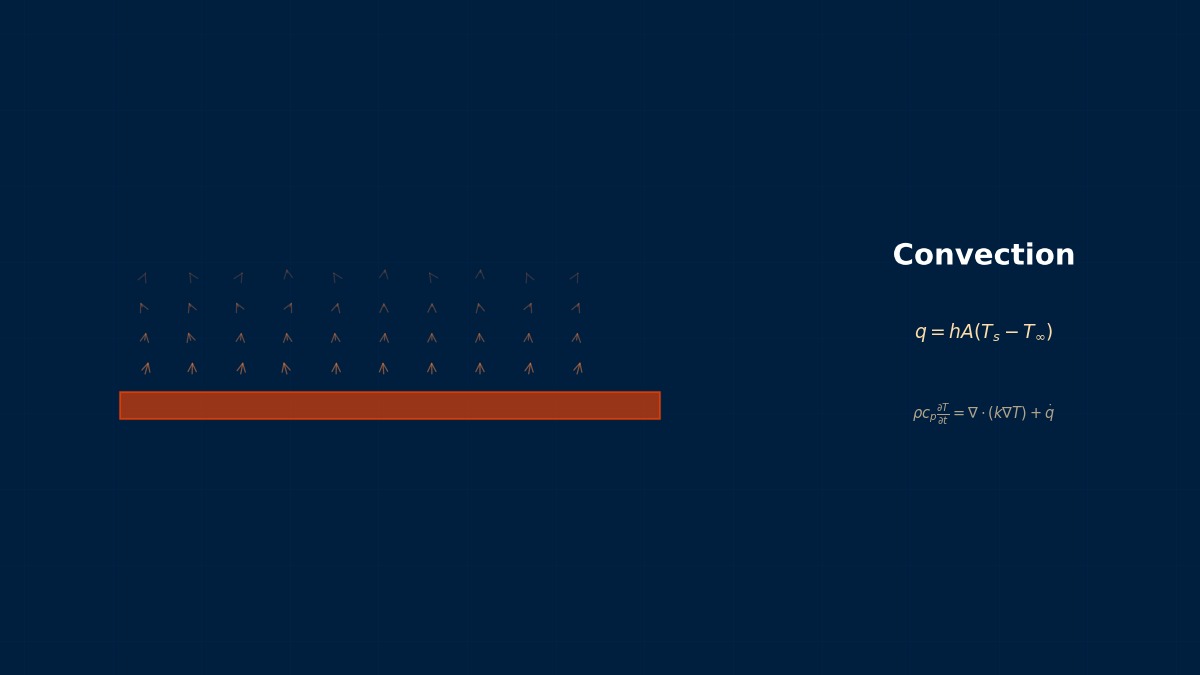
Completely different. When the heated surface faces upward, the air warmed at the plate surface rises due to buoyancy, generating a plume (thermal updraft). Since the warmed air continuously moves away, fresh cold air flows in from the sides, resulting in very good heat transfer.
Conversely, when the heated surface faces downward, the warm air is trapped beneath the plate. The warm air, being lighter, wants to go upward, but the plate acts as a lid. As a result, a stable stratification forms, and almost no convection occurs. The heat transfer coefficient becomes less than half of that for the top surface.
In what specific situations does this become a problem?
The most familiar example is chip cooling when a PCB (printed circuit board) is placed horizontally. If chips are mounted on the top surface, they can be cooled efficiently by natural convection, but if mounted on the bottom surface, they become extremely difficult to cool. This difference can be critical in cases like motherboards inside server racks or embedded devices where boards are mounted on ceiling surfaces.
Other applications where the natural convection correlation for horizontal plates is essential knowledge include evaluating heat loss from the top surface of solar thermal collectors (flat-plate type), heat dissipation from kitchen hot plates, and insulation design for factory ceilings.
Governing Equations and Rayleigh Number
How is it expressed mathematically? First, it's the Rayleigh number, right?
Yes. The dimensionless number governing the strength of natural convection is the Rayleigh number Ra. It represents the ratio of the driving force due to buoyancy to the restraining forces of viscosity and thermal diffusion:
The meaning of each symbol is as follows:
- $g$: Gravitational acceleration [m/s²]
- $\beta$: Volumetric expansion coefficient [1/K] (for an ideal gas, $\beta = 1/T_f$, where $T_f$ is the film temperature)
- $T_s$: Plate surface temperature [K]
- $T_\infty$: Ambient fluid temperature [K]
- $L_c$: Characteristic length [m] (explained later)
- $\nu$: Kinematic viscosity [m²/s]
- $\alpha$: Thermal diffusivity [m²/s] ($\alpha = k / \rho c_p$)
Does a larger Ra number mean more intense convection?
Exactly. A larger Ra number means a larger temperature difference, a larger plate, lower viscosity—in other words, buoyancy dominates and convection becomes active. Conversely, with a small Ra number, heat conduction dominates, and convection hardly occurs. For a horizontal plate's top surface, the transition from laminar to turbulent flow occurs around $Ra \approx 10^7$.
Nu Number Correlations (McAdams, Lloyd-Moran)
Finally, the correlations! The equations are different for top and bottom surfaces, right?
Yes, there is a famous correlation experimentally organized by McAdams (1954). First, for a heated surface facing upward (Hot Surface Up):
And for a heated surface facing downward (Hot Surface Down):
The coefficient for the bottom is 0.27, exactly half of the top's 0.54! Also, there's no turbulent equation for the bottom?
Good observation. On the bottom surface, convection is weak due to stable stratification, and turbulent transition hardly occurs. That's why the 1/4-power law alone can cover a wide range. The coefficient being half means that effectively, the heat transfer coefficient $h$ is half that of the top surface. Even with the same temperature difference, the cooling capacity is only half—this is a very significant difference in design.
By the way, the conversion from Nusselt number to heat transfer coefficient $h$ is:
Here, $k$ is the thermal conductivity of the fluid (e.g., air).
Does it reverse for a cooled surface? That is, does a cold plate's bottom surface cool better?
Sharp. A cooled surface facing downward (Cold Surface Down) has the same mechanism as a heated surface facing upward—a plume occurs where air cooled beneath the plate becomes heavier and sinks. Therefore, use the same correlation (coefficient 0.54/0.15) as for a heated surface facing upward. Conversely, a cooled surface facing upward has the same stable stratification as a heated surface facing downward, so use the coefficient 0.27.
| Orientation | Physical Phenomenon | Applicable Correlation |
|---|---|---|
| Heated Surface Up (Hot Up) | Plume ascent → High Nu | 0.54 / 0.15 |
| Heated Surface Down (Hot Down) | Stable stratification → Low Nu | 0.27 |
| Cooled Surface Down (Cold Down) | Sinking plume → High Nu | 0.54 / 0.15 |
| Cooled Surface Up (Cold Up) | Stable stratification → Low Nu | 0.27 |
Meaning of Characteristic Length Lc = A/P
For a vertical plate, the plate height is the characteristic length, right? What is used for a horizontal plate?
For a horizontal plate, the characteristic length is the value of the plate area $A$ divided by its perimeter $P$:
Let's look at the values for specific shapes:
| Plate Shape | Area $A$ | Perimeter $P$ | $L_c = A/P$ |
|---|---|---|---|
| Square (side $a$) | $a^2$ | $4a$ | $a/4$ |
| Rectangle ($a \times b$) | $ab$ | $2(a+b)$ | $\frac{ab}{2(a+b)}$ |
| Circular disk (diameter $D$) | $\pi D^2/4$ | $\pi D$ | $D/4$ |
Why area ÷ perimeter? It's not intuitively clear…
Good question. In natural convection on a horizontal plate, fluid enters and exits from the plate's edges. $L_c = A/P$ represents the "typical distance fluid travels from the edge." A plate with a large perimeter relative to its area (i.e., a slender plate) has many positions close to the edge, making fluid exchange easier. Conversely, a large square has fluid in the center that is harder to exchange. $L_c = A/P$ scales this "average distance from the edge."
Difference in Flow Structure Between Top and Bottom Surfaces
What shape does the plume on the top surface take?
For a heated surface facing upward (laminar region), "mushroom-shaped" plumes rise quasi-periodically from near the plate's center. Cold air flows in from the edges, crawls along the plate surface toward the center, warms up near the center, and rises. This forms a "large-scale circulation."
In the turbulent region ($Ra > 10^7$), plumes rise randomly from the entire plate surface. A cellular structure (pattern similar to Bénard cells) appears, and heat transfer improves significantly. The 1/3-power law corresponds to this state.
For a heated surface facing downward, it's completely different. Warm air creates a thin thermal boundary layer on the back side of the plate, but since buoyancy acts in the plate direction (upward), the fluid cannot detach. There is only very weak lateral diffusion, causing a slow seepage toward the edges. That's why the heat transfer coefficient is remarkably low. However, around $Ra > 10^5$, weak convection cells similar to the "Taylor instability" mechanism begin to appear beneath the plate.
I see… just the orientation of the plate completely changes the flow physics.
McAdams' 1954 Experiment
William H. McAdams was a professor at MIT and systematized the natural convection correlation for horizontal plates in his 1954 masterpiece 'Heat Transmission' (3rd edition). His experiment was relatively simple: a heated copper plate (10–30 cm square) was placed horizontally in air, and an electric heater provided a constant heat flux. However, the idea of "separating and organizing top and bottom surfaces" was groundbreaking, and even now, over 70 years later, it is used as a standard in engineering design. Later, Lloyd & Moran (1974) introduced the definition $L_c = A/P$, generalizing it for plates of arbitrary shape.
Computational Methods for Natural Convection from a Horizontal Plate
Basic Strategy for CFD Analysis
What approach is taken when solving natural convection on a horizontal plate with CFD?
The basics involve coupled analysis of the Navier-Stokes equations and the energy equation. In natural convection, the velocity and temperature fields are strongly coupled through the buoyancy term. The governing equations to solve are:
Continuity Equation:
Momentum Equation (Boussinesq approximation):
Energy Equation:
The key point is the last buoyancy term $-\rho_0 \beta (T - T_0) \mathbf{g}$. Since the temperature difference drives the flow, temperature and velocity must be solved simultaneously.
Mesh Strategy and Boundary Layer Resolution
How fine should the mesh be? I understand the region near the wall is important, but…
In natural convection, both the velocity boundary layer and the thermal boundary layer must be resolved. For a horizontal plate, the thermal boundary layer thickness is roughly:
For example, with $L_c = 0.05$ m and $Ra = 10^6$, $\delta_T \approx 0.05 / 31.6 \approx 1.6$ mm. Place at least 10–15 layers of mesh within this. The thickness of the first cell at the wall should be around 0.05–0.1 mm.
Another extremely important point is the size of the computational domain. If sufficient space is not ensured around the plate, the entrainment flow will be hindered. Guidelines are:
- Horizontal direction from plate surface: 3–5 times or more the plate dimension
- Above the plate (upstream of plume): 5–10 times the plate dimension
- Below the plate: 3 times or more the plate dimension
If the domain is too small, the Nu number will be underestimated. In practice, domain independence is confirmed when "doubling the domain changes the Nu number by less than 1%."
Boussinesq Approximation vs. Full Compressibility
When is it okay to use the Boussinesq approximation?
The Boussinesq approximation is "density changes only affect the buoyancy term, while density is considered constant in other terms." The applicable condition is:
For air ($T_\infty = 300$ K), $\Delta T < 30$ K is a safe zone. For electronics cooling ($\Delta T \sim 20$–$60$ K), it's at the limit of applicability. For industrial applications with $\Delta T > 100$ K (furnaces, high-power electronics), full compressibility (ideal gas equation of state) should be used.
Turbulence Model Selection
Which turbulence model should I choose? I heard $k$-$\varepsilon$ can be used for natural convection.
Turbulence model selection for natural convection is quite tricky. The standard $k$-$\varepsilon$ model can be inaccurate near walls and sometimes overestimates the Nu number for natural convection by over 30%. The recommended order is:
| Turbulence Model | Accuracy | Computational Cost | Notes |
|---|---|---|---|
| SST $k$-$\omega$ | Good | Medium | Excellent resolution near walls. Most recommended. |
| $k$-$\varepsilon$ (Low-Re type) | Good | Medium | Solves all the way to the wall without wall functions. |
| Standard $k$-$\varepsilon$ + Wall Functions | Poor | Low | Cannot accurately capture wall flows in natural convection. |
| LES (Large Eddy Simulation) | Very High | Very High | For research. Detailed analysis of plume dynamics. |
For the laminar region ($Ra < 10^7$), no turbulence model is needed; a laminar analysis is sufficient.
Natural Convection from a Horizontal Plate in Practice
Chip Cooling Design for Horizontal PCB Placement
How do you actually use this correlation in real PCB cooling design? For example, could you explain with specific numbers?
Of course. Let's consider a practical example: a circuit board with dimensions 100 mm × 150 mm, with a heat-dissipating chip on the upper surface and ambient temperature of 25°C. We want to calculate the heat transfer coefficient $h$ using natural convection.
Step 1: Calculate the characteristic length
- Area: $A = 0.1 \times 0.15 = 0.015$ m²
- Perimeter: $P = 2(0.1 + 0.15) = 0.5$ m
- $L_c = A/P = 0.015 / 0.5 = 0.03$ m
Step 2: Assume a surface temperature and calculate Ra
Suppose the chip temperature is 75°C, so $\Delta T = 75 - 25 = 50$ K.
For air at 50°C (film temperature), $\nu = 1.8 \times 10^{-5}$ m²/s, $\alpha = 2.7 \times 10^{-5}$ m²/s, $\beta = 1/323 = 0.0031$ K$^{-1}$, $g = 9.81$ m/s².
Step 3: Select the appropriate correlation
Since $Ra = 2.7 \times 10^5$ and the surface faces upward (heated), use the laminar correlation:
Step 4: Calculate the heat transfer coefficient
For air at 50°C, $k = 0.0277$ W/(m·K).
Step 5: Calculate heat dissipation capacity
If the chip-bearing area is 50 mm × 50 mm = 0.0025 m²:
This circuit board can dissipate approximately 1.4 W per chip to the ambient air by natural convection alone.
What if the same board is mounted vertically or the chip is on the bottom surface?
Let's compare three scenarios, all with the same board and $Ra = 2.7 \times 10^5$:
| Scenario | Nu | h [W/(m²·K)] | Q per chip [W] | Cooling Ratio |
|---|---|---|---|---|
| Chip on top surface (heated up) | 12.3 | 11.4 | 1.43 | 100% |
| Chip on bottom surface (heated down) | 6.2 | 5.7 | 0.71 | ~50% |
| For comparison: vertical plate (same Ra) | ~9 | ~8.3 | ~1.04 | ~72% |
The critical finding: the bottom-mounted chip can dissipate only about half the heat. This is a major thermal design constraint. In server boards where space is limited, mounting the heat source on the bottom becomes a serious problem.
Additionally, if the board is densely packed with multiple chips, the situation becomes worse:
- Thermal interaction: The thermal wake (warm exhaust plume) from one chip can reduce the cooling efficiency of downstream chips by 20–30%.
- Flow stagnation near the bottom: On the bottom surface, even a slight nearby obstruction can trap warm air, further reducing cooling.
- Solution options: For bottom-mounted chips, forced convection (fans) or heat pipes to relocate the heat dissipation point are necessary.
Related Topics
Experience the theory through interactive simulators in this field
Natural Convection Simulator Thermal Analysis Tools List