Floor Heating Simulation — Analysis of Buried Pipe Heat Conduction and Prediction of Floor Surface Temperature Distribution
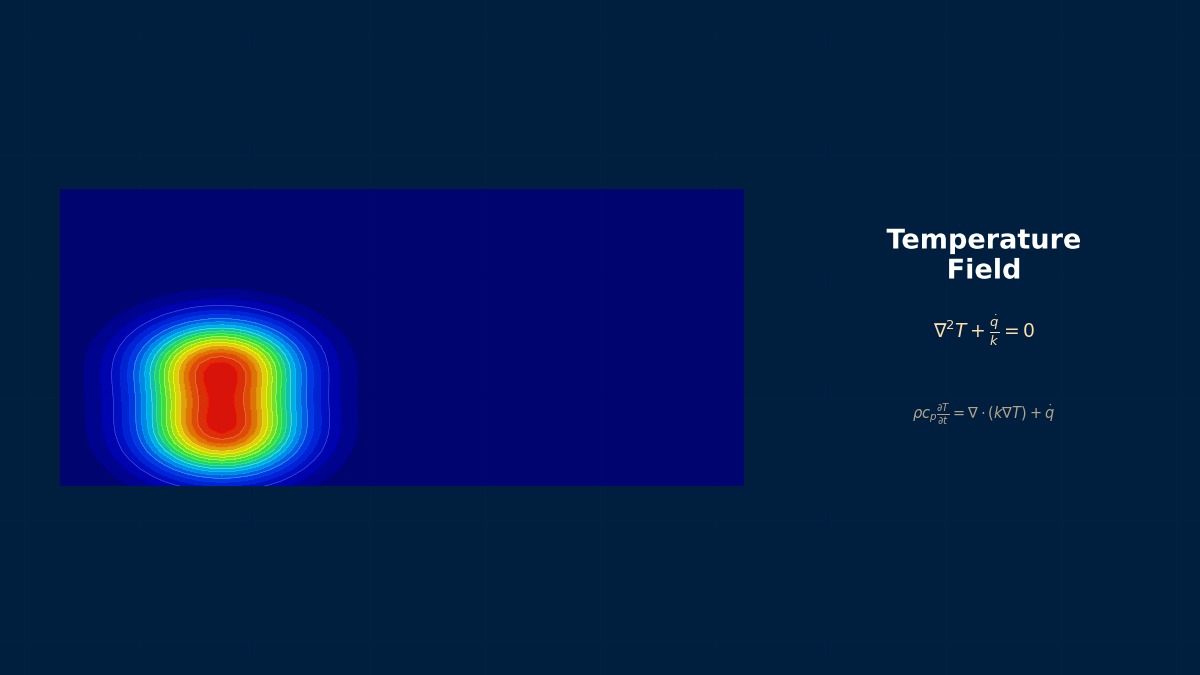
Floor Heating: Theoretical Foundations
Overview — The Big Picture of Floor Heating CAE
Professor, what exactly do we analyze in floor heating simulations? Isn't it just about laying pipes under the flooring?
In a nutshell, we solve the heat conduction from the embedded pipes using FEM to predict the temperature distribution on the floor surface. You say "just laying pipes," but the layout pattern actually makes a huge difference in comfort.
Really? How does it change specifically?
For example, with a pipe spacing of 200mm vs. 300mm, the temperature unevenness on the floor surface (the difference $\Delta T$ between max and min temperature) is significantly different. With 200mm spacing, $\Delta T \approx 1\text{--}2°\text{C}$ is acceptable, but with 300mm, $\Delta T \approx 3\text{--}5°\text{C}$. That's a level where you can feel "this spot is cold, this spot is warm" with your feet.
I see... So what temperature is targeted in Japanese housing?
Japanese building standards recommend a floor surface temperature of 29°C or below. WHO guidelines also suggest 19–29°C for living room floors. Too high a temperature risks low-temperature burns, and too low defeats the purpose of heating. CAE is used for the combinatorial optimization of pipe spacing, embedment depth, and insulation thickness to hit this "just right zone."
Three Heat Transfer Mechanisms
I understand the floor gets warm, but how does the whole room get heated? It doesn't blow air like an air conditioner, right?
Good question. The heat transfer in floor heating consists of three mechanisms:
- Conduction: Heat travels through solids: hot water pipe → mortar → flooring.
- Convection: Natural convection from the warmed floor surface to the indoor air. Warm air rises.
- Radiation: Heat radiates as infrared from the floor surface to walls, ceilings, and furniture. In fact, 50–70% of the total heat emission is this radiation.
Radiation is that significant! Is that the same principle as feeling warm in front of a bonfire?
Exactly. Air conditioners warm the air via convection, so the area near the ceiling gets warm while the feet stay cold—prone to the so-called "warm head, cold feet" phenomenon. Floor heating achieves the opposite: "cool head, warm feet." Fanger's comfort research (1972) also shows that 24°C at the feet and 19°C at the head is most comfortable for the human body. That's why modeling the radiation component is extremely important in CAE.
Governing Equations
The basis is the 3D unsteady heat conduction equation. We solve for the temperature distribution inside the floor slab (concrete + mortar + finish material):
That's the standard heat conduction equation. But how do you handle the hot water flowing inside the pipes?
The hot water in the pipes is often handled with a 1D advection equation. Solving all the pipe bends and branches with full 3D CFD would be computationally prohibitive, so in practice, a coupled "1D pipe + 3D solid conduction" model is mainstream:
Here, $T_w$ is water temperature, $v$ is flow velocity, $s$ is the coordinate along the pipe length, $A_p$ is the pipe cross-sectional area, $d_i$ is the pipe inner diameter, and $q_p$ is the heat emission per unit length from the pipe wall. This tracks how the water cools as it flows through the pipe.
Ah, so that's why the floor temperature differs near the pipe inlet and outlet!
Exactly. In hot water floor heating, the water temperature is higher near the inlet (typically 40–60°C) and drops by 5–10°C near the outlet. This becomes a key point in designing the "pipe layout pattern." Using a spiral (coil) pattern alternates inlet and outlet pipes, averaging out the temperature unevenness.
Thermal Resistance Model of Pipe Layout
How much resistance does the heat encounter from the hot water to the floor surface?
The total thermal resistance from the hot water to the indoor air can be organized as a "series circuit." It's the same concept as Ohm's law in electrical circuits:
| Thermal Resistance | Physical Meaning | Typical Value [m²·K/W] |
|---|---|---|
| $R_{conv,w}$ | Convection: Hot water → Pipe inner wall | 0.001–0.003 |
| $R_{pipe}$ | Conduction: PEX pipe wall | 0.003–0.01 |
| $R_{mortar}$ | Conduction: Mortar embedment layer | 0.02–0.06 |
| $R_{finish}$ | Conduction: Finish material (flooring, etc.) | 0.04–0.15 |
| $R_{conv,r}$ | Convection: Floor surface → Indoor air | 0.10–0.15 |
| $R_{rad}$ | Radiation: Floor surface → Walls/Ceiling | 0.05–0.10 |
The resistance of the finish material is surprisingly large. It probably varies a lot with flooring thickness and material...
Sharp observation. In fact, flooring material selection is the most overlooked point in floor heating design. Solid wood ($k \approx 0.12$ W/(m·K)) and tile ($k \approx 1.0$ W/(m·K)) have about an 8x difference in thermal conductivity. Tile allows pipe heat to reach the surface more easily, so the floor surface temperature is higher even with the same water temperature. That's why tile + floor heating is common in European bathrooms.
Here, $h_{conv} \approx 5\text{--}7$ W/(m²·K) (natural convection for upward-facing surface), $h_{rad} \approx 5\text{--}6$ W/(m²·K) (linearized radiation coefficient around 20°C room temperature). The total $h_{total} \approx 10\text{--}13$ W/(m²·K) is the standard value in practice.
Comfort Indicators and the Intersection with CAE
"Comfort" seems subjective. How do you evaluate it in simulation?
The PMV (Predicted Mean Vote) indicator defined in ISO 7730 is the standard. It quantifies comfort on a scale from "hot (+3) to cold (-3)" based on six factors: temperature, humidity, air velocity, radiant temperature, clothing insulation, and metabolic rate. By inputting CAE results (floor surface temperature distribution, indoor airflow field) into PMV calculation, you can spatially map where in the room is comfortable or uncomfortable.
So CAE temperature calculation results can be used directly for human comfort evaluation. Amazing.
Especially for floor heating, floor surface temperature non-uniformity ($\Delta T_{floor}$) is limited by ASHRAE 55. A temperature difference of 3°C or more under the soles of a seated person is perceived as uncomfortable. CAE can perform this check to judge the quality of the pipe layout pattern before construction.
Ancient Roman Hypocaust
The history of floor heating dates back to ancient Rome around 80 BC. A system called the "hypocaust" involved creating a void under the floor to circulate hot air from a furnace. It was widely used in bathhouses (thermae), and temperature distribution was controlled by varying the height of the supporting pillars (pilae). Korea's "ondol" uses a similar principle and has over 1,000 years of history. Essentially, the same problem modern CAE engineers solve—"how to heat the floor surface uniformly"—was solved by people over 2,000 years ago through empirical rules.
Computational Methods for Floor Heating
Discretization with FEM
How do you actually solve that heat conduction equation on a computer?
We discretize the space using the Finite Element Method (FEM). The floor slab is divided into many small elements, and the temperature within each element is approximated. Transforming it into the weak (variational) form and formulating with Galerkin's method yields the final system of equations:
Here, $[C]$ is the heat capacity matrix, $[K]$ is the thermal conductivity matrix, and $\{F\}$ is the vector of external heat input. It looks similar to the structural analysis equation $[K]\{u\} = \{F\}$, right? In thermal analysis, temperature is the unknown, and we just use the thermal conductivity matrix instead of the stiffness matrix.
So knowledge from structural analysis can be used directly. What elements are used?
For floor heating analysis, 8-node hexahedral elements (linear) are standard. Floor slabs are plate-like, so hexahedral elements are a good fit. The basic approach is a non-uniform mesh: fine around pipes and coarse in distant floor areas.
| Element Type | Node Count | Use in Floor Heating | Notes |
|---|---|---|---|
| 8-node Hexahedron (Linear) | 8 | Main floor slab body | Most common. Optimal for sweeping mesh of layered structures. |
| 20-node Hexahedron (Quadratic) | 20 | High-accuracy regions near pipes | Effective where temperature gradients are steep. |
| 4/10-node Tetrahedron | 4/10 | Complex pipe branch shapes | Used as a supplement where hexahedrons can't be used. |
| 1D Pipe Element | 2 | Hot water piping | COMSOL: Pipe Flow, Fluent: 1D pipe network |
Pipe Modeling Methods
Meshing the pipes in 3D by cutting out circular sections sounds incredibly difficult...
In practice, there are three approaches:
- Full 3D Resolution: Faithfully meshing the pipe's circular cross-section. Most accurate but computationally enormous. For research.
- Equivalent Heat Source Method: Omitting pipes from the 3D model and applying equivalent heat input to nodes at pipe locations. Fast computation but lower accuracy for temperature gradients.
- 1D-3D Coupling Method: Embedding 1D pipe elements into 3D solid elements. COMSOL's "Pipe Flow" module and Ansys Fluent's "embedded pipe" use this. Mainstream in practice.
So 1D-3D coupling offers the best balance. Can it track pipe bends and corners?
Of course. 1D pipe elements place nodes along the pipe path, so they can freely track serpentine or spiral patterns. The image is that at each node, the pipe outer wall is thermally coupled with the surrounding 3D solid elements. The drop in water temperature along the pipe is also calculated in real-time.
CFD + Conduction Coupled Analysis
Earlier, you mentioned "natural convection of indoor air." Do you simulate that too?
We do when high accuracy is needed. We solve for indoor airflow and temperature fields using CFD (Computational Fluid Dynamics) and couple it with the heat conduction analysis at the floor surface boundary. This is called Conjugate Heat Transfer.
When is CFD necessary? Is it always needed?
Actually, in many cases, CFD is unnecessary. Sufficient accuracy can be obtained by simply assigning a constant convective heat transfer coefficient $h_{conv}$ (5–7 W/(m²·K)) to the floor surface. CFD coupling becomes necessary for:
- Spaces with very high ceilings (atriums, gymnasiums) where airflow patterns are complex.
- Evaluating the interaction between cold drafts from windows and floor heating.
- Considering airflow obstruction due to furniture placement.
- When high-accuracy spatial mapping of PMV distribution is desired.
I see, a stepwise approach: solve conduction first, then add CFD if needed.
Time Step and Transient Analysis
I've heard floor heating "takes time to warm up." Can you simulate that warm-up time?
Of course. We track the time evolution with transient analysis. For time discretization, implicit methods (Backward Euler or Crank-Nicolson) are standard. Implicit methods remain stable even with large time steps, so a simulation spanning several hours can be done in tens of steps.
The guideline for the time step is determined from the characteristic thermal diffusion time $\tau$ of the floor slab:
Here, $L$ is the floor slab thickness and $\alpha = k / (\rho c_p)$ is the thermal diffusivity. For a typical floor slab of 300mm thickness with concrete ($\alpha \approx 8 \times 10^{-7}$ m²/s), $\tau \approx 110,000$ seconds ≈ 30 hours. A time step of $\Delta t \approx \tau / 100$ to $\tau / 50$ (300–600 seconds ≈ 5–10 minutes) is appropriate.
With 300-second steps, a 24-hour simulation needs only 288 steps. That's quite manageable.
Exactly. That's why floor heating analyses are popular benchmarks for verifying transient solvers. The large thermal mass of concrete means you don't need minuscule time steps, and the physics is straightforward without turbulence or phase change.
Speeding Up Convergence
When meshing a large residential building with floor heating, the element count can exceed 1 million. To speed up the analysis, use these techniques: (1) Adaptive meshing: coarsen elements far from pipes. (2) Reduced-order model (ROM): once the steady-state floor temperature is found, expand the transient analysis using a ROM. (3) Parallel processing: modern FEM solvers leverage multicore CPUs and GPUs. A well-optimized model can run a 7-day transient analysis in under an hour on a standard workstation.