Thermal Barrier Coating (TBC) Analysis
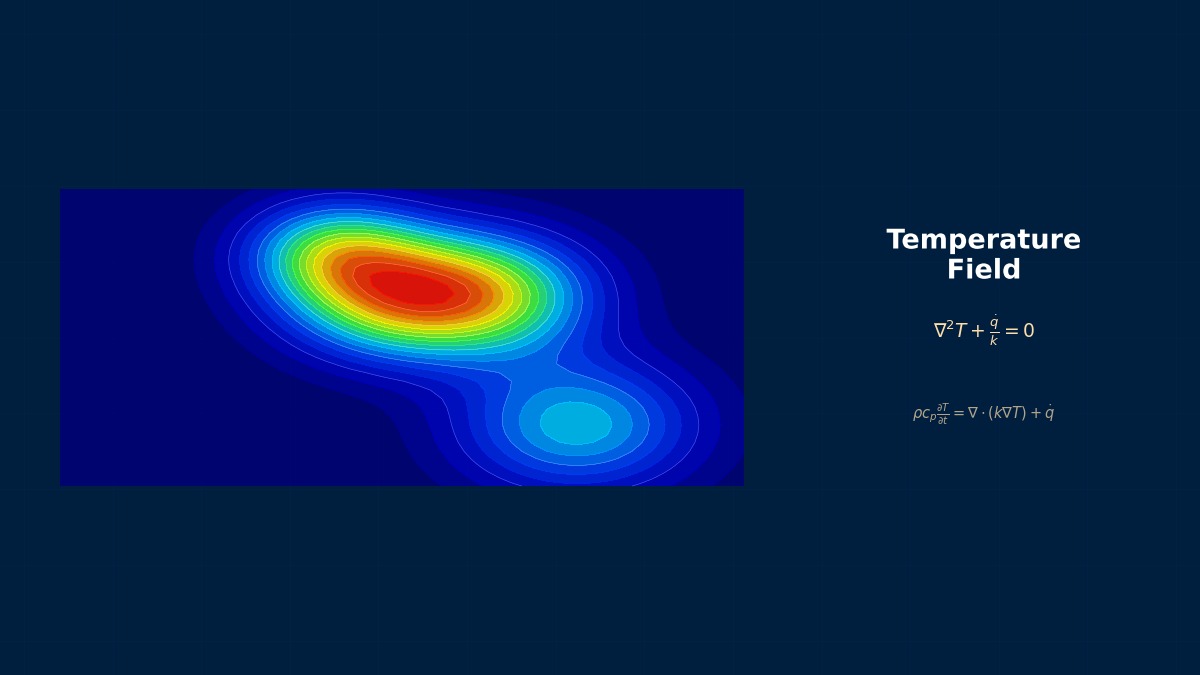
Theory: a thin ceramic carries a large temperature drop
Overview
Can a film of about 0.3 mm on a turbine blade really change temperatures much?
Yes. The ceramic conducts about 1 W/mK, a twentieth of the blade metal (about 20 W/mK), so 0.3 mm of ceramic resists heat like 6 mm of metal. The blade wall sits between hot gas outside and cooling air inside; heat flows in series gas → coating → metal → coolant, so adding the coating's resistance makes it carry a large share of the temperature drop. Let's compute how much the metal cools using series resistances.
Series thermal resistances
Five resistances act in series: gas-side convection, TBC, bond coat, metal wall and internal cooling. The drop across the TBC is the heat flux times its resistance.
The technology that let jet engines run hotter
TBC research began in the US in the 1950s and 60s for rockets and aircraft engines. In the 1970s yttria-stabilised zirconia proved an excellent material, and by the 1980s it was used on jet-engine turbine blades. Turbine inlet temperatures far exceed what blade metal can withstand, made possible by internal cooling, TBCs and superalloys together. Higher inlet temperature means higher efficiency, so TBCs feed directly into fuel economy.
Worked example: a turbine blade wall
Combustion gas 1,500 °C (3,000 W/m²K), internal cooling air 600 °C (2,000 W/m²K), YSZ (1.0 W/mK), 0.1 mm bond coat (10 W/mK), 2 mm superalloy wall (20 W/mK).
TBC thickness and temperatures
| TBC thickness | Heat flux | TBC surface | Metal outer | Metal inner | Drop across TBC |
|---|---|---|---|---|---|
| None | 0.95 MW/m² | — | 1,172 °C | 1,077 °C | — |
| 0.1 mm | 0.86 MW/m² | 1,212 °C | 1,118 °C | 1,031 °C | 86 K |
| 0.3 mm | 0.72 MW/m² | 1,259 °C | 1,034 °C | 962 °C | 217 K |
| 0.5 mm | 0.62 MW/m² | 1,292 °C | 974 °C | 912 °C | 312 K |
Matching the TBC by other means
| Condition | Metal outer temperature |
|---|---|
| 0.3 mm TBC (k 1.0) | 1,034 °C |
| 0.3 mm TBC, sintered (k 1.5) | 1,072 °C |
| No TBC, internal cooling ×2.3 (4,540 W/m²K) | 1,034 °C |
With a TBC the surface actually gets hotter, yet the metal gets cooler.
The TBC impedes heat flow, so heat leaves the gas side less easily and the surface rises from 1,182 °C to 1,259 °C — but the ceramic tolerates that. What matters is the metal beneath dropping by 138 K; a few tens of kelvins can multiply a superalloy's creep life. Matching this without a TBC would need 2.3 times the internal heat transfer coefficient, spending more compressor air on cooling and lowering engine efficiency. But sintering that raises conductivity removes nearly 30% of the benefit, and spallation removes it at once, so TBC life must be assessed together with metal margin.
Analysis tips
- Obtain gas- and coolant-side coefficients from CFD or correlations as boundary conditions.
- Account for TBC conductivity change with service (sintering).
- Include thickness scatter from spraying and assess the thinnest spots.
- Compute thermal stress from the temperature field to assess spallation risk.
- Solve leading/trailing edges and other high-flux regions in 2D or 3D.
“Only the spalled spot burned”
During inspection of a power-generation gas turbine, part of a blade leading edge was oxidised and thinned. The TBC there had spalled in service; the bare metal was exposed to temperatures over 100 K higher by calculation, accelerating oxidation and creep. Since then, inspections that detect spallation and cooling margins letting the metal survive for a time after spallation have been built into design.
Common mistakes
Mistakes and fixes
| Mistake | Effect | Fix |
|---|---|---|
| As-sprayed conductivity only | Overheating late in life | Assess sintered values |
| Uniform thickness | Hot thin spots | Include scatter |
| Omitting bond coat | Oxidation unassessed | Model the layer |
| Ignoring spallation | Sudden damage | Also assess bare metal |
| Ignoring radiation | Surface temperature wrong | Include gas radiation |
I'd like to learn related topics.
Related pages include TBC thermal stress, thermal spray, thermal resistance networks, turbomachinery CHT and furnace simulation.
Related Topics
Experience the theory firsthand with the interactive simulator for this field
All Simulators