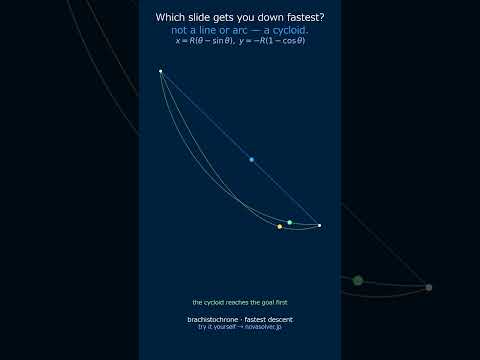
Quick answer The brachistochrone (fastest-descent curve) is a cycloid x = a·(θ − sinθ), y = −a·(1 − cosθ), with descent time T = θ_f·√(a/g); the speed at each point follows energy conservation, v = √(2g·drop). The same cycloid is also tautochrone: from any release point the time to the bottom is π·√(a/g).
Find the shape of the fastest slide between two points at different heights. Vary the horizontal distance, vertical drop and gravity to see the descent time of the fastest curve — a cycloid — and how it compares with a straight ramp. A racing-bead animation lets you feel why a straight line is not the fastest path.
Parameters
Horizontal distance D
m
Sideways distance from start to end point
Vertical drop H
m
Downward fall from start to end point
Ball mass m
kg
Does not affect descent time; sets the kinetic energy
Gravitational field g
m/s²
Earth 9.81, Moon 1.62, Jupiter about 24.8
Results
—
Fastest descent time (s)
—
Straight-ramp time (s)
—
Time saved (%)
—
Cycloid angle θ_f (rad)
—
Cycloid radius a (m)
—
Terminal kinetic energy (J)
—
Race animation — cycloid vs straight ramp
Two beads released together. The bold curve is the cycloid (brachistochrone); the thin line is the straight ramp. The cycloid bead reaches the finish first.
The brachistochrone is a cycloid. x and y are its parametric form, a is the radius parameter and T is the descent time. The fastest path is a cycloid, not a straight line, because dropping steeply early builds up speed.
The final angle θ_f is set by the ratio of horizontal distance D to vertical drop H. The left side increases monotonically in θ, so bisection finds the unique root. The radius a then follows from θ_f.
By energy conservation the terminal speed is path-independent. The straight-ramp descent time follows from uniformly accelerated motion (L is the ramp length).
What is the Brachistochrone Curve?
🙋
A "brachistochrone curve" — is this about something like a slide? You connect a high point and a low point and look for the shape you can slide down fastest?
🎓
Exactly that. It is formally called the brachistochrone problem. In 1696 Johann Bernoulli challenged the mathematicians of Europe: "Of all the curves joining two points at different heights, which shape lets a frictionless bead, sliding under gravity, reach the lower point in the shortest time?" The rules are: zero friction, gravity is the only force.
🙋
Shortest time — so the shortest path, a straight line, must be the answer? The shortest distance between two points is a straight line, after all.
🎓
That is the great trap of this problem. A straight line is the shortest distance, but not the shortest time. Time depends not only on distance but on the speed at each point. A curve that drops steeply at first gains a large speed early and carries it through the rest of the run. The speed banked early more than pays back the extra distance. So a faster path than the straight line does exist. Race the two beads in the animation above and watch.
🙋
You're right — the bead on the bold curve finishes first. So what is the correct shape?
🎓
The answer is a cycloid — the curve a point on the rim of a rolling wheel traces on the ground. Newton solved it overnight and sent the answer anonymously. When Bernoulli saw it, he reportedly said he "recognised the lion by its claw". Leibniz, both Bernoulli brothers and l'Hôpital also solved it. It is a historically pivotal problem.
🙋
That's quite a line-up of giants. What made the problem so important?
🎓
Solving it essentially created a whole branch of mathematics: the calculus of variations. Ordinary calculus finds the point that minimises a function; the calculus of variations finds the function itself that minimises an integral. It now underlies optimal control, the principle of least action in physics, and much more. And the cycloid has a bonus: it is also the tautochrone — the curve on which a bead released from any height reaches the bottom in the same time. One curve, two miracles.
Frequently Asked Questions
Of all the curves connecting two points at different heights, the brachistochrone is the one along which a frictionless bead, sliding under gravity alone, travels from the upper point to the lower point in the shortest time. Johann Bernoulli posed it as a public challenge in 1696. Intuitively the straight line, being the shortest path, seems fastest, but the answer is not a straight line: it is a cycloid, the curve traced by a point on the rim of a rolling wheel, because dropping steeply at first builds up speed early.
A straight line is the shortest distance, but not the shortest time. Descent time depends not only on path length but on the speed at every point. By energy conservation, the deeper the bead has fallen, the faster it moves. A cycloid drops at a steep angle right after the start, so it gains a large speed early and carries that speed through the rest of the descent. This 'build speed early' effect more than repays the extra distance travelled, so the cycloid is faster overall.
The cycloid is x = a(theta - sin theta), y = -a(1 - cos theta), and the final angle theta_f satisfies (theta - sin theta)/(1 - cos theta) = horizontal distance / vertical drop. Because the left side is monotonically increasing in theta, the equation has a unique root that can be found numerically by bisection on the interval (0, 2*pi). Once theta_f is known, the radius parameter a = vertical drop / (1 - cos theta_f) and the descent time T = theta_f * sqrt(a/g) follow. This tool runs that bisection internally.
Remarkably, both are the same cycloid. The brachistochrone is the curve of fastest descent between two points; the tautochrone is the curve on which a bead released from any height reaches the bottom in exactly the same time. Christiaan Huygens used the tautochrone property to design a pendulum clock that is, in theory, perfectly isochronous. One curve satisfying two optimal properties at once is a classic example of the mathematical beauty of the cycloid.
Real-World Applications
Calculus of variations and optimisation theory: The brachistochrone problem gave birth to the calculus of variations, the branch of mathematics that finds the function which minimises or maximises an integral (a functional). It now appears everywhere in modern optimisation — the principle of least action in physics, optimal structural shapes, optimal rocket trajectories, optimal control in economics. The brachistochrone remains the classic introductory example in university courses on analytical mechanics and optimisation.
Pendulum clocks using isochronism: The cycloid is also the tautochrone, so its period is independent of amplitude. In the 17th century Christiaan Huygens exploited this by fitting "cycloidal cheeks" to a pendulum so the bob would swing along a cycloidal arc. An ordinary circular pendulum drifts in period as its amplitude grows, but a cycloidal pendulum is, in theory, accurate at any amplitude.
Curved surfaces in skate parks and roller coasters: When designing surfaces that should "accelerate fast and smoothly" — half-pipes, skateboard ramps, the drop sections of coasters — shapes close to a cycloid serve as a reference. In practice friction, air drag and ride comfort (limiting jerk, the rate of change of acceleration) add constraints, so the result is not an exact cycloid, but the idea of "drop steeply first to bank speed" is shared.
Science education and physical intuition: The counter-intuitive conclusion that "the shortest path is not the fastest" is one of the most striking topics in physics teaching. Demonstration rigs that race beads, and simulators like this tool, convey energy conservation, the link between speed and time, and the idea of optimisation all at once. By letting learners experience the moment intuition fails, they make excellent teaching aids for building the habit of thinking quantitatively.
Common Misconceptions and Pitfalls
The most common mistake is assuming the shortest path must be the fastest. Distance and time are different things; descent time is set by both path length and the speed at each point. A straight line is the shortest distance, but its early acceleration is gentle, so its early speed is small and it ends up slow. A cycloid drops almost vertically at the start, banks a large speed, and uses that speed all the way down — so it wins despite the detour. Remember that "shorter = faster" is a naive intuition that holds only at constant speed.
Next, the misconception that a heavier object descends faster. Under the idealised frictionless condition, descent time does not depend on mass at all. Just as in Galileo's law of falling bodies, gravity gives every object the same acceleration. In this tool, moving the mass slider changes neither the descent time nor the time saved (only the kinetic energy scales with mass). Heavier objects appearing to fall faster in real life is an air-drag effect, which the idealised brachistochrone model ignores.
Finally, jumping to the conclusion that a cycloid can be used directly for a real slide. This tool's model assumes zero friction, zero air drag and a point mass. In reality contact friction, rolling resistance, air drag, and the object's size and rotational inertia all matter, and the truly fastest shape deviates from an exact cycloid. Moreover, in vehicles a sudden change of acceleration (jerk) hurts ride comfort, so designers sometimes deliberately move away from the fastest shape. Use the conclusions of the idealised model as a "guiding principle", and understand that a real device needs corrections.
How to Use
Enter horizontal distance (dNum, 0.5–10 m) and vertical drop (hNum, 0.2–5 m) to define start and end points
Set mass (mNum, 0.1–50 kg) and gravitational acceleration (gNum, typically 9.81 m/s²)
Click Simulate to compute the optimal cycloid path; compare fastest descent time against straight-ramp baseline
Worked Example
A 2 kg object sliding between points separated 4 m horizontally and 1.5 m vertically on Earth (g = 9.81 m/s²). The simulator generates a cycloid with radius a = 1.08 m and final angle θ_f = 2.41 rad. Fastest descent time = 1.68 s versus straight-ramp time = 2.03 s, yielding 17.2% time savings. Terminal kinetic energy = 29.4 J. The curved path accelerates the object faster initially than a linear incline.
Practical Notes
Larger vertical drops (h > 2 m) amplify the cycloid advantage; shallow drops (< 0.3 m) show minimal time gain over straight ramps
Mass cancels from the brachistochrone equation—time depends only on geometry and g, not object weight
Friction and air resistance are neglected; real-world slides lose 5–25% efficiency depending on material (steel > concrete > plastic)
Cycloid radius a ≈ h/2 for balanced horizontal and vertical spans; extreme aspect ratios require curve flattening
🎬 Watch it in motion
Cycloid | the curve that beats a straight line downhill #Shorts
What shape slides down fastest? The brachistochrone #Shorts