NovaSolver›Chladni Figures Simulator — Vibration Modes of a Square Plate Back
Vibration & Waves Simulator
Chladni Figures Simulator — Vibration Modes of a Square Plate
Builds the vibration mode φ_mn(x,y) on a square plate by Ritz combination and renders Chladni nodal lines with the relative eigenfrequency. Sweep mode (m,n), mix α, and node threshold ε to watch where the sand grains gather.
Parameters
Mode m
Mode n
Mix parameter α
Node threshold ε
α=−1 is the classical antisymmetric mode (Chladni figure), α=+1 the symmetric mode, and |α|<1 a mixed mode. The yellow box on the thumbnail grid marks the current mode.
Results
—
Mode (m, n)
—
Symmetry
—
Relative f / f_11
—
Approx. node crossings
Vibration mode heatmap φ(x,y)
Blue = φ<0 (downward phase) / red = φ>0 (upward phase) / white = |φ|<ε (nodal lines where sand grains settle). 100×100 grid evaluation of the Ritz mode.
Mode thumbnail grid (m,n = 1..4)
A 4×4 grid showing 16 different (m,n) modes. The currently selected mode is highlighted with a yellow box. Click a thumbnail to switch to that mode.
Theory & Key Formulas
The vibration mode of a square plate of side $L$ is a product of cosines in $x$ and $y$.
Ritz combination of the two degenerate modes ($\alpha$ is the mix parameter):
Nodal lines are pixels with $|\phi(x,y)| < \varepsilon$.
Relative eigenfrequency for a free-edge Kirchhoff plate:
$$\frac{f_{mn}}{f_{11}} = \frac{m^2 + n^2}{2}$$
$\alpha=+1$ gives a symmetric mode (invariant under $x\leftrightarrow y$); $\alpha=-1$ gives the antisymmetric Chladni mode; intermediate values produce mixed modes whose nodal lines twist diagonally.
What is the Chladni Figures Simulator
🙋
Is this the metal plate with sand from physics class? What is actually happening on the plate?
🎓
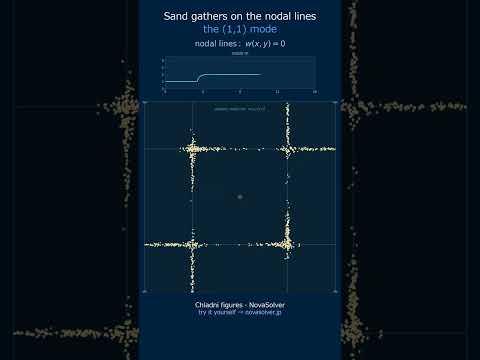
Exactly — that is the Chladni experiment, systematized by Ernst Chladni in 1787. When the plate is driven at one of its resonant frequencies, sand is tossed off the high-amplitude antinodes and settles on the zero-amplitude nodal lines. The pattern you see is the nodal set of the plate's vibration mode φ_mn(x,y). The simulator above computes φ via a Ritz combination and paints pixels with $|\phi| < \varepsilon$ as the white nodal lines.
🙋
What do the indices m and n stand for?
🎓
m is the number of half-wavelengths along x and n along y. Since $\cos(m\pi x/L)$ has m antinodes along x, the (m,n)=(3,5) default produces 3 antinodes in x and 5 in y. On a square plate (m,n) and (n,m) are degenerate, so the eigenfunction is any linear combination $\phi = \cos\!\cos + \alpha\,\cos\!\cos$. Changing α changes which member of the degenerate pair you see.
🙋
α=−1 and α=+1 look completely different. What is happening?
🎓
α=+1 gives a mode that is invariant under x↔y swap (the symmetric mode), so its nodal lines tend to align with the diagonal. α=−1 picks up a sign under the swap (the antisymmetric mode) and reproduces the classical Chladni grids and bands. In real experiments the antisymmetric mode is what sand draws most cleanly. Hit "Sweep α" to watch the continuous transition between them.
🙋
Does "relative frequency 17.0" mean it resonates at 17 times the (1,1) frequency?
🎓
Yes. For a Kirchhoff (thin) plate the eigenfrequency is $f_{mn} \propto (m^2+n^2)$. Normalizing by $f_{11}$ gives $(m^2+n^2)/2$, so (3,5) sits at $(9+25)/2 = 17.0$. The absolute frequency depends on plate thickness, density, Young's modulus, and boundary conditions, but the ratios between modes are determined by geometry alone — that is why this number is useful as a teaching metric.
FAQ
No. The simulator visualizes the nodal set of the mode function φ(x,y) (the locus where |φ|<ε). It does not solve the dynamics of individual sand grains (elastic collisions, friction, inertia). In practice the equilibrium location of the grains is the same as the nodal set, so the white lines drawn here match where the sand finally accumulates in an experiment. With heavy damping or coarse grains the line broadens into a 'node band', which is exactly what the ε parameter mimics.
A square plate has eigenfunctions that are simple products $\cos(m\pi x/L)\cos(n\pi y/L)$, so the math is the cleanest possible setting for teaching. Chladni's original experiments used squares, triangles, and irregular shapes. On a circular plate the eigenfunctions involve Bessel functions and the nodes form combinations of concentric circles and radial lines. The shape changes the figure but the principle (nodal lines of the eigenfunction) is identical.
The φ_mn(x,y) shown here is exactly the mode shape extracted by an FEM eigenvalue analysis of a plate or shell element. CAE codes such as Ansys, Abaqus, or Nastran routinely produce these mode shapes and frequencies. In thin-plate vibration design — engine covers, oil pans, HDD housings — engineers tune plate thickness and rib placement so that excitation frequencies stay away from these modes. Chladni figures also help pick sensor locations: a sensor on a node sees nothing of that mode.
Any linear combination of two degenerate eigenfunctions is itself an eigenfunction, with nodal geometry that varies continuously with the combination coefficient. At α=±1 the lines align with the x or y axis; at intermediate α they twist into diagonals or curves. This is the general phenomenon of eigenmode degeneracy familiar from quantum mechanics and linear algebra: with degenerate eigenvalues the eigenfunction is not unique. In real plates a slight asymmetry (non-uniform thickness, anisotropic material) selects an α away from ±1, which is why "textbook" patterns are not always seen.
Real-world applications
Musical-instrument design (violin and guitar plates): The top and back plates of a violin are designed by tracking specific mode shapes (the so-called T1, ring, and cross modes) at target frequencies. Makers actually sprinkle sand onto the plates and shave wood until the Chladni patterns match the target geometry. The thickness distribution of the finished plate is therefore tuned via these sand-figures rather than purely by formula.
Vibration-fatigue design of plate structures: HDD disks, automotive floor pans, and aircraft skin panels fail in fatigue at antinode locations because that is where stress is highest. Placing reinforcing ribs or fasteners on the nodal lines therefore extends fatigue life dramatically. FEM modal analysis combined with Chladni-style nodal maps is the standard design tool.
Sensor and actuator placement: A piezoelectric (PZT) sensor mounted on a nodal line cannot pick up that mode at all, while one on an antinode is overly sensitive to that mode alone. To distinguish multiple modes the designer chooses positions where the nodal lines of those modes do not overlap. The same logic applies to actuators that drive a chosen mode.
Non-destructive modal testing: Damage in plates and pipes shifts the modal frequencies and locally distorts the nodal pattern. Comparing the measured Chladni-style maps with the healthy baseline (often via impact-hammer tests or scanning laser-Doppler vibrometers) lets engineers detect cracks or debonds in bridges, tanks, and turbine blades.
Common misconceptions and caveats
The most common misconception is that "because Chladni figures are real physics, the simulation must move actual sand grains". In fact a Chladni figure is the steady-state geometric position of the nodes; reproducing transient sand motion is not necessary. The simulator paints the nodal set of φ(x,y) directly, which matches where sand finally settles in the experiment. A particle simulation would be a fun visualization but would converge to the same geometry, so for understanding the lines it is unnecessary.
Another frequent error is to treat the relative frequency (m²+n²)/2 as if it were an absolute frequency in hertz. The real frequency is $f_{mn} = C \cdot (m^2+n^2)/L^2 \cdot \sqrt{D/\rho h}$, which depends on Young's modulus E, density ρ, thickness h, side L, Poisson's ratio, and the boundary conditions (free, simply supported, or clamped). The 17.0 displayed here is only "(1,1)-normalized", a useful teaching metric. For real hardware design you must validate the absolute number with FEM or measurement.
Finally, do not assume that only α=±1 modes exist in practice. Idealized perfectly-isotropic, perfectly-symmetric plates have α=±1 eigenfunctions, but real plates have small thickness variations, material anisotropy, and asymmetric boundary conditions, and the corresponding "mixed" modes show up at intermediate α. Sweeping α in the simulator continuously twists the nodal lines, and that is exactly the physical reason why textbook patterns are not always seen in experiments — a nice example of degeneracy and perturbation theory in action.
Set mode integers m and n (range 1–6) using the slider and the sliders to define the plate's vibration pattern along x and y directions
Adjust the slider (0–1) to blend symmetric and antisymmetric boundary conditions; the slider controls damping effects (0–0.1) for realistic modal decay
Click simulate to compute eigenfrequencies via Ritz method and display nodal lines where plate displacement equals zero; compare relative frequencies (f_mn/f_11) across modes
Worked Example
For a 0.5 m × 0.5 m steel plate (ρ=7850 kg/m³, E=210 GPa, thickness=2 mm) with m=2, n=1: fundamental f_11≈94 Hz. Mode (2,1) yields f_21≈235 Hz (relative f≈2.5), displaying one vertical nodal line bisecting the plate. Adding m=n=3 produces f_33≈469 Hz with 9 approximate node crossings in a 3×3 grid pattern. Increasing the slider shifts frequencies ~2–5% due to boundary condition coupling.
Practical Notes
Damping above 0.08 causes nodal lines to blur; use low values for clean acoustic visualization in anechoic chamber testing
Integer mode pairs (m,n) with m=n exhibit high symmetry and stronger acoustic radiation; avoid near m≠n for vibration isolation design
Nodal line density increases quadratically with mode order; (5,5) generates ~25 node crossings useful for speaker cone analysis and ultrasonic transducer tuning
🎬 Watch it in motion
Chladni Figures | sound makes sand draw on a plate #Shorts
Chladni Figures | sound makes sand draw on a plate #Shorts