Parameters
About
Select end conditions and cross section shape. Adjust length, modulus, and yield stress to compute critical load, slenderness ratio, and safety factor.
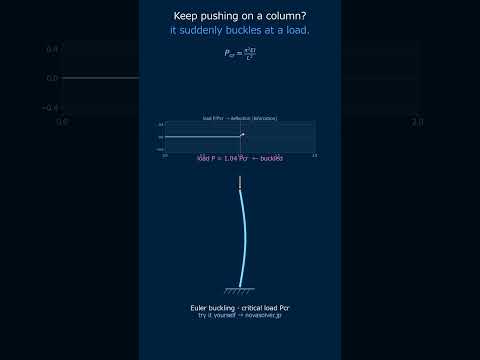
The Euler buckling load predicts the critical axial force at which a perfectly straight, elastic column becomes unstable. It depends on stiffness, length, and end conditions.
$$P_{cr}= \frac{\pi^2 E I}{(K L)^2}$$$P_{cr}$ = Critical buckling load (N)
$E$ = Modulus of Elasticity (Pa)
$I$ = Minimum area moment of inertia (m⁴)
$L$ = Column length (m)
$K$ = Effective length factor (from end conditions)
The Johnson parabolic formula accounts for inelastic buckling and material yield strength, providing a more accurate failure load for intermediate and short columns.
$$P_{cr}= A \sigma_y \left[1 - \frac{\sigma_y (K L / r)^2}{4 \pi^2 E}\right]$$$A$ = Cross-sectional area (m²)
$\sigma_y$ = Material yield strength (Pa)
$r$ = Radius of gyration, $\sqrt{I/A}$ (m)
$K L / r$ = Slenderness ratio (key design parameter)
Structural Engineering & Building Design: Calculating the safe load for steel columns in building frames is a fundamental application. Engineers must ensure columns supporting multiple floors do not buckle under the immense compressive load, especially during events like earthquakes where lateral movement can occur.
Aerospace & Aircraft Struts: Landing gear and internal wing supports are designed as columns. Weight is at a premium, so materials are pushed to their limits. Precise buckling analysis ensures these components are as light as possible without risking a catastrophic failure upon landing.
Industrial Machinery & Presses: The drive screws in mechanical presses and the pistons in hydraulic systems act as columns. If they buckle under operational load, the entire machine can be destroyed. Johnson's formula is often used here for the stockier components.
Scaffolding & Construction Support: Temporary support columns used in construction must be sized correctly for the expected load. Underestimating the buckling load can lead to sudden collapse, making this a critical safety calculation on any job site.
When you start using this tool, there are a few common pitfalls to watch out for. First is the misconception that "buckling is covered by strength calculations". You might think a material with a yield stress of 300 MPa can withstand loads up to 300 MPa, but a slender column can buckle and snap under a stress less than one-tenth of that. For example, a slender round steel bar (S45C, 20mm diameter, 2m long) supported by pins at both ends will buckle under a load of only about 5% of its yield stress. Remember: strength and stiffness are different things.
Next is a blind spot in parameter input. The "Radius of Gyration, r" is calculated automatically, but are you conscious of the direction of its source, the "Area Moment of Inertia, I"? For non-isotropic cross-sections like H-beams, I is completely different about the weak axis versus the strong axis. When selecting a cross-section shape in the tool, it's easy to unconsciously assume the strong axis (larger I). However, it's dangerous if you don't always consider which direction in the actual structure has weaker restraint.
Finally, "the real-world interpretation of the End Condition Factor K". Textbook-perfect "fully fixed" or "perfectly pinned" conditions hardly exist on-site. For instance, a column base fixed with bolts is "semi-fixed", and even welding rarely provides perfect rotational restraint. So don't just select K=0.5 (both ends fixed) in the tool and feel safe. It's essential to design with a margin, thinking "the actual behavior might be closer to K=0.7". Before applying a safety factor to your calculation result, question whether there's a safety margin in the input conditions themselves.
The concept of buckling applies not just to columns, but to various "thin structures under compression". The first to mention is plate buckling (local buckling). It's the phenomenon where a plate, like the web or flange of an H-beam, buckles in waves under in-plane compression, and it's also crucial for automobile body panels and ship hull plates. If column buckling is the bending of a "line", then plate buckling is closer to the wrinkling of a "surface".
Another is shell buckling. Think of thin-walled structures with curved surfaces, like rocket body tubes, dome roofs, or the body of a plastic bottle. These can show complex buckling modes, like diamond patterns, under axial compression or external pressure. The "influence of slenderness (slenderness ratio)" you learn with this tool helps develop a fundamental sense corresponding to a shell's "thinness ratio".
Surprisingly, it even connects to micro- and nano-mechanics. For example, the cantilevers (probes) in atomic force microscopes or micro-beams in MEMS devices can sometimes buckle due to "invisible compressive forces" like intermolecular forces or residual stress. The macroscopic Euler formula lives on as a fundamental principle even in the micro-world. Viewed through the lens of "compressive instability", this becomes a cross-disciplinary common language, from architecture to nanotechnology.
Once you're comfortable with this tool's formulas, take a step beyond "linear buckling analysis". First, understand that what this tool and linear analysis provide are theoretical values for an "ideal, perfectly straight column". In reality, initial deflection and load eccentricity exist, so the actual buckling load is lower. This is the realm of "elasto-plastic buckling" and "large deflection analysis". Trying a "nonlinear static analysis" after a "buckling analysis" in FEA software will let you experience the impact of initial imperfections.
If you want to deepen the mathematical background, following the derivation process of the Euler formula is the best way. That formula comes from the differential equation for the column's deflection curve, $EI \frac{d^2 y}{dx^2} = -P y$. This "simple differential equation eigenvalue problem" is actually the essence representing structural stability. Getting familiar with eigenvalues and eigenvectors here will greatly deepen your understanding of the "buckling modes" you encounter in FEA.
The next recommended topic is "the Energy Method (Timoshenko's method)". This technique, which finds the buckling load from the relationship between the strain energy stored in deformation and the work done by external forces, is a powerful tool for approximating the buckling of complex cross-sections or continua. All the formulas handled by this tool—Euler, Johnson—can be seen as special cases of this Energy Method. I recommend starting by trying the Energy Method with hand calculations on a simple example, like a cantilever beam with a concentrated load at its tip.