Analyse how a steel I-beam bent about its strong axis can swing sideways and twist — lateral-torsional buckling — before reaching its full bending strength. Adjust the section, unbraced length and load condition to see the elastic critical moment, design capacity and safety factor update in real time, and confirm the effect of lateral bracing.
Parameters
I-beam section
Sets I_y, J, C_w and W_pl automatically
Unbraced length L
m
Unbraced length of the compression flange
Young's modulus E
GPa
Shear modulus G
GPa
Load condition (Cb factor)
Moment-distribution factor C_b
Applied bending moment M
kN·m
Design bending moment acting on the beam
Results
—
Elastic critical moment M_cr (kN·m)
—
Plastic moment M_p (kN·m)
—
Design bending capacity M_cap (kN·m)
—
Slenderness λ_LT
—
Safety factor SF
—
Verdict
—
Lateral-torsional buckling mode — animation
The compression flange of an I-beam in strong-axis bending swings sideways and the section twists — the lateral-torsional buckled shape. The △ marks at the ends are lateral bracing points; the span between them is the unbraced length L.
Design bending capacity vs unbraced length
Elastic critical moment vs unbraced length (section comparison)
Theory & Key Formulas
$$M_{cr}=C_b\frac{\pi}{L}\sqrt{E I_y\,G J+\left(\frac{\pi}{L}\right)^2 E I_y\,E C_w}$$
Elastic critical moment M_cr. L: unbraced length of the compression flange, I_y: minor-axis second moment of area, J: St. Venant torsion constant, C_w: warping constant, E: Young's modulus, G: shear modulus, C_b: moment-distribution factor.
Plastic moment M_p (W_pl: plastic section modulus, f_y: yield strength, 235 MPa for S235 steel) and non-dimensional slenderness λ_LT.
The design bending capacity M_cap is the lesser of M_cr and M_p. Adding lateral bracing to shorten the unbraced length L raises M_cr sharply, so a short beam develops its full plastic moment M_p.
What is Lateral-Torsional Buckling?
🙋
I came across "lateral-torsional buckling" in my structures class... but doesn't a beam just take a load from above and bend downwards? What does it mean for it to buckle sideways?
🎓
Good question. A beam is indeed designed to bend about its strong axis, the tall direction. But when you bend an I-section — tall and thin sideways — about that strong axis, the top compression flange behaves like a "slender column". And a column under compression buckles, right? That flange drifts off to one side, dragging the whole section into a twist with it. That is lateral-torsional buckling, LTB. The energy stored in the compression side by the bending is released all at once in the sideways tipping direction.
🙋
Wait — so you can't even use the bending strength you calculated for the section?
🎓
That is exactly what makes LTB dangerous. The beam can collapse at a much lower load, before reaching the "plastic moment M_p" the section could otherwise develop. That collapse load is the "elastic critical moment M_cr". Try increasing the "unbraced length L" slider on the left. M_cr keeps dropping, and beyond a certain length it falls below M_p. Once that happens, the capacity you can use in design becomes M_cr instead. The longer the beam, the more LTB governs.
🙋
You're right, M_cr crashes when I make L longer. So how do you prevent lateral-torsional buckling?
🎓
The most effective move is to support the compression flange sideways — lateral bracing. Look at the M_cr formula: the unbraced length L is in the denominator. Add a bracing point to halve L and M_cr more than doubles. In practice, floor slabs, secondary beams, joists and braces hold the compression flange laterally. Brace it short enough and the beam can develop its full plastic moment M_p again.
🙋
I see. Does changing the section help? I can pick IPE300, HEA200 and so on.
🎓
It does. What matters for LTB is the "minor-axis stiffness". The M_cr formula contains the minor-axis second moment of area I_y, the torsion constant J and the warping constant C_w. For a similar bending strength, a section with wide flanges — an H-section like HEA200 — has larger I_y and C_w, so it resists LTB better. Switch sections in the "section comparison" chart below and you will see the wide-flange curve sitting higher. As a rule of thumb, the more slender and tall the section, the weaker it is in LTB.
🙋
There's a Cb factor in the load-condition list — what is that?
🎓
Cb is the "moment-distribution factor". The base M_cr formula is keyed to the harshest case, where the whole beam carries a uniform bending moment. But a real beam has a moment distribution — under a uniformly distributed load the mid-span moment is larger than at the ends, for instance. The shorter the region of high moment, the less prone to LTB the beam is, and Cb credits that. Cb is 1.0 for uniform bending, about 1.13 for a uniformly distributed load and about 1.35 for a central point load. Switch it on the left and you will see M_cr rise.
Frequently Asked Questions
Lateral-torsional buckling (LTB) is the failure of a slender steel I-beam bent about its strong axis, in which the compression flange swings sideways and the whole cross-section twists before the beam reaches its full bending strength. The energy stored in the compression side by the bending is released by the section tipping over and twisting. It occurs most readily in long beams whose compression flange is not laterally restrained, and can collapse the beam well below the plastic moment M_p.
For a simply supported I-beam, M_cr = C_b·(π/L)·√( E·I_y·G·J + (π/L)²·E·I_y·E·C_w ). L is the unbraced length of the compression flange, I_y is the minor-axis second moment of area, J is the St. Venant torsion constant, C_w is the warping constant, E is Young's modulus and G is the shear modulus. C_b is the moment-distribution factor — 1.0 for uniform bending, larger for other load patterns. M_cr falls steeply as the unbraced length L increases.
The most effective measure is to add lateral bracing (lateral support points) to the compression flange. Bracing shortens the unbraced length L of the compression flange, and from M_cr = C_b·(π/L)·√(...) this raises M_cr sharply. With L short enough the beam can develop its plastic moment M_p and lateral-torsional buckling does not occur. In practice, secondary beams, floor slabs, joists and braces support the compression flange. Choosing a section that is stiffer about the minor axis (larger I_y and C_w) also helps.
The design bending capacity M_cap is the lesser of the elastic critical moment M_cr and the plastic moment M_p. A short, well-braced beam has M_cr greater than M_p and can develop the full plastic moment M_p of the section. A long, unbraced beam has M_cr well below M_p and fails by elastic lateral-torsional buckling before reaching the plastic moment. If the non-dimensional slenderness λ_LT = √(M_p/M_cr) is well below 1 the response is plastic; if it is large, elastic buckling governs.
Real-World Applications
Steel-frame beam design: In the steel beams of office buildings, factories and warehouses, the LTB check is at the heart of bending design. The longer the span, the longer the unbraced length and the more LTB governs the capacity. Where a floor slab continuously braces the compression flange, the plastic moment can be expected; at the tip of a cantilever or during construction before the floor is in place, the LTB capacity drops sharply. Skipping the construction-stage check leads to accidents.
Crane girders and bridge girders: The runway girders of overhead cranes and the main girders of steel bridges are classic LTB targets, carrying bending over long stretches. Bridge girders brace the compression flange with cross-frames and lateral bracing, and during erection temporary bracing is added so wind and self-weight do not cause LTB. The erection stage, with incomplete bracing, is often a harsher LTB condition than the completed structure.
Roof purlins and cantilever canopies: Purlins supporting the large roofs of gymnasiums and factories, and cantilever canopies over shopfronts, vary in how easily the compression flange can be braced depending on whether it is on top or bottom. Under gravity load the top flange is in compression and the roofing braces it; under wind uplift the bottom flange goes into compression with no bracing, and the LTB risk shoots up. Not overlooking the reversal of load direction is essential.
Pre-study and verification for CAE analysis: Before running a detailed eigenvalue (linear buckling) analysis or non-linear FEM, a closed-form M_cr calculation like this tool gives a first read. Checking that the first buckling mode of the FEM is lateral-torsional and that the eigenvalue (buckling load factor) roughly matches the hand-calculated M_cr catches boundary-condition or restraint-modelling mistakes early. An order-of-magnitude discrepancy is a sign to suspect the modelling of the lateral bracing or the load application point.
Common Misconceptions and Pitfalls
The biggest misconception is assuming a beam is safe as long as the section bending strength (plastic moment M_p) is satisfied. LTB is not a section failure; it is a stability problem in which the beam as a whole tips sideways. In a long, unbraced beam, elastic LTB can occur at less than half of M_p. Always evaluate the design bending capacity as the lesser of M_cr and M_p, and do not rely on a section check alone. When λ_LT in this tool is large (above 1), it is a sign that LTB governs.
Next, the misconception that one piece of lateral bracing at the support is enough. What governs the LTB capacity is the "length L of the region where the compression flange is not laterally restrained", not the full length of the beam. Even with both ends supported, a long span between them will buckle laterally. What matters is bracing the compression-side flange, and that the bracing has enough stiffness and strength to be effective. Whether a floor slab or secondary beam attaches to the "compression flange" or only to the tension side makes a completely different result. Always check whether the load direction puts the compression flange on top or on the bottom.
Finally, dismissing it with "just use Cb = 1.0 everywhere to stay conservative". Cb = 1.0, assuming uniform bending, is indeed the most conservative, but real beams carry uniformly distributed or point loads, and the region of high moment is limited. Fixing Cb at 1.0 underestimates the LTB capacity and leads to unnecessarily large sections or excessive bracing. Conversely, there are special cases — cantilevers, reverse-curvature moments — where Cb is handled differently, and using a large Cb without checking the code provisions is dangerous. Choose an appropriate Cb for the load and moment distribution, following the design standard.
How to Use
Enter beam span (L) in metres — typical range 2–8 m for laterally unsupported I-beams.
Input Young's modulus (E) in GPa — use 200 GPa for structural steel, 69 GPa for aluminium.
Set shear modulus (G) in GPa — typically 0.4×E for isotropic materials.
Specify applied bending moment (M) in kN·m about the strong axis.
Read M_cr (elastic critical moment where lateral-torsional buckling initiates), plastic moment M_p, design capacity M_cap, slenderness λ_LT, and safety factor SF.
Worked Example
Universal Beam 457×191×98 kg/m, span L = 4.5 m, E = 200 GPa, G = 80 GPa, applied moment M = 150 kN·m. Simulator calculates M_cr ≈ 245 kN·m (elastic limit), M_p ≈ 420 kN·m (plastic capacity), design capacity M_cap ≈ 185 kN·m (after partial safety factors γ_M1 = 1.05), λ_LT ≈ 1.32, yielding SF ≈ 1.23. Verdict: SAFE — moment is below design capacity.
Practical Notes
Lateral-torsional buckling dominates when beams are bent about the strong axis without continuous lateral support; unpropped cantilevers or simply supported spans over 3 m are high-risk.
Increasing span length by 1 m typically reduces M_cr by 15–25 % depending on section properties.
Stiffer sections (higher I_y and C_w) and shorter spans delay buckling; use restraints at intervals ≤ 1.5 m for critical applications.
🎬 Watch it in motion
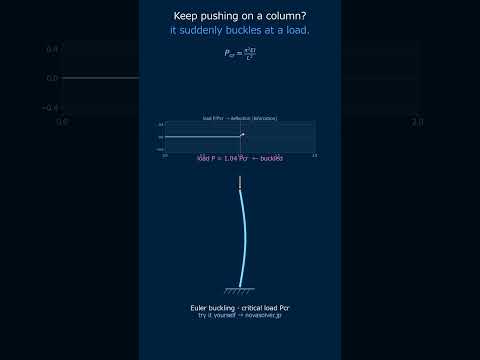
Euler Buckling | a slender column snaps sideways at once #Shorts
Why does a column suddenly snap? Euler buckling #Shorts