NovaSolver›Maxwell-Boltzmann Speed Distribution Simulator Back
Statistical Mechanics Simulator
Maxwell-Boltzmann Speed Distribution Simulator
Quick answer The Maxwell–Boltzmann distribution has density f(v) = 4π·(m/(2πkT))^(3/2)·v²·exp(−m·v²/(2kT)) (m = molecular mass, k = Boltzmann constant, T = absolute temperature). Its speeds v_p = √(2kT/m), ⟨v⟩ = √(8kT/(πm)) and v_rms = √(3kT/m) always keep the ratio 1 : 1.128 : 1.225.
Visualize the molecular speed distribution f(v) of an ideal gas from temperature and molar mass. Most-probable, mean and RMS speeds plus window and cumulative probabilities update in real time.
Parameters
Temperature T
K
Molar mass M
g/mol
Observed speed v
m/s
Probability window Δv
m/s
Example molar masses: H₂ = 2, He = 4, N₂ = 28, O₂ = 32, Ar = 40, CO₂ = 44. The window collects the probability inside v ± Δv/2.
Results
—
Most-probable v_p
—
RMS speed v_rms
—
Window probability
—
P(V > v) cumulative
Maxwell-Boltzmann distribution f(v)
x = speed v (m/s) / y = probability density f(v) / blue dashed = v_p, green dashed = mean speed, orange dashed = v_rms / yellow dot = observed v, shaded = window [v−Δv/2, v+Δv/2]
Temperature comparison (T/2, T, 2T)
Same molar mass, three temperatures. Orange = T/2, blue = current T (highlighted), red = 2T. Higher T spreads the curve to the right and lowers the peak.
Theory & Key Formulas
The magnitude of molecular velocities in an ideal gas follows the Maxwell-Boltzmann distribution.
Probability density of speed $v$ ($m$ is molecular mass, $k$ Boltzmann's constant, $T$ absolute temperature):
Molecular mass from molar mass $M_g$ in g/mol ($N_A$ is Avogadro's number):
$$m = \frac{M_g \times 10^{-3}}{N_A}$$
The three speeds always sit in the ratio $v_p : \langle v\rangle : v_\text{rms} \approx 1 : 1.128 : 1.225$, and the distribution is asymmetric with a long right tail.
What is the Maxwell-Boltzmann Simulator
🙋
Roughly how fast are air molecules zipping around at room temperature? I genuinely have no intuition for it.
🎓
Faster than people guess. At room temperature (300 K), the most-probable speed of nitrogen is about 422 m/s — well over 1500 km/h, almost twice the speed of an airliner. But molecules are not all moving at one speed; the population is spread out as a probability distribution. That distribution is $f(v) = 4\pi(m/(2\pi kT))^{3/2}\,v^2\,e^{-mv^2/(2kT)}$, the Maxwell-Boltzmann form, which is exactly what the simulator above plots.
🙋
Why list "most-probable", "mean", and "RMS" speeds? Aren't they all just "the speed"?
🎓
All three are characteristic speeds derived from the same distribution but with different definitions. v_p is the peak position, ⟨v⟩ is the simple mean, and v_rms is the root-mean-square. Their ratio is always $1 : 1.128 : 1.225$, regardless of temperature or species. Pressure and kinetic-energy formulas use $(1/2) m v^2$, so they need v_rms; mean-free-path and collision-frequency arguments need ⟨v⟩. Pick the right one for the question you are asking.
🙋
When I press "Sweep temperature", the peak slides to the right!
🎓
Right — v_p grows as $\sqrt{T}$. Notice that it also gets shorter as it shifts: total area under the curve must stay 1, so the peak gets "wider, lower, more right-shifted" with conservation of area. The bottom comparison plot makes this crystal clear: orange T/2, blue T (highlighted), and red 2T are three distinctly shaped curves at the same molar mass.
🙋
What do the "window probability" and "cumulative probability" cards mean?
🎓
If you randomly pick one molecule, those are the probabilities that its speed lies in a given range. The window probability is for v ± Δv/2 — basically the area of the yellow shaded strip — and shows about 9 % at the defaults. The cumulative one is the probability that v exceeds the observed value — the entire right-side area — and reads about 42 % for N₂ at 300 K with v = 500 m/s. So even a "slightly above mean" speed of 500 m/s is exceeded by 4 in 10 molecules; that long tail is the signature of the distribution.
FAQ
It applies to (1) classical (negligible quantum effects) (2) weakly interacting (3) thermal-equilibrium (4) many-particle gases. Liquid helium at very low temperature (Fermi-Dirac or Bose-Einstein distributions instead), dense liquids and near-critical fluids, post-shock or laser-pumped systems far from equilibrium, all break the assumptions. The practical "safe zone" is dilute gases from room temperature up to a few thousand kelvin.
Each velocity component (vx, vy, vz) is independently Gaussian with mean 0 and variance kT/m, so in 3D velocity space the origin has the highest probability density. The distribution of the magnitude |v| = v, however, is multiplied by the spherical surface area 4πv², so it goes to zero at the origin and peaks at v_p = √(2kT/m), giving the asymmetric Maxwell-Boltzmann form. This simulator plots that magnitude distribution f(v).
Gas pressure follows from molecular momentum transfer: $P = (1/3)\rho \langle v^2\rangle = (1/3)\rho v_\text{rms}^2$. The mean translational kinetic energy per molecule is $\langle E\rangle = (1/2)m v_\text{rms}^2 = (3/2)k T$, which is essentially the operational definition of temperature. This is the equipartition theorem in its simplest form, allocating $(1/2)k T$ to each translational degree of freedom.
Yes. The cumulative probability P(V > v_esc) at the escape velocity gives a Jeans-escape estimate. Earth's escape velocity is about 11.2 km/s, but at the upper-atmosphere temperature (≈ 1000 K) hydrogen (M = 2) has v_rms about 3.5 km/s, so the question hinges on the far tail of the distribution. The Moon and Mars have weak gravity, lower escape velocities, and thus lose light molecules continuously, which is why neither holds a substantial atmosphere.
Real-world applications
Transport phenomena (diffusion, viscosity, thermal conduction): Diffusion coefficients, viscosity, and thermal conductivity of a gas are estimated from the mean speed ⟨v⟩ and the mean free path λ as roughly $D \sim \lambda \langle v\rangle / 3$. The mean speed comes directly from the Maxwell-Boltzmann distribution, so once you fix temperature, pressure, and molar mass you can predict pump-down times, gaseous heat conduction in insulating foams, and process-gas diffusion times in semiconductor tools to within a factor of two.
Reaction kinetics and the Arrhenius law: Chemical reaction rates depend on the fraction of molecules with kinetic energy above an activation energy $E_a$. That fraction is approximately the high-energy tail of Maxwell-Boltzmann, $\sim e^{-E_a/(kT)}$, which is the physical origin of the Arrhenius law $k = A\,e^{-E_a/(kT)}$. Doubling the temperature in the simulator dramatically lifts the tail, which is exactly why reaction rates rise exponentially with temperature.
Vacuum, thin-film, and semiconductor processing: Inside a low-pressure vacuum chamber the rate at which gas molecules strike a wall is set by the mean speed, and combined with a sticking coefficient determines the deposition rate. Designs of CVD/PVD reactors and molecular-beam epitaxy (MBE) systems use RMS speeds, Knudsen numbers (Kn), and flow-rate calculations from each precursor's molar mass and temperature. The distribution is part of the daily working toolkit in semiconductor processing.
Planetary science and atmospheric escape: Whether a planet or moon retains an atmosphere depends largely on whether RMS speeds at the upper-atmosphere temperature exceed the escape velocity. Earth holds onto everything except helium; Mars and the Moon have weak gravity and bleed light molecules. Even for exoplanet atmospheric composition, the high-speed tail of Maxwell-Boltzmann is integrated against estimated escape velocities to evaluate long-term retention.
Common misconceptions and caveats
The most frequent mistake is to imagine that all molecules move at the same speed. In reality the distribution is wide: there is always a non-negligible fraction at one tenth the most-probable speed and a non-negligible fraction above three times v_p. Try sliding the observed-speed control to 1000 m/s (about 2.4 v_p) on the default N₂/300 K setup; the cumulative probability P(V > v) is still several percent. So no — molecules absolutely do not all travel at v_p.
Another classic error is to treat v_p, ⟨v⟩, and v_rms as interchangeable. Even when a textbook simply says "molecular speed", the precise meaning depends on context. Pressure $P = (1/3)\rho v_\text{rms}^2$ and kinetic energy $(3/2)k T$ need v_rms; mean free path and collision frequencies use ⟨v⟩; and the location of the peak is v_p. Their fixed ratio $1 : 1.128 : 1.225$ does not make them equivalent — pick the right one if you care about better than ten percent accuracy.
Finally, do not assume Maxwell-Boltzmann always applies. At very low temperature, quantum statistics take over (Fermi-Dirac, Bose-Einstein); at high density, intermolecular forces dominate; just behind a strong shock or after a fast laser pulse, the gas is far from thermal equilibrium; in glow discharges and the solar wind, electrons and heavy particles often have different temperatures. CFD, DSMC (Direct Simulation Monte Carlo), or numerical Boltzmann-equation solvers are required in those regimes. The simulator here assumes the cleanest case — a dilute thermal-equilibrium gas between room temperature and a few thousand kelvin.
Set temperature (200–2000 K) using the slider; displayed in the input field
Set molar mass (2–200 g/mol) using the slider for gas species (He, N₂, O₂, CO₂, etc.)
Set speed window center (the slider, 0–3000 m/s) and width (the slider, 10–500 m/s) to compute probability density f(v)
Read output: Most-probable speed vₚ, RMS speed v_rms, window probability P(v±Δv/2), and tail probability P(V > v)
Worked Example
Nitrogen (N₂, M = 28 g/mol) at T = 300 K. Simulator computes vₚ = 421 m/s, v_rms = 517 m/s, v_mean = 454 m/s. Setting v = 450 m/s with Δv = 50 m/s yields window probability ≈ 0.0156 (1.56% of molecules in 425–475 m/s band). Tail probability P(V > 600 m/s) ≈ 0.089, indicating ~8.9% molecules exceed 600 m/s at this temperature.
Practical Notes
For molecular diffusion rates in industrial reactors, focus on mean speed (0.921 × v_rms); higher molar mass shifts distribution leftward proportionally to 1/√M
Gas effusion through pores scales with v_mean; doubling absolute temperature increases mean speed by √2, affecting separation membrane selectivity
Cumulative tail probability P(V > v) identifies high-energy collision fraction; critical for reaction activation energy thresholds in combustion modeling
At low T or high M, v_p and v_rms converge; use RMS for kinetic energy (½mv²_rms) calculations in pressure and heat capacity derivations
🎬 Watch it in motion
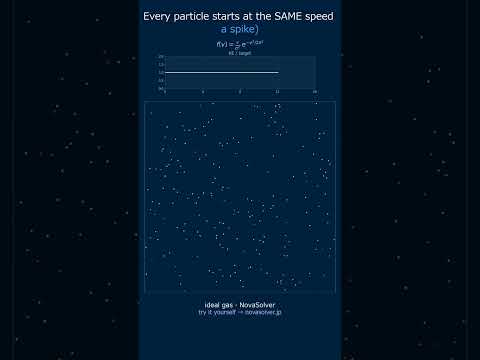
Ideal Gas | identical speeds relax into a bell curve #Shorts