NovaSolver›Rocket Thrust & Tsiolkovsky Equation Simulator Back
Aerospace / Propulsion
Rocket Thrust & Tsiolkovsky Equation Simulator
Quick answer The Tsiolkovsky rocket equation is ΔV = Isp·g₀·ln(m₀/m_f) (Isp = specific impulse, m₀/m_f = mass ratio, g₀ = 9.80665 m/s²). Thrust is F = ṁ·Ve = ṁ·Isp·g₀ (ṁ = propellant mass flow rate, Ve = exhaust velocity).
Calculate ΔV from specific impulse and mass ratio using the Tsiolkovsky rocket equation in real time. Compare with real rocket engines and explore multi-stage rocket performance.
Rocket Parameters
ΔV (velocity change)
—
—
While paused, moving a slider updates the results immediately.
Results
—
Thrust F [kN]
—
Specific impulse [s]
—
Accumulated Δv [m/s]
—
Current mass ratio m/mf
As propellant (ṁ) is expelled rearward, the vehicle becomes lighter and accumulates a velocity change according to $\Delta v=v_e\ln(m_0/m_f)$. A higher mass ratio yields a greater Δv.
Dv
Mass ratio m₀/mf
—
Exhaust velocity Ve
—
Propellant mass
—
Burn time
—
ΔV vs. Mass Ratio
Propellant Consumption
Engine comparison
Burn
ΔV is proportional to the logarithm of the mass ratio. The current setting is marked by a red dot.
Compare
Burn time vs. remaining mass. As propellant is consumed, the vehicle gets lighter and acceleration increases.
Theory & Key Formulas
Specific-impulse comparison of major rocket engines (liquid-propellant systems generally outperform solid-propellant systems).
Theory & Key Formulas
$\Delta V = I_{sp} \cdot g_0 \cdot \ln\!\left(\dfrac{m_0}{m_f}\right)$
Thrust and mass flow rate
$F = \dot{m} \cdot V_e = \dot{m} \cdot I_{sp} \cdot g_0$
How can a rocket propel itself in space? There's no air out there, right?
🎓
A rocket does not push on air. It moves forward by ejecting propellant backward, and the reaction force pushes the vehicle forward. That is Newton's third law. Aircraft need air for propellers and wings, but rockets carry both fuel and oxidizer, burn them, and accelerate hot gas through a nozzle. In vacuum, the exhaust can expand more efficiently, so performance often improves.
🙋
So "ΔV 9400 m/s to reach low Earth orbit" means it actually achieves a speed of 9.4 km/s. That's unbelievably fast, but...
🎓
A circular low Earth orbit at about 400 km altitude has an orbital speed of roughly 7.9 km/s. In practice, drag losses and gravity losses add about 1,500 m/s each, so launch to LEO needs roughly 9,400 m/s of ΔV. The hard part of the rocket equation is its logarithm: doubling ΔV requires squaring the mass ratio. A single stage would need a mass ratio near $e^{9400/3000} \approx 23$, meaning more than 95% of the vehicle would be propellant. Staging helps by dropping empty tanks and engines along the way.
🙋
I heard SpaceX's Raptor engine is incredibly high-performance—what's its specific impulse?
🎓
Raptor uses methane (CH₄) and liquid oxygen (LOX) in a full-flow staged-combustion cycle. Its vacuum specific impulse is about 380 s, with sea-level thrust around 230 metric tons per engine. The RS-25 uses liquid hydrogen and LOX and reaches a higher vacuum Isp of about 453 s, but liquid hydrogen has low density and requires large tanks. Methane is denser, easier to handle, and can potentially be produced on Mars from atmospheric CO₂ and water, which is why it fits SpaceX's Mars architecture.
🙋
How is CAE used in rocket engine design?
🎓
Rocket engines are an extreme CAE application. Combustion chambers and nozzles face temperatures of thousands of degrees and pressures of hundreds of atmospheres. CFD predicts combustion flow and heat flux, while thermal-stress analysis supports regenerative cooling-channel design. Turbopumps running at tens of thousands of rpm also require rotor dynamics and fatigue analysis. Predicting combustion instability often needs coupled fluid-structure analysis, making rocket engines one of the most demanding aerospace CAE problems.
Frequently Asked Questions
What is the difference between solid and liquid rockets?
Solid rockets store fuel and oxidizer premixed in a solid grain, so they are simple to manufacture, store, and launch quickly. Liquid rockets store propellants in separate tanks and can control flow rate, which enables higher Isp and throttling. Typical solid motors are about 200 to 280 s, while liquid engines are commonly about 300 to 460 s.
What is a Hohmann transfer orbit?
A Hohmann transfer is an elliptical orbit that moves between two circular orbits with minimum ΔV. It uses one burn at the departure orbit and a second burn at the destination orbit. A Hohmann transfer from Earth orbit toward Mars typically requires about 5 to 6 km/s of ΔV.
Why does electric propulsion, such as ion engines, have high specific impulse?
Ion engines accelerate propellant such as xenon with electric fields, reaching Isp values around 1,000 to 10,000 s. Their thrust is very small, often from millinewtons to newtons, so burns can last months or years. They are well suited to deep-space probes and station-keeping for geostationary satellites.
What does a delta-V budget mean?
A delta-V budget is the total ΔV required or available across a mission. For example, launch to LEO takes about 9.4 km/s, LEO to trans-lunar injection about 3.2 km/s, and lunar landing about 2.1 km/s. Summing these phases determines the mission architecture and rocket scale.
How much ΔV does SpaceX Starship have?
Starship with Super Heavy is estimated to place roughly 100 to 150 metric tons into low Earth orbit. Fully loaded, its launch stack has on the order of 9 to 10 km/s of ΔV. For Mars missions, orbital refueling is planned because direct departure without refueling would not provide enough margin.
What is Rocket Thrust Simulator?
Rocket Thrust Simulator is a fundamental topic in engineering and applied physics. This interactive simulator lets you explore the key behaviors and relationships by directly manipulating parameters and observing real-time results.
By combining numerical computation with visual feedback, the simulator bridges the gap between abstract theory and physical intuition — making it an effective learning tool for students and a rapid-verification tool for practicing engineers.
Physical Model & Key Equations
The simulator is based on the governing equations behind Rocket Thrust & Tsiolkovsky Equation SimulatorV. Understanding these equations is key to interpreting the results correctly.
Each parameter in the equations corresponds to a slider in the control panel. Moving a slider changes the equation's solution in real time, helping you build a direct connection between mathematical expressions and physical behavior.
Real-World Applications
Engineering Design: The concepts behind Rocket Thrust & Tsiolkovsky Equation SimulatorV are applied across mechanical, structural, electrical, and fluid engineering disciplines. This tool provides a quick way to estimate design parameters and sensitivity before committing to full CAE analysis.
Education & Research: Widely used in engineering curricula to connect theory with numerical computation. Also serves as a first-pass validation tool in research settings.
CAE Workflow Integration: Before running finite element (FEM) or computational fluid dynamics (CFD) simulations, engineers use simplified models like this to establish physical scale, identify dominant parameters, and define realistic boundary conditions.
Common Misconceptions and Points of Caution
Model assumptions: The mathematical model used here relies on simplifying assumptions such as linearity, homogeneity, and isotropy. Always verify that your real system satisfies these assumptions before applying results directly to design decisions.
Units and scale: Many calculation errors arise from unit conversion mistakes or order-of-magnitude errors. Pay close attention to the units shown next to each parameter input.
Validating results: Always sanity-check simulator output against physical intuition or hand calculations. If a result seems unexpected, review your input parameters or verify with an independent method.
Enter specific impulse (Isp) in seconds—typical values: 450s for LOX/LH2 engines, 300s for RP-1/LOX, 230s for solid rocket motors
Input initial mass (m0) and final mass (mf) in kilograms to establish your mass ratio—subtract propellant consumption to derive mf
Adjust thrust slider to model engine performance; simulator calculates ΔV using Tsiolkovsky equation: ΔV = Isp × g × ln(m0/mf)
Review real-time ΔV output in m/s to assess mission feasibility against orbital mechanics requirements
Worked Example
SpaceX Merlin 1D vacuum engine: Isp=345s, initial vehicle mass m0=500,000kg (Falcon 9 first stage), final mass mf=30,000kg (structure + residual propellant). ΔV = 345 × 9.81 × ln(500,000/30,000) = 345 × 9.81 × 2.813 = 9,512 m/s. This enables low Earth orbit insertion at ~9.4 km/s with margin for gravity losses and atmospheric drag.
Practical Notes
Mass ratio dominates performance: doubling propellant fraction increases ΔV logarithmically, not linearly—critical for multi-stage architecture decisions
Account for residual propellant (ullage) in mf calculations; Falcon 9 reserves ~3% of loaded propellant mass for tank pressurization and engine cutoff uncertainty
Vacuum Isp differs significantly from sea-level values—use 345s (vacuum) not 280s (sea-level) for first-stage thrust calculations above 10km altitude
Gravity losses consume ~1.5–2.0 km/s of ΔV during ascent; simulator output represents theoretical maximum, not achievable mission ΔV
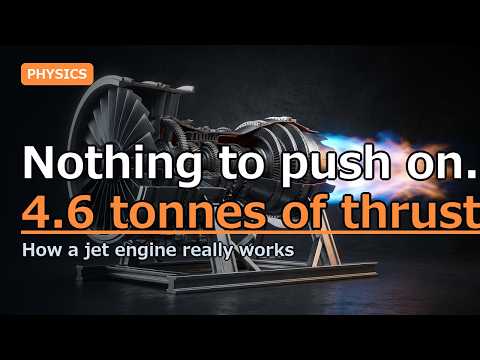
🎬 Watch it in motion
Nothing to Push On — Yet 4.6 Tonnes of Thrust | Jet Engine Explained