Waves & Vibration
Standing Wave Modes on a String
Visualize standing waves (fundamental and harmonics) on a string in real-time animation. Adjust tension, length, and linear density to experience changes in natural frequency — from guitar tuning to FEM eigenvalue analysis.
Results
256
nth Natural Frequency (Hz)
Standing Wave Animation
Harmonic Spectrum
💬 Ask the Professor
🙋
When I press a guitar fret, the pitch gets higher. Is that because the vibrating string length changes?
🎓
Exactly. Pressing a fret shortens the vibrating part of the string, so L decreases. From f₁=(1/2L)√(T/μ), a smaller L raises the frequency. To go up one octave, the vibrating length is halved. Guitar frets are placed in a geometric sequence so each semitone raises frequency by 2^(1/12)≈1.0595.
🙋
A violin has four strings of almost the same length, so why do they make different pitches?
🎓
The linear density μ is different. The low G string is thicker and has larger linear density, so its pitch is lower. The high E string is thinner and has smaller linear density, so its pitch is higher. Even with the same length and tension, a fourfold increase in μ halves the frequency. Tuning adjusts tension, while the pitch range is designed mainly through linear density.
🙋
For n=2, the middle of the string is a node. If I touch the middle, does the sound disappear?
🎓
The opposite. Lightly touching the midpoint suppresses modes that need that point to move, including the fundamental, while allowing the n=2 mode to remain. That is the harmonic technique guitarists use at the 12th fret to play a note one octave higher. Node positions are a key part of harmonic structure.
🙋
How does this standing-wave idea connect to CAE eigenvalue analysis?
🎓
FEM eigenvalue analysis, or modal analysis, finds the standing-wave patterns of a 3D structure. Solving [K-ω²M]{φ}=0 gives natural angular frequencies ωₙ and mode shapes {φ}. Those are the structural equivalents of string frequencies and vibration shapes.
Frequently Asked Questions
How do standing waves in wind instruments differ from strings?
For a string fixed at both ends, both ends are nodes with zero displacement. In an open-open pipe, both ends are antinodes. In a closed-open pipe, the closed end is a node and the open end is an antinode. Closed pipes emphasize odd harmonics, giving a different tone color.
How do more harmonics change the sound?
The types and strengths of harmonics determine timbre. A piano and a guitar can play the same fundamental frequency but sound different because their harmonic spectra differ. Fourier analysis decomposes a waveform into these frequency components.
What is resonance?
Resonance occurs when an external excitation frequency matches an object's natural frequency, causing amplitude to grow sharply. Pushing a swing at the right timing is a familiar example. Bridge and building resonance follow the same principle, and FEM modal analysis helps predict risky resonance frequencies before design finalization.
What is the difference between string wave speed and sound speed?
The string wave speed v=√(T/μ) is the speed of transverse waves traveling along the string. It is different from the speed of sound in air, about 340 m/s. A vibrating guitar string pushes air, and that air vibration becomes the sound wave you hear.
What is Standing Wave & String Vibration Modes?
Standing Wave & String Vibration Modes is a fundamental topic in engineering and applied physics. This interactive simulator lets you explore the key behaviors and relationships by directly manipulating parameters and observing real-time results.
By combining numerical computation with visual feedback, the simulator bridges the gap between abstract theory and physical intuition — making it an effective learning tool for students and a rapid-verification tool for practicing engineers.
Physical Model & Key Equations
The simulator is based on the governing equations behind Standing Wave Modes on a String. Understanding these equations is key to interpreting the results correctly.
Each parameter in the equations corresponds to a slider in the control panel. Moving a slider changes the equation's solution in real time, helping you build a direct connection between mathematical expressions and physical behavior.
Real-World Applications
Engineering Design: The concepts behind Standing Wave Modes on a String are applied across mechanical, structural, electrical, and fluid engineering disciplines. This tool provides a quick way to estimate design parameters and sensitivity before committing to full CAE analysis.
Education & Research: Widely used in engineering curricula to connect theory with numerical computation. Also serves as a first-pass validation tool in research settings.
CAE Workflow Integration: Before running finite element (FEM) or computational fluid dynamics (CFD) simulations, engineers use simplified models like this to establish physical scale, identify dominant parameters, and define realistic boundary conditions.
Common Misconceptions and Points of Caution
Model assumptions: The mathematical model used here relies on simplifying assumptions such as linearity, homogeneity, and isotropy. Always verify that your real system satisfies these assumptions before applying results directly to design decisions.
Units and scale: Many calculation errors arise from unit conversion mistakes or order-of-magnitude errors. Pay close attention to the units shown next to each parameter input.
Validating results: Always sanity-check simulator output against physical intuition or hand calculations. If a result seems unexpected, review your input parameters or verify with an independent method.
How to Use
- Set string length using lSlider (0.5–2.0 m); this determines wavelengths of standing wave modes
- Adjust tension (tVal in Newtons, 10–100 N) using tSlider to change wave velocity and frequency
- Define linear mass density (the input field in kg/m, 0.001–0.01) using the slider; higher values lower wave speed
- Select harmonic mode (n=1 fundamental through n=5 overtones) to visualize corresponding node/antinode patterns
- Control amplitude with the slider (0–50 mm) to scale oscillation magnitude without affecting modal structure
- Observe real-time animation showing phase coherence and standing wave nodes locked at string endpoints
Worked Example
Guitar E-string: length L=0.65 m, tension T=75 N, linear mass density μ=0.004 kg/m. Wave velocity v=√(T/μ)=√(75/0.004)≈137 m/s. Fundamental frequency f₁=v/(2L)=137/(1.3)≈105 Hz (close to E2 at 82 Hz; typical for acoustic guitars). Second harmonic (n=2): 210 Hz with one central node. Third harmonic (n=3): 315 Hz with two interior nodes. Amplitude set to 15 mm produces visible oscillation without material failure. Each mode maintains antinodes at displacement maxima and zero displacement at fixed ends.
Practical Notes
- Tension dominates frequency: doubling T increases f by √2 factor (≈1.41×), while doubling μ decreases f by √2
- Real strings exhibit damping; higher harmonics (n≥4) dissipate energy fastest, explaining why only first few modes appear audible in plucked instruments
- String materials: steel (μ≈7800 kg/m³ with small cross-section) vs. nylon (μ≈1100 kg/m³) produce different inharmonicity curvature
- Resonance occurs when driving frequency matches fn=(n/2L)√(T/μ); mistuning by >2% prevents visible antinode reinforcement
🎬 Watch it in motion
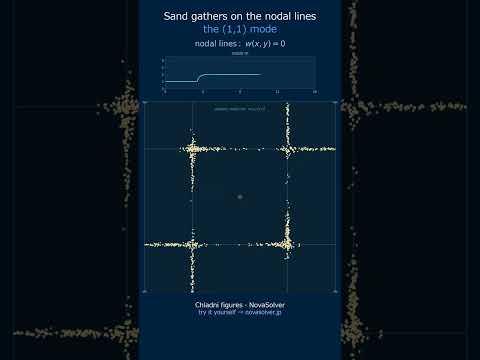
Chladni Figures | sound makes sand draw on a plate #Shorts
Standing Waves | the shape of every harmonic on a string #Shorts
Chladni Figures | sound makes sand draw on a plate #Shorts