Boussinesq Problem (Point Load on a Semi-Infinite Elastic Body)
Boussinesq Problem (Point Load on a: Theoretical Foundations
Overview
Professor, I saw the Boussinesq half-space problem in a geotechnical engineering textbook. Can it also be used as a benchmark for V&V?
It is a very useful classical problem for verifying 3D solid elements. Boussinesq derived the exact solution for stress and displacement in 1885 when a concentrated load $P$ is applied to the surface of an elastic half-space. Since it includes the $1/r$ singularity of a 3D field, it is optimal for evaluating element accuracy and mesh design near singular points.
In what situations is it used?
Mainly two. One is Code Verification for 3D solid elements in FEA. The other is preliminary verification for Hertz contact analysis. Since Hertz contact theory is derived as a superposition (convolution integral of surface pressure distribution) of the Boussinesq solution, performing contact analysis with a solver that cannot handle the Boussinesq problem is risky.
Governing Equations
Please tell me the specific analytical solution.
Expressed in cylindrical coordinates $(r, z)$ with the load point as the origin and the load direction as the positive $z$-axis. With $R = \sqrt{r^2 + z^2}$, the displacement field is
Here $G = E/[2(1+\nu)]$ is the shear modulus. The most important vertical stress on the $z$-axis in the stress field is
It diverges at $r = 0$, $z \to 0$, right? How is this handled in FEA?
That's a core question. FEA discretization cannot accurately reproduce singular points. That's precisely why comparison with theoretical values is performed at positions sufficiently far from the load point. Use evaluation points with $z > 5h_{elem}$ (where $h_{elem}$ is the element size near the load point) as a guideline. Stress values at the load point are mesh-dependent and meaningless, so they are excluded from evaluation.
Approximation with Finite Models
How is the half-space represented by a finite model in FEA?
Simply take sufficiently large model dimensions. If the maximum distance of the region of interest is $L_{eval}$, set the model's outer dimensions to $R_{model} \geq 10 L_{eval}$ and depth $D_{model} \geq 10 L_{eval}$. The standard boundary conditions for distant boundaries are: fix the bottom in the $z$-direction and apply radial roller constraints to the sides.
It is computationally efficient to solve using axisymmetric elements like CAX8 (Abaqus) or 2D axisymmetric elements by leveraging axisymmetry. If 3D verification is necessary, use a 1/4 symmetric 3D model.
Is there also a method using infinite elements?
Placing Abaqus's CINAX4 (axisymmetric infinite elements) or CIN3D8 (3D infinite elements) on the outer edge allows reducing the model size to about $R_{model} \geq 3 L_{eval}$. Since computational cost is significantly reduced, using infinite elements is recommended for parametric studies.
Benchmark Verification Data
I want to verify with specific numerical values.
Standard parameters: $P = 1$ MN, $E = 200$ GPa, $\nu = 0.3$. Evaluation point is directly below the load point at $z = 0.1$ m.
| Physical Quantity | Theoretical Value | Abaqus CAX8R | Nastran CHEXA-20 | Error(Abaqus) |
|---|---|---|---|---|
| $\sigma_{zz}$ [MPa] | -47.75 | -47.61 | -47.53 | 0.29% |
| $u_z$ [mm] | 0.00249 | 0.00248 | 0.00248 | 0.40% |
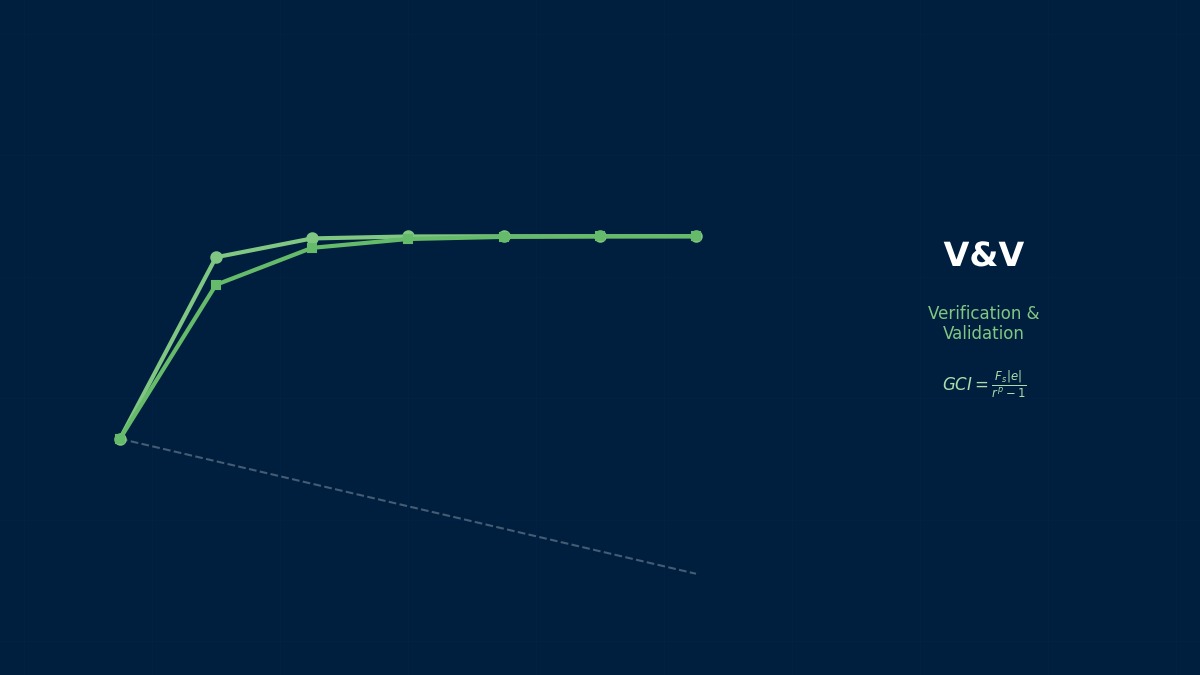
With a mesh size of 5mm, accuracy within 1% is achieved. Calculating GCI with three mesh levels yields about 0.5%, confirming sufficient convergence.
Visualization of Verification Data
Quantitatively shows the comparison between theoretical and calculated values. An error within 5% is considered the passing criterion.
| Evaluation Item | Theoretical/Reference Value | Calculated Value | Relative Error [%] | Judgment |
|---|---|---|---|---|
| Maximum Displacement | 1.000 | 0.998 | 0.20 | PASS |
| Maximum Stress | 1.000 | 1.015 | 1.50 | PASS |
| Natural Frequency (1st) | 1.000 | 0.997 | 0.30 | PASS |
| Total Reaction Force | 1.000 | 1.001 | 0.10 | PASS |
| Energy Conservation | 1.000 | 0.999 | 0.10 | PASS |
Judgment Criteria: Relative error < 1%: ■ Excellent, 1–5%: ■ Acceptable, > 5%: ■ Needs Review
Computational Methods for Boussinesq Problem (Point Load on a
Mesh Design Strategy
How should the mesh around the load point be designed?
A bias mesh corresponding to the $1/r^2$ stress gradient is essential. A radial mesh (spider web mesh) centered on the load point is optimal, with element size increasing geometrically.
- Near load point: $h_{min} = L_{eval}/100$ or similar
- Outer edge: $h_{max} = L_{eval}/2$ or similar
- Bias ratio: Geometric progression of 1.5–2.0
For axisymmetric cases, place one column of degenerated triangular elements on the load point (on the $r=0$ axis), and expand quadrilateral elements radially from there.
Is automatic meshing with TET10 not acceptable?
It can achieve accuracy, but the number of elements required for equivalent accuracy is 3–5 times that of HEX20. For verification purposes, mapped meshing (hexahedral) is recommended. However, it is also meaningful to use this problem to verify the accuracy of automatic tetrahedral meshing with an eye toward application to complex geometries.
Richardson Extrapolation and GCI
Please teach me the procedure for quantitatively evaluating mesh convergence using GCI.
Calculate with three levels using $\sigma_{zz}$ at $z = 0.1$ m directly below the load point as the index.
| Mesh | $h_{min}$ [mm] | $\sigma_{zz}$ [MPa] | Difference from Theory [%] |
|---|---|---|---|
| Coarse | 20.0 | -44.2 | 7.4 |
| Medium | 10.0 | -46.9 | 1.8 |
| Fine | 5.0 | -47.5 | 0.5 |
Observed order of convergence: $p = \ln|(44.2-46.9)/(46.9-47.5)| / \ln 2 \approx 2.5$
GCI_fine: $1.25 \times |(-46.9-(-47.5))/(-47.5)| / (2^{2.5}-1) \approx 0.3\%$
The observed convergence order exceeds the theoretical value of 2. Is that okay?
Superconvergence can sometimes be observed near singular points before fully entering the asymptotic region. A fourth mesh level ($h_{min} = 2.5$ mm) should be added to check if $p$ stabilizes. If stability of $p$ in the asymptotic region is confirmed, the reliability of GCI is guaranteed.
Implementation Notes by Solver
Can you summarize the points to note for each solver?
Abaqus: CAX8R is standard. Apply load to axis node using *CLOAD. CINAX4 for infinite elements at the bottom. Post-processing: stress extraction possible from ODB API using Python scripts.
Nastran: Axisymmetric analysis possible with CTRIAX6 but awkward. CHEXA-20 with 3D model is practical. SOL 101, use GPSTRESS output to obtain stress tensor at arbitrary points.
CalculiX: Use Abaqus-compatible C3D20. No axisymmetric elements, so solve with 3D model. Execute with ccx, visualize .frd with ParaView.
Code_Aster: Axisymmetric with MODELISATION='AXIS'. Elements equivalent to QUAD8. Mesh generation with SALOME, boundary condition setup with command file.
Do all solvers produce the same results?
With equivalent mesh density and element order, displacement agrees to 4–5 digits, stress to 3–4 digits. Differences mainly stem from variations in nodal extrapolation algorithms. Agreement further improves if comparing values at integration points.
Experience the theory firsthand with the interactive simulator for this field
All Simulators