Mesh Refinement Ratio and GCI Convergence Verification Method
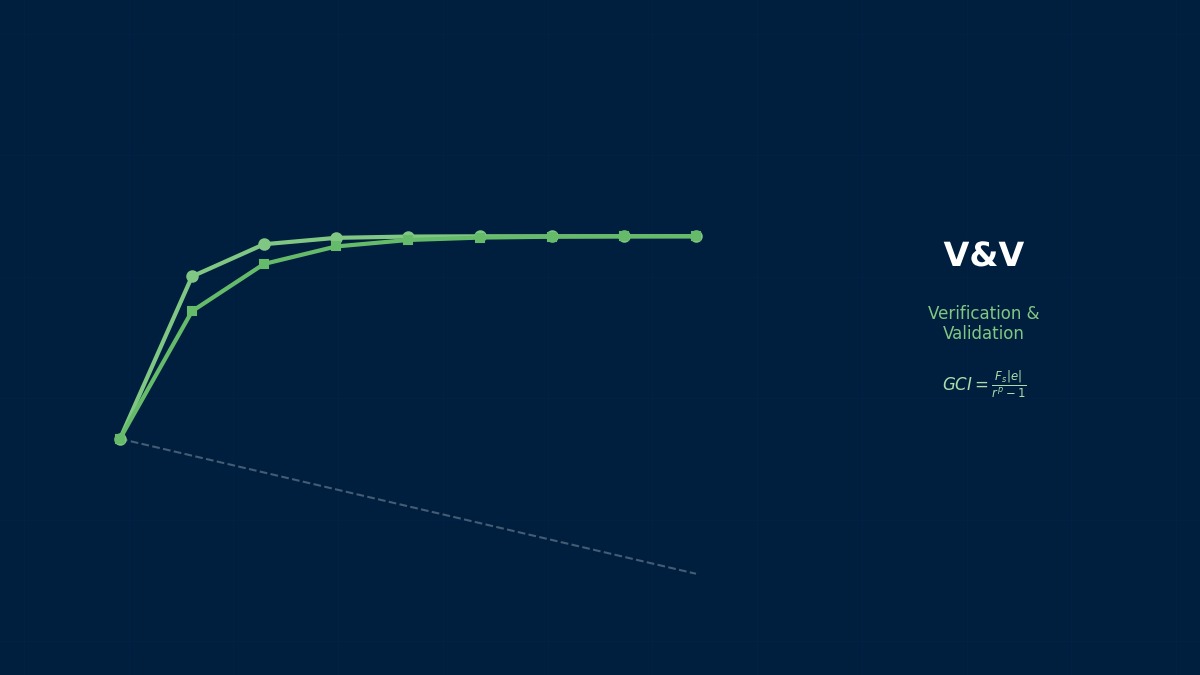
Mesh Refinement Ratio and GCI Convergence: Theoretical Foundations
Overview — What is a Mesh Convergence Study?
Professor, how many mesh levels do we need to compare for a mesh convergence study? I was told to "try three," but why isn't two enough?
A minimum of three levels. If you only compare two meshes, you can only say "the results are close, so it's probably okay." With three, you can estimate the convergence rate (order p) and predict the limit solution as mesh size → 0 via extrapolation. This is Richardson extrapolation, and quantifying its error band is the GCI (Grid Convergence Index).
I see, so with just two points you can only draw a straight line, but with three points you can understand the curve's shape.
Exactly. The three-mesh method is also specified as the standard procedure in ASME V&V 20 (the Verification & Validation guideline for computational fluid and solid mechanics). To state "mesh dependency is negligible" in papers or project reports, providing GCI values has become the international common language.
Mesh Convergence Study forms the core of the V&V process, quantitatively evaluating discretization error and guaranteeing solution reliability. Its essence is summarized in the following three elements.
- Refinement ratio r — The ratio of representative sizes between coarse and fine meshes. $r \geq 1.3$ (recommended $r = \sqrt{2} \approx 1.41$)
- Richardson extrapolation — Estimates the limit solution as mesh size → 0 from results of three or more meshes
- GCI — Quantifies discretization uncertainty as a 95% confidence interval
Definition of Mesh Refinement Ratio r
The refinement ratio is like the "magnification factor" for how much finer to make the mesh, right? Using $r = 2$ would halve the element size, which seems simple.
For structured grids, $r = 2$ is indeed simple, but the element count becomes 8 times larger in 3D. The computational cost explodes. That's why ASME V&V 20 recommends $r = \sqrt{2} \approx 1.41$. The element count only increases by about 2.8 times. Conversely, if $r < 1.3$, the difference between meshes becomes too small and gets buried in rounding error, making the estimation of the observed order $p$ unstable.
The definition of the mesh refinement ratio (grid refinement ratio) is as follows.
Here, $h$ is the representative grid size. To always ensure $r > 1$, the numerator is the coarse mesh and the denominator is the fine mesh.
Representative Size for Unstructured Meshes
For structured grids, the element size is uniform so $h$ is clear, but for unstructured meshes like tetra meshes, how do you define $h$?
The most standard method is to back-calculate an equivalent length from the average volume of all elements. $d$ is the spatial dimension number; use area for 2D, volume for 3D.
$N$ is the number of elements, $V_i$ is the volume of each element (area for 2D), and $d$ is the spatial dimension number (2 or 3). This definition allows obtaining a representative size as a scalar value even for unstructured meshes.
So for unstructured meshes, can the refinement ratio $r$ be calculated from the ratio of element counts?
Yes. For isotropic refinement, the relationship between the element count ratio and $r$ is as follows.
For example, for a 3D model with $N_{\text{fine}} = 800{,}000$ and $N_{\text{coarse}} = 200{,}000$, then $r = (800{,}000 / 200{,}000)^{1/3} = 4^{1/3} \approx 1.587$, ensuring a sufficient refinement ratio.
Richardson Extrapolation
Richardson extrapolation is essentially a method to predict "what the answer would be if the mesh were infinitely fine," right? How is it calculated specifically?
The discretized solution $f_h$ can be expressed relative to the true solution $f_{\text{exact}}$ by the following Taylor expansion.
Here, $p$ is the theoretical order of the discretization scheme, and $g_p$ is an unknown coefficient. Ignoring higher-order terms, the extrapolated value can be obtained from three meshes ($h_1 < h_2 < h_3$, $f_1, f_2, f_3$).
Here, $r_{21} = h_2 / h_1$, and $\hat{p}$ is the observed order (discussed later) estimated from the three solutions.
So you're further correcting the result of the finest mesh $f_1$ to get closer to the true solution.
Exactly. However, since higher-order terms are truncated, the extrapolated value is an "estimate," not the true value. That's precisely why we quantify the uncertainty with GCI.
Calculation of Observed Order p
For a constant refinement ratio ($r_{21} = r_{32} = r$), the observed order $\hat{p}$ can be calculated directly by the following formula.
$f_1$: solution on fine mesh, $f_2$: solution on medium mesh, $f_3$: solution on coarse mesh. If $\hat{p}$ is close to the theoretical order $p_{\text{formal}}$ (e.g., 2 for quadratic elements), it can be judged that the solution is within the asymptotic range.
What if $r_{21} \neq r_{32}$ (not constant)? In practice, I think it's often not perfectly constant due to mesher constraints.
Good question. In that case, it cannot be solved explicitly, so the following nonlinear equation is solved by iterative methods (fixed-point iteration or Newton's method).
Here, $\varepsilon_{32} = f_3 - f_2$, $\varepsilon_{21} = f_2 - f_1$, $s = \text{sign}(\varepsilon_{32}/\varepsilon_{21})$. It usually converges within about 10 iterations.
GCI (Grid Convergence Index)
Looking at the GCI formula, there's a safety factor $F_s$. What does that mean?
$F_s$ is a "safety factor" to increase confidence. Roache's original paper recommends $F_s = 3$ (conservative) for the two-mesh method and $F_s = 1.25$ for the three-mesh method. With the three-mesh method, the consistency of extrapolation accuracy has been verified using the observed order $\hat{p}$, so the safety factor can be smaller.
The GCI on the fine mesh side ($\text{GCI}_{21}^{\text{fine}}$) is defined by the following formula.
Here, $\varepsilon$ is the relative error.
| Method | Safety Factor $F_s$ | Meaning |
|---|---|---|
| 2-mesh method | 3.0 | Conservative because $\hat{p}$ is unknown |
| 3-mesh method | 1.25 | Equivalent to 95% confidence interval with $\hat{p}$ estimated |
I'd like to try a concrete example. For example, if the maximum stress on three meshes is 248.3 MPa, 251.6 MPa, and 260.1 MPa respectively?
Let $f_1 = 248.3$ (fine), $f_2 = 251.6$ (medium), $f_3 = 260.1$ (coarse), and $r = \sqrt{2}$.
$\varepsilon_{21} = 251.6 - 248.3 = 3.3$, $\varepsilon_{32} = 260.1 - 251.6 = 8.5$
$\hat{p} = \ln(8.5/3.3) / \ln(\sqrt{2}) = \ln(2.576)/0.3466 \approx 2.73$
$\varepsilon = (251.6 - 248.3)/248.3 = 0.01329$
$\text{GCI}_{21}^{\text{fine}} = 1.25 \times 0.01329 / (1.414^{2.73} - 1) = 0.01661 / 1.634 \approx 0.0102 = 1.02\%$
This means that relative to the fine mesh result of 248.3 MPa, there is a discretization uncertainty of $\pm 1.0\%$ that can be reported.
Asymptotic Range Check
Whether the solution is within the asymptotic range is checked by the following indicator.
If this value is close to 1 (guideline: $0.95 \leq \text{AR} \leq 1.05$), then the solution is in the asymptotic range, and the reliability of GCI and Richardson extrapolation is high. If it deviates significantly from 1, the mesh may not be fine enough, or the model may contain a singularity.
What should be done if it's not in the asymptotic range?
There are three options. (1) Add an even finer mesh and recalculate, (2) Move the evaluation point away from the singularity (e.g., use section average stress instead of stress concentration point), (3) Use higher-order elements to reach the asymptotic range sooner. In practice, (2) often has the best cost-performance.
Computational Methods for Mesh Refinement Ratio and GCI Convergence
Procedure for the Three-Mesh Method
The standard procedure for the three-mesh method based on ASME V&V 20 is shown below.
- Generate three mesh levels: Coarse, medium, fine with refinement ratio $r \geq 1.3$ (recommended $\sqrt{2}$). Keep the mesh topology common.
- Run analysis under identical conditions: Unify boundary conditions, material properties, and solver settings completely.
- Extract quantities of interest: Record the values $f_1, f_2, f_3$ of the physical quantities of interest (maximum stress, average temperature, pressure loss, etc.).
- Calculate representative mesh sizes $h_1, h_2, h_3$: Use cell size for structured grids, or the volume average method mentioned earlier for unstructured.
- Calculate observed order $\hat{p}$
- Calculate Richardson extrapolated value $f_{\text{ext}}$
- Calculate $\text{GCI}_{21}^{\text{fine}}$ and $\text{GCI}_{32}^{\text{coarse}}$
- Calculate asymptotic range check AR: OK if close to 1.
The procedure is clear. But for unstructured meshes, isn't it difficult to "keep the same topology"?
Indeed, for unstructured meshes, maintaining exactly the same topology is difficult. Therefore, the practical approach is to "uniformly scale the global mesh size by a factor of $1/r$." Apply local refinement to the same regions and with the same ratios for all three levels, unifying the "recipe" for mesh generation.
Extension to Non-uniform Refinement Ratios
When $r_{21} \neq r_{32}$, the observed order $\hat{p}$ must be solved by iterative methods for the nonlinear equation mentioned earlier. In practice, sufficient accuracy can be obtained with the following fixed-point iteration.
Use the formula for the constant ratio case for the initial value $\hat{p}_0$, and iterate until $|\hat{p}_{k+1} - \hat{p}_k| < 10^{-6}$.
Handling Multiple Quantities of Interest
There could be cases where GCI is 1% for maximum stress but 5% for deflection, right? Which result should be reported?
Report all of them is the correct answer. GCI is calculated independently for each quantity of interest; you cannot say "the model has a GCI of 1% overall." Local quantities (stress at a concentration point) and global quantities (total reaction force, maximum deflection) have completely different convergence behaviors. It's normal for local quantities to converge more slowly. Best practice is to evaluate at least three quantities directly relevant to design judgment and report their respective GCIs.
Mesh Refinement Ratio and GCI Convergence in Practice
Mesh Convergence Study Workflow
| Step | Task | Judgment Criteria |
|---|---|---|
| 1. Mesh Generation | Three levels: coarse, medium, fine ($r \geq 1.3$) | Check $r$, mesh quality metrics (aspect ratio < 5, etc.) |
| 2. Analysis Execution | Run three cases with identical BCs and solver settings | All cases converge normally |
| 3. $\hat{p}$ Calculation | Calculate observed order | $0 < \hat{p} \leq p_{\text{formal}} + 1$ |
| 4. GCI Calculation | Calculate $\text{GCI}_{21}^{\text{fine}}$ | Consistency with design margin |
| 5. AR Check | Confirm asymptotic range | $0.95 \leq \text{AR} \leq 1.05$ |
| 6. Reporting | Record GCI values and mesh information | Detail level sufficient for third-party reproduction |
Common Pitfalls and Countermeasures
A senior colleague consulted me saying, "I did a mesh convergence study but got a GCI of 50%." What could be the cause?
The top three causes for excessively large GCI are these.
- Evaluation at a singularity — At stress concentration points (notch tip, load point), the theoretical solution diverges to infinity, so it never converges no matter how fine the mesh. Countermeasure: Evaluate at a location away from the singularity or use section average stress.
- Refinement ratio too small — If $r < 1.1$, rounding error and discretization error cannot be distinguished. Countermeasure: Ensure $r \geq 1.3$.
- Analysis not converged — In nonlinear analysis, if the solver's convergence criteria are too loose, the solutions themselves for each mesh become inaccurate. Countermeasure: Set residuals sufficiently small.
The point about singularities is extremely important in practice. Stress at a corner is infinite, so the value keeps increasing no matter how much you refine the mesh...
Yes. A common pitfall for CAE beginners is performing "convergence study using maximum stress." Especially in models with sharp edges without fillets, the maximum stress monotonically increases as the mesh is refined and does not converge. The choice of evaluation quantity determines the success or failure of the mesh convergence study.
Items to Include in Reports
When reporting mesh convergence study results, always include the following information.
- Number of elements and representative size $h$ for each mesh
- Refinement ratios $r_{21}$, $r_{32}$
- Quantity of interest (physical quantity name, location, direction)
- Values of the quantity of interest for each mesh $f_1, f_2, f_3$
- Observed order $\hat{p}$
- Richardson extrapolated value $f_{\text{ext}}$
- $\text{GCI}_{21}^{\text{fine}}$ (percent)
Related Topics
Experience the theory with interactive simulators in this field
Mesh Convergence Simulator