Richardson Extrapolation
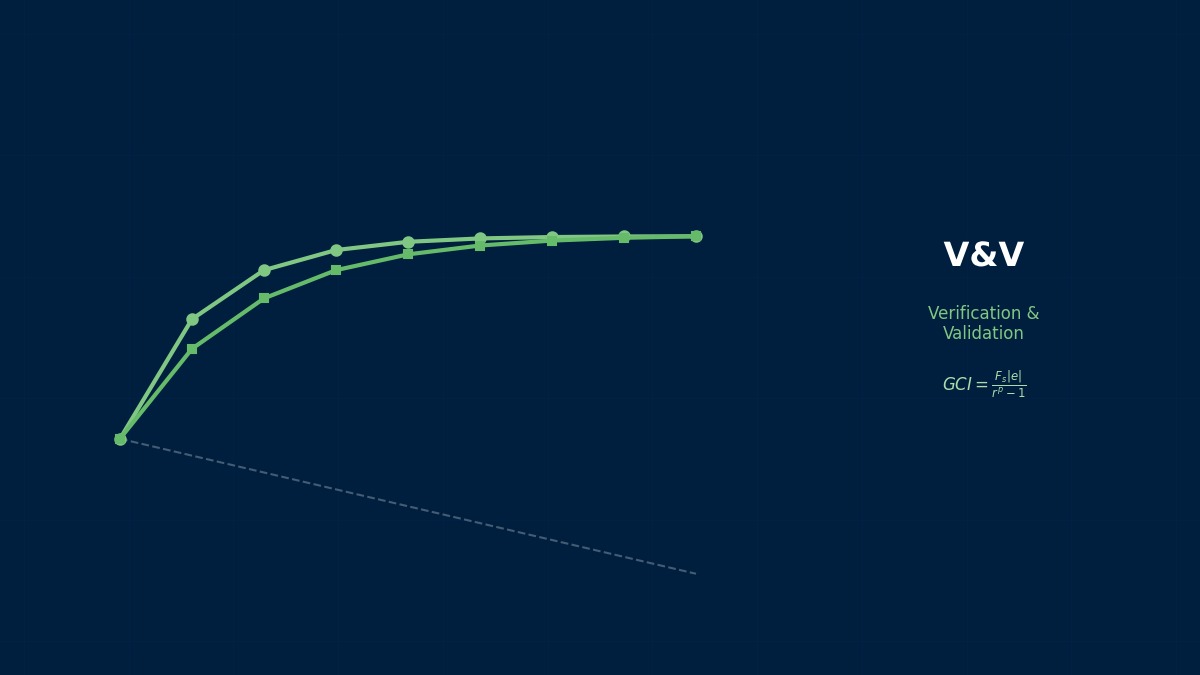
Theory: predicting zero spacing from how error decreases
Overview
Finer grids take so long. Is there a way to estimate a more accurate value from coarser-grid results?
Richardson extrapolation does exactly that. Once grids are fine enough, error falls roughly as spacing to the p-th power, so comparing two results at halved spacing estimates the remaining error; subtracting it approaches the zero-spacing value. But it assumes error falls cleanly with spacing^p — with singularities or grids too coarse, it can mislead. Let's see when it works and when it misses.
The extrapolation formula
$h$ is spacing and $p$ the order. If $p$ is right and higher-order terms are small, the extrapolated error falls faster than $h^p$.
Repeated extrapolation (Romberg)
Assuming a fourth-order error remains after removing the second-order one, extrapolate again — the same idea as Romberg integration, effective when the error expansion has only even powers.
“The deferred approach to the limit”
In 1911 the British scientist Richardson, computing stresses in a masonry dam by finite differences, showed how to estimate the zero-spacing value from calculations at different spacings, and in 1927 discussed it at length as 'the deferred approach to the limit'. He is also known for attempting numerical weather prediction by hand. In 1955 Romberg repeated the idea to sharply raise numerical-integration accuracy. Born as a way to gain accuracy with little computation before electronic computers, the method now serves as a verification tool.
Worked examples
Example 1: a smooth problem (fin heat rate)
A fin with adiabatic tip (mL = 2, exact 1.928055) solved by second-order differences:
| Method | Value | Relative error |
|---|---|---|
| 32 cells | 1.925305 | 1.4×10⁻³ |
| 64 cells | 1.927353 | 3.6×10⁻⁴ |
| Extrapolated (32, 64; p = 2) | 1.9280353 | 1.0×10⁻⁵ |
| Second level (16, 32, 64) | 1.92804431 | 5.6×10⁻⁶ |
Example 2: a non-smooth problem (integral of √x)
∫√x dx (exact 2/3) by the trapezoidal rule. The derivative diverges at x = 0, so error falls only as roughly spacing to the 1.5:
| Method | Relative error |
|---|---|
| 40 intervals (fine) | 1.2×10⁻³ |
| Extrapolated (20, 40), p = 2 assumed | 4.8×10⁻⁴ |
| Extrapolated (20, 40), observed p = 1.47 | 1.8×10⁻⁵ |
The same extrapolation improves 2.5 times or 68 times depending on using the right order.
Extrapolation stakes everything on error falling as spacing^p. With an endpoint singularity like √x, error falls only as the 1.5 power even with a second-order scheme. Assuming 2 misjudges the correction and gains little. Observed order from three grids matches the problem's true behaviour. The same happens in real CFD and structural analysis at corners, contact edges and separation points. The rule: confirm the observed order is stable before extrapolating.
How to use it
- Compute on three or more grids at constant ratio.
- Find observed order and compare with formal; if very different, investigate (singularities, coarse grids).
- If observed order is stable, extrapolate with it.
- Treat the extrapolated value as a better estimate and express uncertainty with GCI.
- Integrated quantities (forces, heat rates) extrapolate more reliably than local ones (point stresses).
“Extrapolation doubled the stress”
In a structural analysis, Richardson-extrapolating peak stress near a corner from three grids gave nearly twice the fine-grid value. Stress kept rising with each refinement, and observed order was only about 0.3. The corner is ideally a singularity with infinite stress — the zero-spacing value to extrapolate to didn't exist. The real part has a small fillet; modelling it made stress converge and the extrapolation meaningful.
Common mistakes
Mistakes and fixes
| Mistake | Effect | Fix |
|---|---|---|
| Assuming formal order | Extrapolation misses | Use observed order |
| Extrapolating at singularities | Non-existent values | Add fillets or evaluate away |
| Grids too coarse | Not asymptotic | Check order stability |
| Extrapolating oscillatory convergence | Misleading values | Use oscillation range |
| Treating the extrapolation as exact | Uncertainty ignored | Express band with GCI |
I'd like to learn related topics.
Try extrapolation with the Richardson extrapolation tool. Related pages include three-grid GCI, Roache's GCI, singularities and meshing, adaptive mesh refinement and solution verification.
Related Topics
Experience the theory firsthand with the interactive simulator for this field
All Simulators