Application Procedure of GCI (Three Mesh Method)
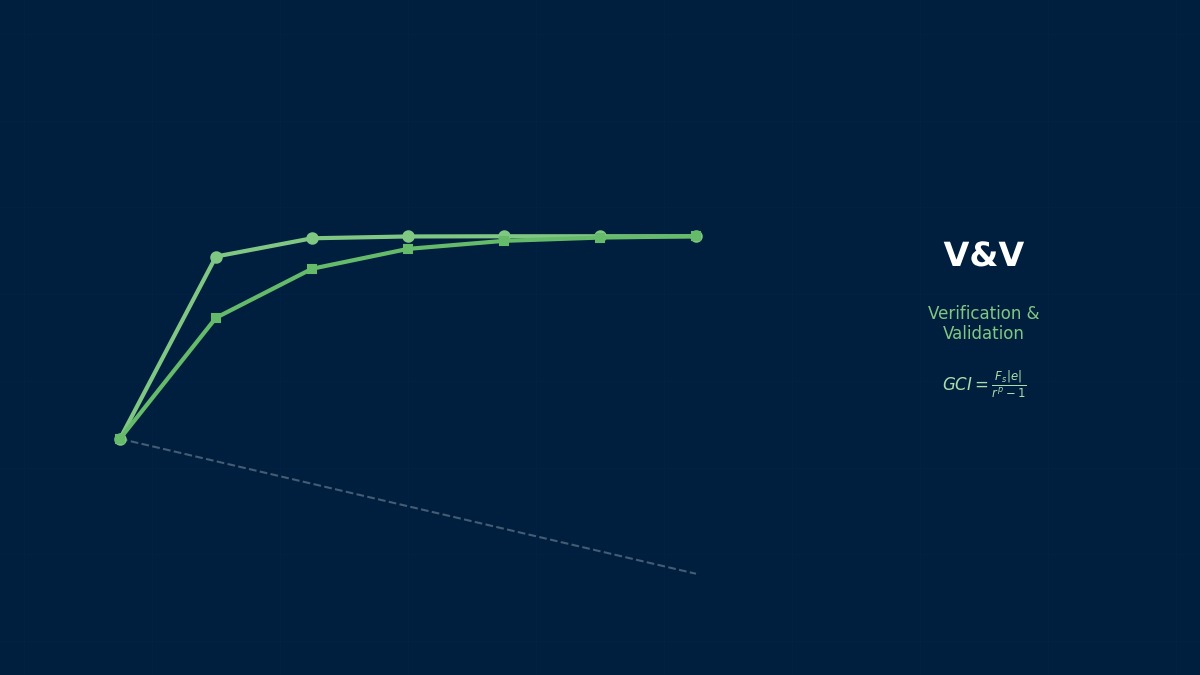
Theory: testing the GCI band
Overview
I reported 'discretisation error ±0.2%' via GCI, but I'm unsure the true error really lies within. Is there a way to check?
Most convincing is setting the GCI band beside the true error on a problem with an exact solution. The GCI derives observed order from three grids and scales the fine-grid difference by a safety factor, but how trustworthy that band is depends on whether the grids are in the asymptotic range and how order and safety factor are handled. Since your own problem has no exact solution, checking the GCI procedure itself on a similar problem that does is reassuring.
The test problem
The dimensionless equation of a fin with an adiabatic tip, with an exact base heat rate $q$. Solved with second-order differences, with the base gradient also second order.
GCI versus true error
If the ratio of true error to GCI is below 1, the GCI band contains the true error.
Where the safety factors 1.25 and 3 come from
Roache gathered many computational examples to see how often the GCI band contained the true error, proposing a safety factor of 1.25 when observed order is confirmed on three or more grids and 3 when order is merely assumed from two grids, for roughly 95% confidence. Similar checks across many flow and heat-transfer problems have since found these numbers broadly sound. Being empirical statistics, they're worth re-checking on an exact-solution problem resembling your own.
Worked example: testing GCI on fin heat rate
For a fin with mL = 2, the exact base heat rate is 1.928055. For each grid triplet, observed order, GCI, true error and their ratio:
| Grids (fine, medium, coarse) | Observed order | GCI | True error | Ratio |
|---|---|---|---|---|
| 8 / 4 / 2 | 1.33 | 3.97% | 2.00% | 0.50 |
| 16 / 8 / 4 | 1.69 | 0.82% | 0.55% | 0.66 |
| 32 / 16 / 8 | 1.85 | 0.19% | 0.14% | 0.74 |
| 64 / 32 / 16 | 1.93 | 0.047% | 0.036% | 0.77 |
| 18 / 12 / 8 (ratio 1.5) | 1.81 | 0.59% | 0.44% | 0.74 |
Every triplet's ratio is below 1 — the true error lies within the GCI band.
Right. With observed order properly computed and safety factor 1.25, the GCI contained the true error for every triplet here. Coarser grids yield observed orders below the formal 2, making GCI larger (conservative). And if you cut corners? Assuming formal order 2 on the coarse 8/4/2 triplet gives a GCI of 2.00% — exactly the true error (ratio 1.00), no margin. Dropping the safety factor to 1 on the fine 64/32/16 triplet gives 0.96 — almost at the edge. Both computing observed order and keeping the safety factor underpin GCI's reliability.
Application steps
- Build three grids refined similarly in all directions with ratio at least 1.3.
- Converge iterations fully on each grid and compute the quantity.
- Check the sign of differences and compute observed order (iterating if ratios vary).
- Compute GCI (Fs 1.25) and the extrapolated value; beware orders far from formal.
- Where possible, verify the procedure on a similar exact-solution problem.
“The GCI was too small”
A design group reported GCI by multiplying the two-grid difference by a safety factor of 1.25 while assuming order 2. A third grid later showed observed order of only 1.2, and the properly recomputed GCI was about three times the reported value. With only two grids, order can't be confirmed, so the rule is a safety factor of 3; 1.25 applies only when order is confirmed on three or more grids. Skipping steps quietly shrinks the apparent error band.
Common mistakes
Mistakes and fixes
| Mistake | Effect | Fix |
|---|---|---|
| Fs 1.25 with two grids | Band too narrow | Fs 3 |
| Assuming formal order | No margin on coarse grids | Compute observed order |
| Ratio too small | Differences lost in iteration error | 1.3 or more |
| Not checking asymptotic range | GCI reliability unknown | Check order stability |
| Never testing the procedure | Unchecked assumptions reported | Verify on exact-solution problems |
I'd like to learn related topics.
Try order and extrapolation with the Richardson extrapolation tool. Related pages include Roache's GCI, Richardson extrapolation, mesh refinement ratio, solution verification and adaptive mesh refinement.
Related Topics
Experience the theory firsthand with the interactive simulator for this field
All Simulators