Acoustic-Structural Interaction
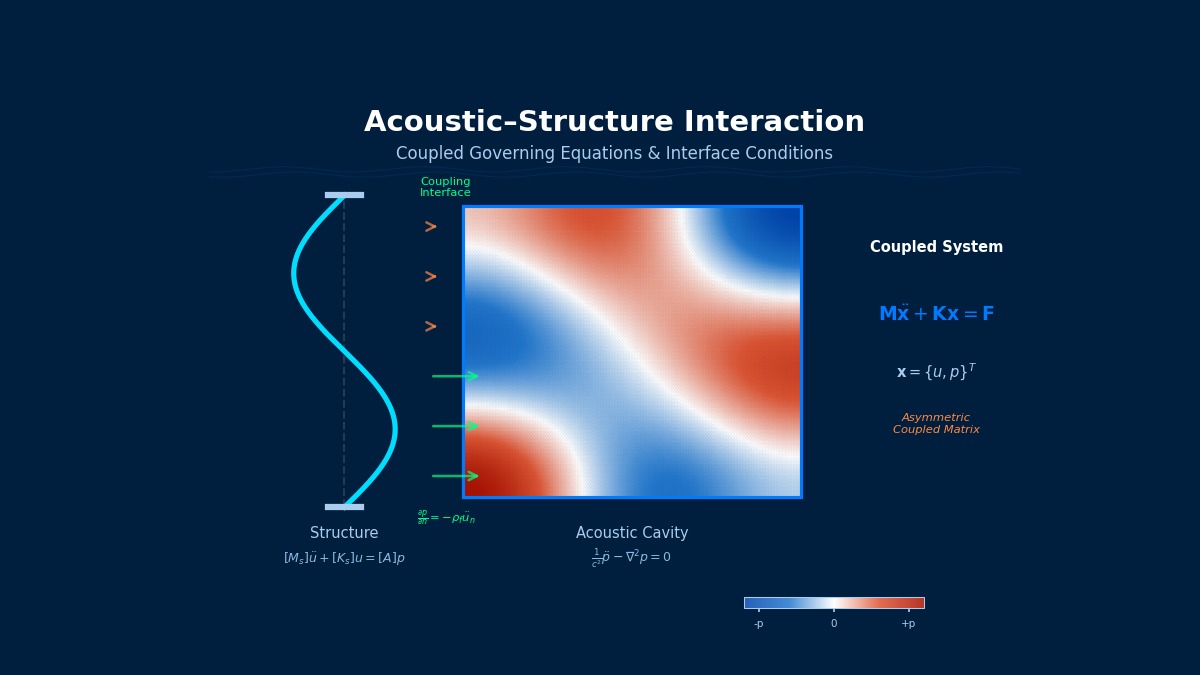
Overview
Professor, does acoustic-structure interaction essentially mean that sound and structure mutually influence each other?
Acoustic-Structural Interaction: Theoretical Foundations
That's right. When a structure vibrates, it pushes the surrounding air or fluid, generating sound waves. Conversely, sound pressure acts as a load on the structure, inducing vibration. This bidirectional coupling is Acoustic-Structural Interaction (ASI).
Specifically, in what situations does it become a problem?
A typical example is vehicle interior noise. Engine vibration excites the body panels, and the panels compress and expand the air inside the cabin, creating the sound heard by occupants. Other examples include aircraft fuselage transmission noise, building sound insulation design, and submarine sonar dome design.
Governing Equations
What equations describe the structural side and the acoustic side, respectively?
The structural side uses the standard equation of motion for an elastic body.
The term $[A]\{p\}$ on the right side is the load term from sound pressure to the structure, and $[A]$ is the coupling matrix. The acoustic side uses the time-domain version of the Helmholtz equation, i.e., the wave equation.
Where do these two connect?
They connect through boundary conditions at the coupling interface. From the acoustic side, the normal velocity at the interface must match the displacement velocity of the structure.
Writing this in matrix form, the entire coupled system becomes an asymmetric equation system.
The asymmetry seems troublesome.
Indeed. In Nastran, using FLUID elements (CAABSF, CHEXA, etc.) internally assembles this asymmetric coupled system. Abaqus provides *TIE constraints for Acoustic-Structural coupling.
Frequency Domain Formulation
Vibration and noise are often discussed in terms of frequency, right?
Assuming harmonic response, we can transform to the frequency domain using $\{u\} = \{\hat{u}\}e^{i\omega t}$, $\{p\} = \{\hat{p}\}e^{i\omega t}$.
Solving for each frequency allows efficient calculation of the Frequency Response Function (FRF).
With this formulation, it's easier to see which modes are problematic at which frequencies.
Exactly. Especially when the natural frequency of the structure is close to the natural frequency of the acoustic cavity, coupled resonance occurs, amplifying the sound pressure. The booming problem in vehicle interiors is a classic example.
Practical Points
What should we be careful about when performing analysis?
First is the acoustic mesh element size. For the maximum analysis frequency $f_{max}$, ensure at least 6 nodes per wavelength are within an element.
For air with $c = 343$ m/s and $f_{max} = 1000$ Hz, $h \leq 57$ mm. For quadratic elements, it can be slightly coarser, but for linear elements, it's better to adhere to this.
I see, with lower-order elements, a fairly fine mesh is needed. I'm starting to get a clearer picture of the overall concept.
"Sound Deforms Structures" – The Phenomenon of Acoustic Radiation Pressure
When learning the theory of acoustic-structural interaction, many people are newly surprised by the fact that "sound pressure exerts force on a structure." In fact, ultrasonic cleaners operate precisely on this principle, where 28–40 kHz sound waves generate microscopic bubbles (cavitation) on the surface of metal parts, physically removing dirt. The sound pressure level can exceed 150 dB. Inaudible to the human ear, yet possessing enough energy to deform metal – the theory of acoustic coupling begins by describing the nature of such "invisible forces" with equations.
Computational Methods for Acoustic-Structural Interaction
Discretization of Acoustic-Structural Coupling using FEM
How is acoustic-structural coupling handled in FEM? The elements are different for structure and acoustics, right?
Good question. The structural side uses standard shell or solid elements, and the acoustic side uses acoustic fluid elements with pressure degrees of freedom. At the coupling interface, the displacement DOFs of the structure and the pressure DOFs of the acoustics are coupled.
How is it done in Nastran?
In Nastran, FLUID elements (acoustic versions of CHEXA, CPENTA, CTETRA) are used, and an ACMODAL surface is defined on the structural face. The coupled system is solved using SOL 108 (Frequency Response) or SOL 111 (Modal Frequency Response).
FEM-BEM Coupling Method
For external radiation problems, the infinite domain is problematic with FEM, right?
Exactly. For internal problems (closed spaces like vehicle interiors), FEM alone is sufficient, but for external radiation problems, it's combined with BEM (Boundary Element Method). Structural vibration is solved with FEM, and the velocity at the radiating surface becomes the boundary condition for BEM.
The Kirchhoff-Helmholtz integral equation for BEM is as follows.
Here, $G = \frac{e^{ikR}}{4\pi R}$ is the 3D free-space Green's function.
So BEM doesn't require volume meshes, making it suitable for external problems.
Yes. Siemens Simcenter 3D (formerly LMS Virtual.Lab) and FFT ASTRA are representative tools for FEM-BEM coupling. HEAD acoustics' ARTEMIS is also boundary element-based.
Statistical Energy Analysis (SEA)
At high frequencies, doesn't the FEM mesh become enormous?
Sharp observation. In the high-frequency range (roughly above 500 Hz for automobiles), modal density becomes extremely high, making the deterministic FEM approach impractical. That's where Statistical Energy Analysis (SEA) is used.
The basic equation of SEA is power balance.
Here, $\eta_{ij}$ is the coupling loss factor, $n_i$ is the modal density of subsystem $i$, and $E_i$ is the energy.
So the method is chosen based on the frequency band.
Yes. Low frequency: FEM, High frequency: SEA, Mid-frequency band: Hybrid FE-SEA (supported by Simcenter 3D's Hybrid FE-SEA and Wave). This selection is fundamental to practical vibration-acoustic analysis.
| Frequency Band | Method | Representative Tools |
|---|---|---|
| Low Frequency (~500 Hz) | FEM / FEM-BEM | Nastran, Abaqus, COMSOL |
| Mid Frequency | Hybrid FE-SEA | Simcenter 3D, Wave6 |
| High Frequency (500 Hz~) | SEA | VA One (ESI), AutoSEA |
Time Domain Explicit Method
What about impact sounds or transient sounds?
They are solved in the time domain. LS-DYNA supports explicit methods for acoustic-structural coupling and is used for transient analysis of airbag deployment sounds and door closing sounds. Abaqus/Explicit also allows coupling with acoustic elements.