Electroactive Polymer (EAP) Analysis
Overview
Professor! Today let us talk about Electroactive Polymer (EAP) analysis, right? What is it about?
Theory: electrodes attract and squeeze the film
Overview
How do dielectric elastomers used as artificial muscles work?
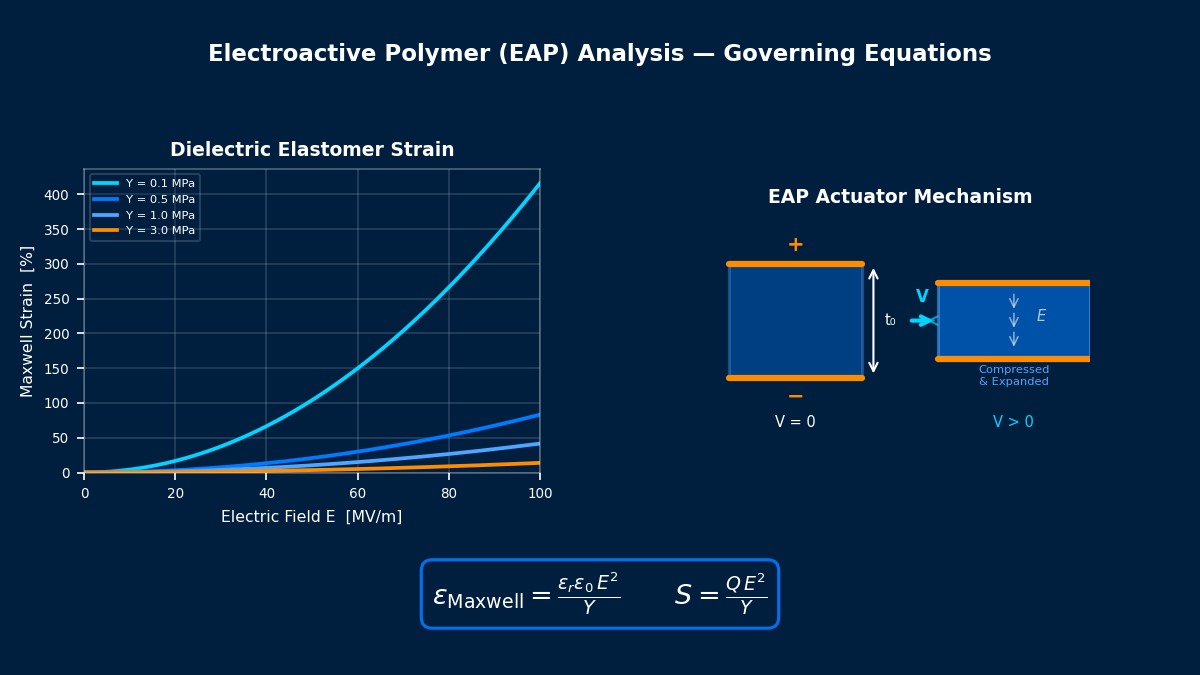
Compliant electrodes that stretch with the film are coated on both faces of a rubber-soft film. Applying voltage, the positive and negative charges on the faces attract and squeeze the film through its thickness; rubber keeps nearly constant volume, so it spreads in-plane as it thins. This squeezing pressure (Maxwell stress) is proportional to field squared. The film is so soft that strains far exceed piezoelectrics, but fields of tens of V/μm are needed. And as the film thins, the same voltage gives a stronger field and higher pressure — positive feedback that collapses it at some point. Estimating this is a key role of coupled analysis.
Maxwell stress and thickness strain
t₀ is original thickness (50 μm), Y Young's modulus and s fractional thickness compression; a small-strain linear approximation.
Pull-in instability
Equilibrium at constant voltage including thinning; for a linear spring no solution exists beyond s = 1/3.
Pelrine's large strains
Röntgen observed rubber films deforming under voltage in the 19th century, but practically large strains were shown only in 2000 by Pelrine and colleagues at SRI International, who reported area expansions over 100% in pre-stretched acrylic and silicone films. Later Zhao, Suo and others explained pull-in instability with large-deformation theory and clarified why pre-stretching avoids it.
Worked examples
Example 1: voltage to compress a 50 μm film
| Material | εr | Modulus | Field for 10% | Voltage for 10% (with thinning) | Voltage for 20% (with thinning) |
|---|---|---|---|---|---|
| Acrylic | 4.7 | 1.0 MPa | 49 V/μm | 2.21 kV | 2.77 kV |
| Silicone | 2.8 | 1.0 MPa | 64 V/μm | 2.86 kV | 3.59 kV |
| Polyurethane | 7.0 | 17 MPa | 166 V/μm | 7.45 kV | 9.37 kV |
Example 2: pull-in voltage (linear approximation)
| Material | Pull-in voltage | Field at pull-in |
|---|---|---|
| Acrylic | 2.98 kV | 89 V/μm |
| Silicone | 3.87 kV | 116 V/μm |
| Polyurethane | 10.1 kV | 302 V/μm |
Strain energy stored at 10% compression is 5 kJ/m³ for a 1 MPa film and 85 kJ/m³ for polyurethane (17 MPa).
If 20% needs 2.8 kV and it collapses at 3 kV, the usable range is quite narrow.
That's with a linear spring. In practice two tricks widen the range. One exploits rubber's sharp stiffening at large stretch, which resists electrostatic squeezing. The other pre-stretches the film in-plane, starting it in the stiff regime where instability is less likely; the thinner film also sees a stronger field at the same voltage, giving large strain at lower voltage. Linear formulas can't capture these, so analysis couples hyperelastic models (neo-Hookean, Ogden etc.) with the electrostatic equations to study equilibrium and stability under large deformation. Dielectric breakdown also matters: required fields approach the film's strength, so it may break down before collapsing.
Analysis workflow
- Fit hyperelastic properties from uniaxial and biaxial tests.
- Treat electrodes as boundaries deforming with the film and couple Maxwell stress.
- Include pre-stretch and frame constraints and ramp voltage gradually.
- Find where equilibrium is lost (instability) and where field exceeds dielectric strength.
- For dynamic use, account for viscoelastic lag and creep.
“A film that failed below the predicted voltage”
In one dielectric-elastomer actuator, the film thinned locally and tore below the design voltage set by linear formulas. The film was thinner near the electrode edge, where the field intensified and local pull-in occurred. Coupled analysis with a hyperelastic model reproduced the deformation concentrating near the edge. Pre-stretching the film and grading the field at the electrode edge allowed stable operation up to design voltage.
Common mistakes
Mistakes and fixes
| Mistake | Effect | Fix |
|---|---|---|
| Ignoring thinning | Field underestimated | Use deformed thickness |
| Linear material at large strain | Instability misjudged | Hyperelastic model |
| No pre-stretch | Performance understated | Include pre-stretch |
| Ignoring breakdown | Breakdown before pull-in | Compare with strength |
| Ignoring edge field concentration | Local tearing | Shape the edges |
I'd like to learn related topics.
Related pages include piezoelectric analysis, magnetostriction, electrostatic MEMS, Lorentz force and magnetic bearings.