Magnetic Bearing Analysis
Overview
Professor! Today let us talk about magnetic bearing analysis. What is it about?
Magnetic Bearing Analysis: Theoretical Foundations
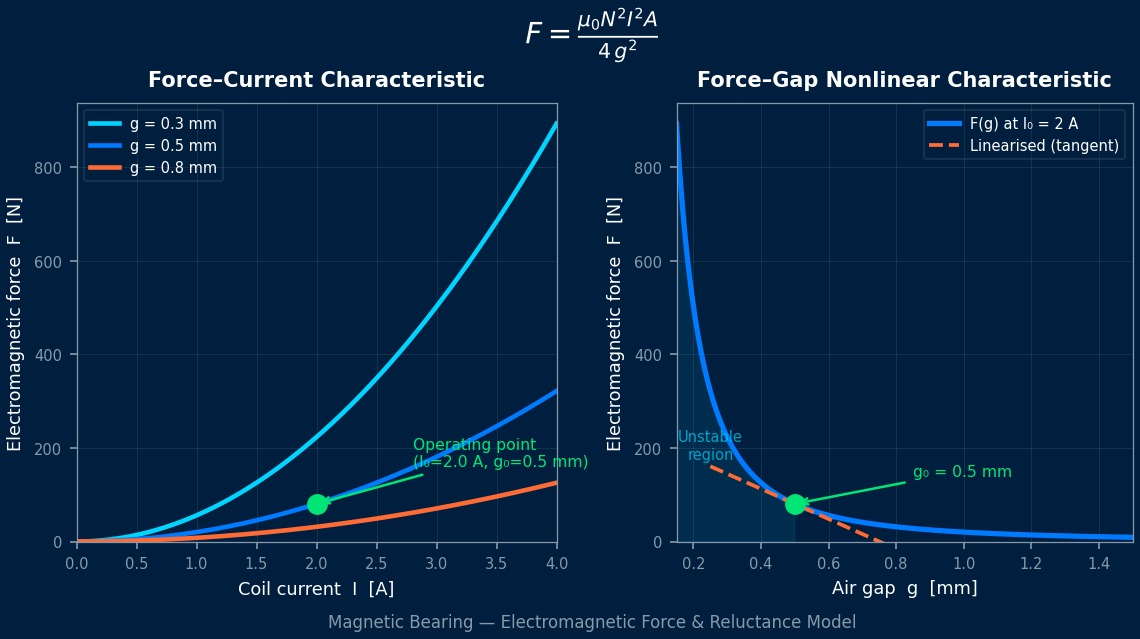
Non-contact support using electromagnets. Essential for high-speed rotation machinery. PID control of current stiffness and displacement stiffness.
Governing Equations
Professor, your explanation is easy to understand! The haze around describing magnetic bearing analysis has cleared up.
Discretization Method
How do you actually solve these equations on a computer?
We use spatial discretization by the Finite Element Method (FEM). We assemble the element stiffness matrix and construct the global stiffness equation.
We perform transformation to the weak form (variational form) and use formulation by the Galerkin method using test functions and shape functions. The choice of element type (low-order elements vs. high-order elements, full integration vs. reduced integration) is directly linked to the trade-off between solution accuracy and computational cost.
Matrix Solution Algorithms
What exactly do you mean by matrix solution algorithms?
We solve the simultaneous equations using direct methods (LU decomposition, Cholesky decomposition) or iterative methods (CG method, GMRES method). For large-scale problems, preconditioned iterative methods are effective.
| Solution Method | Classification | Memory Usage | Applicable Scale |
|---|---|---|---|
| LU decomposition | Direct Method | O(n²) | Small to Medium Scale |
| Cholesky decomposition | Direct Method (Symmetric Positive Definite) | O(n²) | Small to Medium Scale |
| PCG Method | Iterative Method | O(n) | Large Scale |
| GMRES method | Iterative Method | O(n·m) | Large Scale / Non-symmetric |
| AMG Preconditioner | Preprocessing | O(n) | Very Large Scale |
So, if you cut corners on the finite element method part, you'll pay for it later. I'll keep that in mind!
Implementation in Commercial Tools
So, what software can be used to do magnetic bearing analysis?
| Tool Name | Developer/Current | Main File Format |
|---|---|---|
| COMSOL Multiphysics | COMSOL AB | .mph |
| JMAG-Designer | JSOL Corporation | .jmag, .jproj |
| Ansys Mechanical (formerly ANSYS Structural) | Ansys Inc. | .cdb, .rst, .db, .ans, .mac |
| Abaqus FEA (SIMULIA) | Dassault Systèmes SIMULIA | .inp, .odb, .cae, .sta, .msg |
Vendor Lineage and Product Integration History
Is the background of each software quite dramatic?
COMSOL Multiphysics
Tell me about "COMSOL Multiphysics"!
Founded in Sweden in 1986. Started as FEMLAB with MATLAB integration, later renamed to COMSOL. Strong in multiphysics.
Current Affiliation: COMSOL AB
JMAG-Designer
What exactly is JMAG?
Developed by Japan's JSOL Corporation. An electromagnetic field analysis tool specialized for electrical equipment design.
Current Affiliation: JSOL Corporation
Ansys Mechanical (formerly ANSYS Structural)
Tell me about "Ansys Mechanical"!
Developed in 1970 by Swanson Analysis Systems Inc. (SASI). Based on APDL (Ansys Parametric Design Language).
Current Affiliation: Ansys Inc.
Ah, I see! So that's how it was established in Sweden in 1986.
File Formats and Interoperability
Are there any points to note when transferring data between different software?
| Format | Extension | Type | Overview |
|---|---|---|---|
| STEP | .stp/.step | Neutral CAD | ISO 10303 compliant 3D CAD data exchange format. Supports geometry + PMI. |
| IGES | .igs/.iges | Neutral CAD | Early CAD data exchange standard. Has issues with surface data compatibility. Transition to STEP is progressing. |
| VTK | .vtk/.vtu | Visualization | Visualization Toolkit format. Used by ParaView, etc. |
When converting models between different solvers, attention must be paid to the correspondence of element types, compatibility of material models, and differences in the representation of loads and boundary conditions. Particularly, high-order elements and special elements (cohesive elements, user-defined elements, etc.) often cannot be directly converted between solvers.
I see... Formats seem simple at first glance, but they're actually quite deep, aren't they?
Practical Considerations
Are there things like "field wisdom" that aren't covered in textbooks?
Verifying mesh convergence, validating the appropriateness of boundary conditions, and performing sensitivity analysis of material parameters are extremely important.
Additionally, understanding the physical meaning of the analysis results and conducting validation against experimental data are essential.