Effects of Temperature Gradient on Structures — Thermal Stress, Deformation Mechanisms, and FEM Coupled Analysis
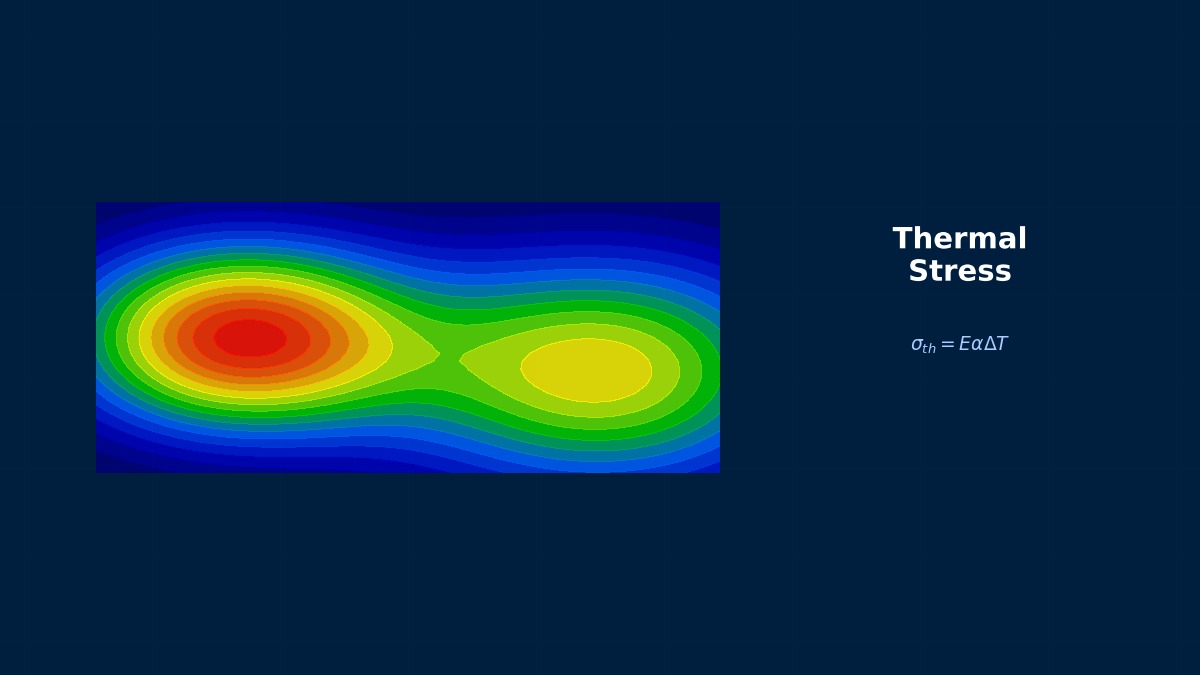
Effects of Temperature Gradient on Structures: Theoretical Foundations
Why Does a Temperature Gradient Generate Stress?
Professor, what kind of impact does a temperature gradient have on a structure? Doesn't it just expand when the temperature rises?
Good question. Indeed, if it's heated uniformly and can expand freely, the stress is zero. However, when a temperature gradient exists, the story is completely different. The high-temperature part tries to expand significantly, while the low-temperature part "doesn't want to expand that much yet"—this internal constraint generates stress even without external constraints.
Huh, stress occurs even without being pressed from the outside? That's counterintuitive...
Yes, this is the core of the temperature gradient problem. Let's think with a concrete example. Imagine a turbocharger turbine housing. The inner surface on the exhaust gas side is about 800°C, while the cooled outer surface is about 500°C. The inner surface wants to expand greatly, but the outer surface holds it back. As a result, compressive stress occurs on the inner surface, and tensile stress occurs on the outer surface. This stress distribution repeats with each engine start and stop, becoming the cause of thermal fatigue cracking.
I see... So the inner and outer surfaces are pulling against each other. Does that mean the larger the temperature difference, the larger the stress?
Exactly. Stress increases in proportion to the temperature difference $\Delta T$. It is also proportional to Young's modulus $E$ and the coefficient of linear expansion $\alpha$. So aluminum ($\alpha \approx 23 \times 10^{-6}$/K) generates about twice the thermal strain of steel ($\alpha \approx 12 \times 10^{-6}$/K), but its Young's modulus is 1/3 that of steel, so the actual magnitude of thermal stress is determined by the combination of material properties.
Fundamental Equation: Thermal Stress in a Constrained Body
How is it expressed quantitatively?
First, consider the most basic case—a uniform material under plane stress, completely constrained. For a temperature change $\Delta T$, the free thermal strain is $\varepsilon_{th} = \alpha \Delta T$, but since it's completely constrained and cannot expand, this amount directly generates stress as elastic strain:
Here, $E$ is Young's modulus, $\alpha$ is the coefficient of linear expansion, and $\nu$ is Poisson's ratio. Dividing by $(1-\nu)$ accounts for the effect of biaxial constraint (constraint in two in-plane directions under plane stress). For uniaxial constraint, the denominator is 1; for triaxial constraint (suppression of volume change), it becomes $(1-2\nu)$. The negative sign indicates "temperature increase → compressive stress".
I'd like to plug in some concrete numbers. For example, for steel with a 100°C temperature difference?
For steel, using $E = 200$ GPa, $\alpha = 12 \times 10^{-6}$ /K, $\nu = 0.3$, the calculation is:
$$\sigma = \frac{200 \times 10^3 \times 12 \times 10^{-6} \times 100}{1 - 0.3} = \frac{240}{0.7} \approx 343 \;\text{MPa}$$
A mere 100°C temperature difference results in 343 MPa—exceeding the yield stress of mild steel (about 250 MPa). Can you see how significant the effect of a temperature gradient is?
Exceeding yield at 100°C! That can't be ignored in design...
Through-Thickness Gradient: Membrane Force and Bending Moment
For cases where the front and back surfaces of a plate have different temperatures, like the turbocharger earlier, is it more complicated?
Yes. For a plate of thickness $h$ with a through-thickness temperature distribution $T(y)$, the temperature effect can be separated into a membrane force component and a bending moment component. Taking the midplane as $y=0$:
Intuitively, $N_{th}$ is the "effect of the entire plate expanding uniformly," and $M_{th}$ is the "effect of the plate warping." If the temperature distribution is symmetric about the midplane, then $M_{th} = 0$ (no warping); if it's antisymmetric, then $N_{th} = 0$ (no expansion, only bending).
For example, if only one side is heated, both membrane force and bending occur, right?
Exactly. For instance, if the top surface of a bridge deck in direct sunlight is 50°C and the shaded bottom surface is 30°C, assuming a linear gradient $T(y) = 40 + 20y/h$, both $N_{th}$ and $M_{th}$ occur. This thermal gradient bending causes long-span bridges to deform into an arch shape by several millimeters during the day—this is considered as a temperature load in bridge design codes.
Bimetallic Strip Curvature Formula
Is the bimetallic strip used in thermostats also an application of temperature gradient?
Good observation. A bimetallic strip is a structure where two types of metal are bonded together, a device that converts temperature changes into curvature changes by utilizing the difference in their coefficients of linear expansion. There's a classical curvature formula derived by Timoshenko (1925):
Here, $m = t_1/t_2$ (thickness ratio of the two layers), $n = E_1/E_2$ (Young's modulus ratio), $h = t_1 + t_2$ (total thickness). When $m = 1$ (equal thickness) and $n = 1$ (equal stiffness), the curvature is maximized—meaning the combination with the same thickness and stiffness but different coefficients of linear expansion bends the most.
I see! This formula could also be used to predict warping in electronic circuit boards.
Exactly. In electronic packaging, when a silicon chip ($\alpha \approx 2.6 \times 10^{-6}$/K) is soldered onto an organic substrate ($\alpha \approx 15 \times 10^{-6}$/K), warping occurs upon cooling from the reflow oven due to the same principle as the bimetallic strip. This is a problem directly related to the reliability of solder joints.
In-Plane Temperature Gradient and Plane Stress
There are in-plane temperature gradients too, right, not just through-thickness?
Yes. For a flat plate with an in-plane temperature gradient $T(x, y)$, the governing equation of thermoelasticity can be written using the stress function $\phi$ as follows:
The $\nabla^2 T$ on the right-hand side is key. If the temperature distribution is a harmonic function (Laplacian = 0)—meaning under steady-state heat conduction with no internal heat source and a smooth temperature distribution—then the right-hand side becomes zero, and an in-plane temperature gradient alone does not generate internal stress. However, this is only true if the boundaries are free. If constrained at the boundaries, stress will of course occur.
The shape of the temperature distribution itself affects stress. Does the result change between steady-state and transient states?
Exactly. In a non-steady (transient) temperature field, $\nabla^2 T = (\rho c_p / k) \, \partial T / \partial t \neq 0$, so internal stress occurs even with free boundaries. Transient states involving rapid temperature changes, like engine startup or jet engine cycles, are the most dangerous—because the maximum temperature gradient occurs at that moment.
The "Invisible Force" Bending Shinkansen Rails
On a summer afternoon, the top surface of Shinkansen rails can reach over 60°C due to solar radiation. Meanwhile, the bottom surface in contact with the ballast (gravel) remains around 40°C. This temperature gradient of about 20°C generates a bending moment in the rail, causing it to warp upward. In long rail sections, this effect accumulates, causing minute deformation of the roadbed called "track irregularity." Since Shinkansen safe operation requires track management on the order of 0.5 mm, this temperature gradient effect is an important parameter in maintenance planning. A similar phenomenon occurs in concrete bridges, where the deck height fluctuates by several millimeters between day and night. "If the temperature differs, the structure will inevitably move"—this simple principle governs infrastructure design.
Computational Methods for Effects of Temperature Gradient on Structures
Sequential Coupled Analysis Flow
What are the steps to analyze the effect of temperature gradient using FEM?
Typically, sequential coupling (one-way coupling) is used. The procedure has two steps:
- Step 1 — Heat Conduction Analysis: Set boundary conditions (convection, radiation, contact thermal resistance, etc.) and solve for the temperature field $T(\mathbf{x}, t)$.
- Step 2 — Structural Analysis: Map the temperature field obtained in Step 1 as a "temperature load" onto the structural model and calculate displacement and stress.
It's a one-way flow from temperature to structure, assuming structural deformation does not affect the temperature field, hence "one-way." This provides sufficient accuracy for many industrial applications.
So you do the two analyses separately. Do you use the same mesh?
Basically, using the same mesh provides more accurate temperature→displacement mapping. However, in practice, the mesh for thermal analysis (refined for fluid boundary layers) and the mesh for structural analysis (refined for stress concentration areas) are often different. In that case, interpolation mapping (nearest neighbor, projection method, RBF interpolation, etc.) is used to transfer the temperature field. In ANSYS Workbench, if the meshes are identical, they can be linked with a single flag, and even with different meshes, automatic mapping is performed.
Discretization of the Heat Conduction Equation
What form does the heat conduction analysis equation take?
Fourier's heat conduction equation is:
$\rho$ is density, $c_p$ is specific heat, $k$ is thermal conductivity, $\dot{q}$ is internal heat generation (e.g., Joule heating). Discretizing with FEM gives:
$$[C]\{\dot{T}\} + [K_T]\{T\} = \{Q\}$$
$[C]$ is the heat capacity matrix, $[K_T]$ is the thermal conductivity matrix, $\{Q\}$ is the heat flux vector. For steady-state analysis, simply solve $[K_T]\{T\} = \{Q\}$ with $\{\dot{T}\} = 0$.
Thermal Load Vector Formulation
After the temperature is found in Step 1, how is it passed to the structural analysis? It's hard to imagine temperature becoming a "load."
Good question. The structural FEM equation is $[K]\{u\} = \{F\}$, but the thermal load goes into the force vector $\{F\}$ on the right-hand side. The element-level thermal load vector is:
$$\{F_{th}\}_e = \int_{\Omega_e} [B]^T [D] \{\varepsilon_{th}\} \, d\Omega$$
Here, $[B]$ is the strain-displacement matrix, $[D]$ is the elasticity matrix, $\{\varepsilon_{th}\} = \alpha \Delta T \{1, 1, 1, 0, 0, 0\}^T$ (3D) is the thermal strain vector. In other words, the thermal strain calculated from the temperature difference $\Delta T$ at each node is converted into equivalent nodal forces.
Ah, so it's "converting expansion due to temperature difference into mechanical load"!
Steady-State vs. Transient Analysis Decision
Should the temperature field be solved as steady-state? Or is transient analysis necessary?
The decision criteria are the comparison between the thermal time constant of the structure and the speed of temperature change. The thermal time constant is $\tau = \rho c_p L^2 / k$, where $L$ is the characteristic length. If the temperature change is sufficiently slow compared to $\tau$ (i.e., it always nearly follows the steady state), then steady-state is OK. For rapid heating/cooling, transient analysis is essential.
| Decision Criteria | Steady-State Analysis | Transient Analysis |
|---|---|---|
| Temperature Change Speed | Slow (minutes ~ hours) | Rapid (seconds ~ minutes) |
| Typical Examples | Steady operation of piping | Engine startup/shutdown |
| Main Concern | Maximum deformation | Stress history & thermal fatigue |
| Computational Cost | Low | High (proportional to number of time steps) |
In cases like turbochargers or gas turbines where the transient temperature gradient during startup is maximum, transient analysis is used to pass the temperature distribution at each time step to the structure. The most dangerous moment is often in the transient state, not the steady state, so "Is steady-state sufficient?" should be judged carefully.
Related Topics
Experience the theory with interactive simulators in this field
Thermal Stress Simulator All Simulators