Electromagnetic Field Simulation of Coplanar Waveguides (CPW)
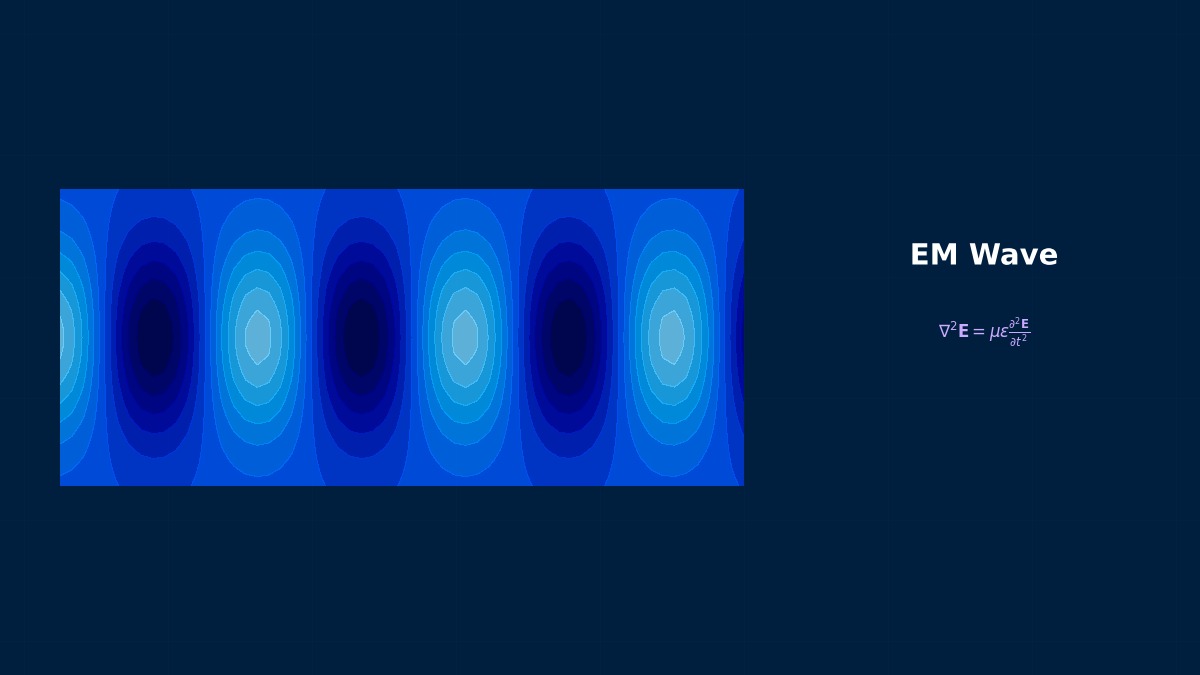
Electromagnetic Field Simulation of Coplanar Waveguides: Theoretical Foundations
Basic Structure of CPW
What's the difference between a coplanar waveguide and a microstrip? They're both transmission lines on a substrate, right?
The major difference is the location of the ground plane. Microstrip has a ground plane on the backside of the substrate, but CPW places the ground planes on both sides of the signal line on the same plane. Looking at the cross-section, it has a G-S-G (Ground-Signal-Ground) structure.
What are the advantages of having the ground on the same plane?
There are three practical benefits.
- No vias required — Since the ground is on the surface, connection vias to the backside are unnecessary. This simplifies component mounting in MMICs and RFICs.
- Easy probe measurement — G-S-G probes can be placed directly on it, making it the standard structure for on-wafer measurements.
- Low dispersion — It propagates in a quasi-TEM mode, resulting in less frequency dispersion compared to microstrip, making it suitable for broadband design.
Since its invention by C.P. Wen in 1969, it has become the de facto standard structure in compound semiconductor circuits like GaAs or InP. Recently, it's also widely used in 5G millimeter-wave front-ends in the 28/39 GHz bands.
The parameters defining the cross-sectional structure of a CPW are as follows.
| Parameter | Symbol | Description | Typical Value |
|---|---|---|---|
| Signal Line Width | $w$ | Width of the center conductor | 10–500 μm |
| Gap Width | $s$ | Spacing between signal line and ground | 5–200 μm |
| Substrate Thickness | $h$ | Thickness of the dielectric substrate | 100–635 μm |
| Conductor Thickness | $t$ | Metallization thickness | 0.5–5 μm |
| Relative Permittivity | $\varepsilon_r$ | Permittivity of the substrate | 2.2 (PTFE) – 12.9 (GaAs) |
Characteristic Impedance and Elliptic Integrals
Is the characteristic impedance of a CPW calculated using empirical formulas like for microstrip?
No, for CPW there is an analytical formula using the complete elliptic integral of the first kind, $K(k)$. It's derived from the conformal mapping method.
The characteristic impedance of a CPW on an infinitely thick substrate (no backside ground) is given by the following equation.
Here, each variable is defined as follows.
- $w$: Signal line width, $s$: Gap width
- $K(k)$: Complete elliptic integral of the first kind $\displaystyle K(k) = \int_0^{\pi/2} \frac{d\theta}{\sqrt{1 - k^2 \sin^2\theta}}$
- $k'$: Complementary parameter of $k$
I've never seen elliptic integrals before... Do you actually calculate this by hand for every design?
No, we don't calculate by hand. There are convenient approximation formulas for the ratio $K(k)/K(k')$, which are often used in practice.
Approximation for $K(k)/K(k')$ (Hilberg approximation):
The error of this approximation is below 0.01% across the entire range, providing sufficient accuracy even with calculator-level computation.
Effective Permittivity
Since the electric field of a CPW is distributed both within the substrate and in the air, the effective permittivity is a weighted average of the substrate's relative permittivity $\varepsilon_r$ and air ($\varepsilon_r = 1$).
Here, $k_1$ is a modified parameter that accounts for the substrate thickness $h$.
Does the effective permittivity change if the substrate is thin?
Yes, it changes. When the substrate becomes thinner, more of the electric field leaks into the air side, so $\varepsilon_{\text{eff}}$ moves away from $\varepsilon_r$ and approaches 1. Conversely, if the substrate is sufficiently thick ($h \gg w + 2s$), then $k_1 \to k$, converging to the infinite-thickness substrate approximation $\varepsilon_{\text{eff}} \approx (\varepsilon_r + 1)/2$. For example, on an alumina substrate ($\varepsilon_r = 9.8$) with $h = 635\,\mu\text{m}$, $w = 50\,\mu\text{m}$, $\varepsilon_{\text{eff}}$ becomes about 5.4.
Loss Mechanisms
What factors determine CPW loss? It seems significant in millimeter-wave, right?
CPW loss can be broken down into three factors. All become more significant as frequency increases, so none can be ignored in millimeter-wave.
The total loss $\alpha_{\text{total}}$ is expressed as the sum of the following three components.
1. Conductor Loss $\alpha_c$
Due to the skin effect, high-frequency currents concentrate on the conductor surface, increasing the effective resistance. The skin depth $\delta_s$ is given by:
For gold (Au), with $\sigma = 4.1 \times 10^7\,\text{S/m}$, $\delta_s \approx 0.79\,\mu\text{m}$ at 10 GHz, and becomes as thin as $\delta_s \approx 0.28\,\mu\text{m}$ at 77 GHz. The conductor thickness $t$ needs to be at least $3\delta_s$.
Does surface roughness also have an effect?
It has a significant effect. When the conductor surface roughness (RMS value $R_q$) is comparable to the skin depth, the current path lengthens, increasing resistance. The Hammerstad-Jensen model applies a correction factor $K_{sr} = 1 + \frac{2}{\pi}\arctan\!\left(1.4\left(\frac{R_q}{\delta_s}\right)^2\right)$ to the conductor loss. In the mmWave band, a difference of 0.1μm in $R_q$ can change insertion loss by 0.5 dB/cm.
2. Dielectric Loss $\alpha_d$
$\tan\delta$ is the substrate's loss tangent. Selection of low-loss substrates is crucial; representative values are shown below.
| Substrate Material | $\varepsilon_r$ | $\tan\delta$ (@10 GHz) | Application |
|---|---|---|---|
| Fused Silica | 3.78 | 0.0001 | High-precision filters |
| Alumina (Al₂O₃) | 9.8 | 0.0003 | MMIC substrate |
| GaAs | 12.9 | 0.0006 | RFIC |
| Rogers RO4003C | 3.55 | 0.0027 | PCB high-frequency circuits |
| FR-4 | 4.4 | 0.02 | Low frequency only (unsuitable for GHz band) |
3. Radiation Loss $\alpha_r$
Electromagnetic waves radiate from CPW discontinuities (bends, T-junctions, gap mismatches) into the substrate. Especially on substrates with high $\varepsilon_r$, surface wave modes are easily excited, becoming a cause of crosstalk to adjacent circuits. Radiation loss increases proportionally to the square of frequency and can become dominant in the mmWave band.
CPW Variant Structures
I heard there are various types of CPW. How do you choose which one to use?
There are three main variant structures. They are chosen based on the design objective.
| Structure | Features | Benefits | Applications |
|---|---|---|---|
| CBCPW (Conductor-Backed CPW) | Ground also on substrate backside | Improved heat dissipation, mechanical strength | Power amplifiers, package internal wiring |
| FGCPW (Finite-Ground CPW) | Ground width limited to finite size | Miniaturization, isolation from adjacent circuits | MMIC, high-density integrated circuits |
| CPW + Air Bridge | Grounds connected by bridges | Suppression of slot-line mode | T-junctions, bends in MMICs |
Particularly, CBCPW (with backside ground) requires caution in simulation. A parallel-plate mode can be excited between the backside ground and the surface ground, coupling with the intended CPW mode. To prevent this...
Related Topics
Experience the theory firsthand with the interactive simulator for this field
All Simulators