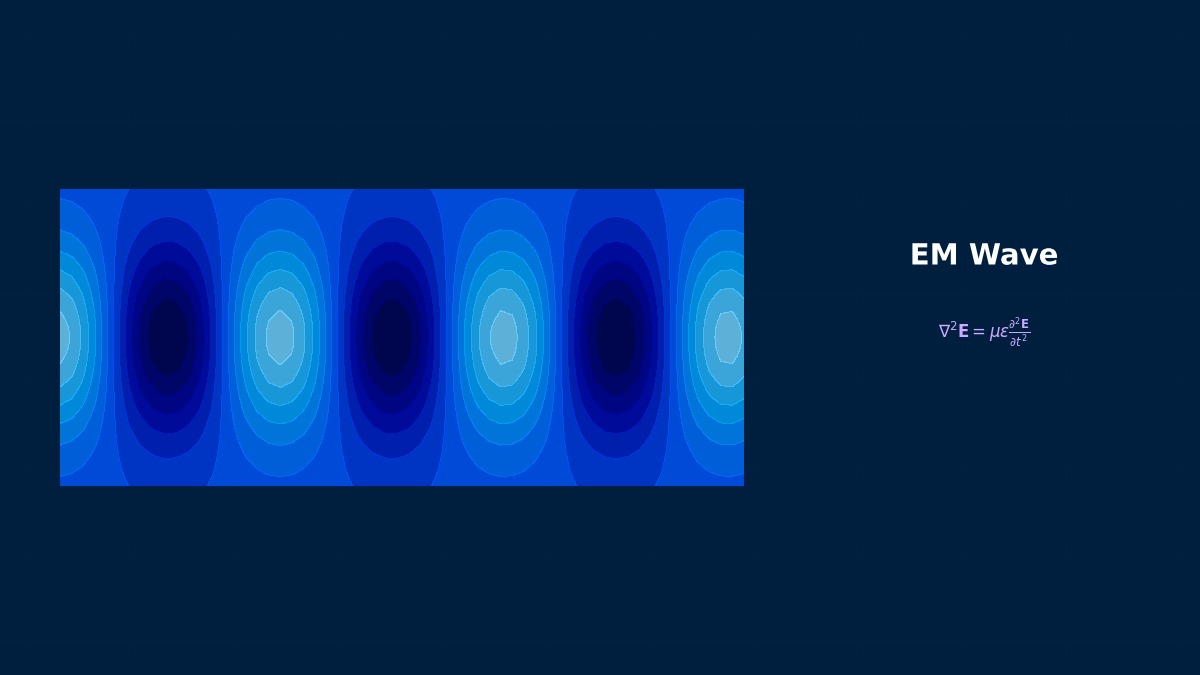
High-Frequency FEM
Theory and Physics
High-Frequency Electromagnetic Field FEM
Professor, what is the governing equation for solving high-frequency electromagnetic fields with FEM?
The Helmholtz equation (frequency domain):
$k_0 = \omega/c = 2\pi f/c$: free-space wavenumber. Discretized using edge elements (Nédélec elements), solving a complex symmetric matrix.
That's the method used by HFSS, right?
Yes. Ansys HFSS is the leading example of frequency-domain FEM. It can analyze complex geometries with high accuracy using tetrahedral meshes + 2nd-order edge elements. Its adaptive meshing feature automatically iterates until S-parameter convergence.
Summary
- Helmholtz Equation — Wave equation in the frequency domain
- Edge Elements — Natural discretization for vector fields
- Complex Symmetric Matrix — Solved by direct or iterative methods
The "Numerical Dispersion" Problem in High-Frequency FEM—Errors Accumulate as Wavelengths Shorten
High-frequency FEM has an inherent problem called "numerical dispersion." It's a phenomenon where the phase velocity of electromagnetic waves propagating within the FEM approximation deviates from the true speed of light. This error becomes larger when the mesh is coarser and the frequency is higher (phase error accumulates proportionally to propagation distance). Countermeasures are: ① Use a finer mesh (element edge length below 1/6 to 1/10 of the wavelength), ② Use higher-order elements (2nd/3rd order polynomials), ③ Adopt methods with less numerical dispersion, such as DG-FEM (Discontinuous Galerkin Finite Element Method). In the millimeter-wave band (30–300 GHz), this problem directly impacts design accuracy.
Physical Meaning of Each Term
- Electric Field Term $\nabla \times \mathbf{E} = -\partial \mathbf{B}/\partial t$: Faraday's law of electromagnetic induction. A time-varying magnetic flux density generates an electromotive force. 【Everyday Example】A bicycle dynamo (generator) generates voltage in a nearby coil by rotating a magnet—a direct application of this law where a changing magnetic field induces an electric field. Induction cooking (IH) heaters also use the same principle, where high-frequency magnetic field changes induce eddy currents in the pot bottom, heating it via Joule heating.
- Magnetic Field Term $\nabla \times \mathbf{H} = \mathbf{J} + \partial \mathbf{D}/\partial t$: Ampère-Maxwell's law. Current and displacement current generate a magnetic field. 【Everyday Example】When current flows through a wire, a magnetic field is created around it—this is Ampère's law. Electromagnets operate on this principle, passing current through a coil to create a strong magnetic field. Smartphone speakers also apply this law: current → magnetic field → force on the diaphragm. At high frequencies (GHz-band antennas, etc.), the displacement current $\partial D/\partial t$ cannot be ignored, describing electromagnetic wave radiation.
- Gauss's Law $\nabla \cdot \mathbf{D} = \rho_v$: Indicates that electric charge is the divergence source of electric flux. 【Everyday Example】Rubbing a plastic sheet against hair makes hair stand up due to static electricity—electric field lines radiate outward from the charged sheet (electric charge), exerting force on the light hair. In capacitor design, the electric field distribution between electrodes is calculated using this law. ESD (electrostatic discharge) countermeasures are also based on electric field analysis following Gauss's law.
- Magnetic Flux Conservation $\nabla \cdot \mathbf{B} = 0$: Expresses the absence of magnetic monopoles. 【Everyday Example】Cutting a bar magnet in half does not create a magnet with only a N pole or only a S pole—N and S poles always exist as a pair. This means magnetic field lines form "closed loops with no start or end points." In numerical analysis, to satisfy this condition, the formulation using vector potential $\mathbf{B} = \nabla \times \mathbf{A}$ is used, automatically guaranteeing magnetic flux conservation.
Assumptions and Applicability Limits
- Linear material assumption: Permeability and permittivity do not depend on magnetic/electric field strength (nonlinear B-H curve needed in saturation region)
- Quasi-static approximation (low frequency): Displacement current term can be ignored ($\omega \varepsilon \ll \sigma$). Common in eddy current analysis
- 2D assumption (cross-section analysis): Effective when current direction is uniform and edge effects can be ignored
- Isotropic assumption: Direction-specific property definitions needed for anisotropic materials (e.g., rolling direction of silicon steel sheets)
- Non-applicable cases: Additional constitutive laws needed for plasma (ionized gas), superconductors, nonlinear optical materials
Dimensional Analysis and Unit Systems
| Variable | SI Unit | Notes / Conversion Memo |
|---|---|---|
| Magnetic Flux Density $B$ | T (Tesla) | 1T = 1 Wb/m². Permanent magnets: 0.2–1.4T |
| Magnetic Field Strength $H$ | A/m | Horizontal axis of B-H curve. Conversion from CGS Oe (Oersted): 1 Oe = 79.577 A/m |
| Current Density $J$ | A/m² | Calculated from conductor cross-section and total current. Note non-uniform distribution due to skin effect |
| Permeability $\mu$ | H/m | $\mu = \mu_0 \mu_r$. In vacuum $\mu_0 = 4\pi \times 10^{-7}$ H/m |
| Electrical Conductivity $\sigma$ | S/m | Copper: approx. 5.96×10⁷ S/m. Decreases with temperature rise |
Numerical Methods and Implementation
FEM Implementation
Please tell me the implementation considerations for high-frequency FEM.
1. Mesh: 5–10 elements per wavelength $\lambda$ (for 2nd-order elements)
2. Port Settings: Set mode patterns for waveguide ports and extract S-parameters
3. Absorbing Boundary: Model open space with PML (Perfectly Matched Layer)
4. Matrix Solver: Iterative methods (GMRES+preconditioner) for large-scale problems. HFSS uses Domain Decomposition Method (DDM) for domain-decomposed parallelization
How about frequency sweeps?
HFSS's Fast Frequency Sweep uses rational function approximation to interpolate S-parameters across the entire band from a few direct solutions. It's very efficient because it doesn't need to solve again at each frequency.
Summary
- $\lambda/5$–$\lambda/10$ Mesh — For 2nd-order elements
- DDM — Domain-decomposed parallelization for large-scale problems
- Fast Frequency Sweep — High-speed via rational function interpolation
Edge Elements (Nedelec Elements)—Why They Are Essential for High-Frequency FEM
If you use regular node elements (Lagrange elements) for high-frequency electromagnetic field FEM, "spurious modes"—fake eigenmodes that don't physically exist—appear. Edge elements (also called Nedelec elements or Whitney elements) were developed to prevent this. They assign degrees of freedom not to nodes but to element edges, automatically satisfying the ∇·E=0 (zero divergence of electric field) condition. Almost all major high-frequency FEM tools, including HFSS, are based on edge elements. If asked "Why does HFSS use Nedelec elements?", the simplest answer is "to eliminate spurious solutions."
Edge Elements (Nedelec Elements)
Elements specialized for electromagnetic field analysis. Automatically guarantee continuity of tangential components, eliminating spurious modes. Standard for 3D high-frequency analysis.
Nodal Elements
Used for scalar potential formulations. Effective for scalar potential methods in magnetostatics and electrostatic field analysis.
FEM vs BEM (Boundary Element Method)
FEM: Handles nonlinear materials and inhomogeneous media. BEM: Naturally handles infinite domains (open region problems). Hybrid FEM-BEM is also effective.
Nonlinear Convergence (Magnetic Saturation)
When analyzing magnetic circuits with iron cores, the B-H curve becomes nonlinear in the saturation region, requiring iterative solution of nonlinear equations. Newton-Raphson method is commonly used. Convergence criteria: relative residual < 1e-4. Divergence often occurs when the initial permeability is set too high; starting with a linear solution as the initial guess is effective.
Related Topics
なった
詳しく
報告