Aerodynamic Analysis of Sports Equipment
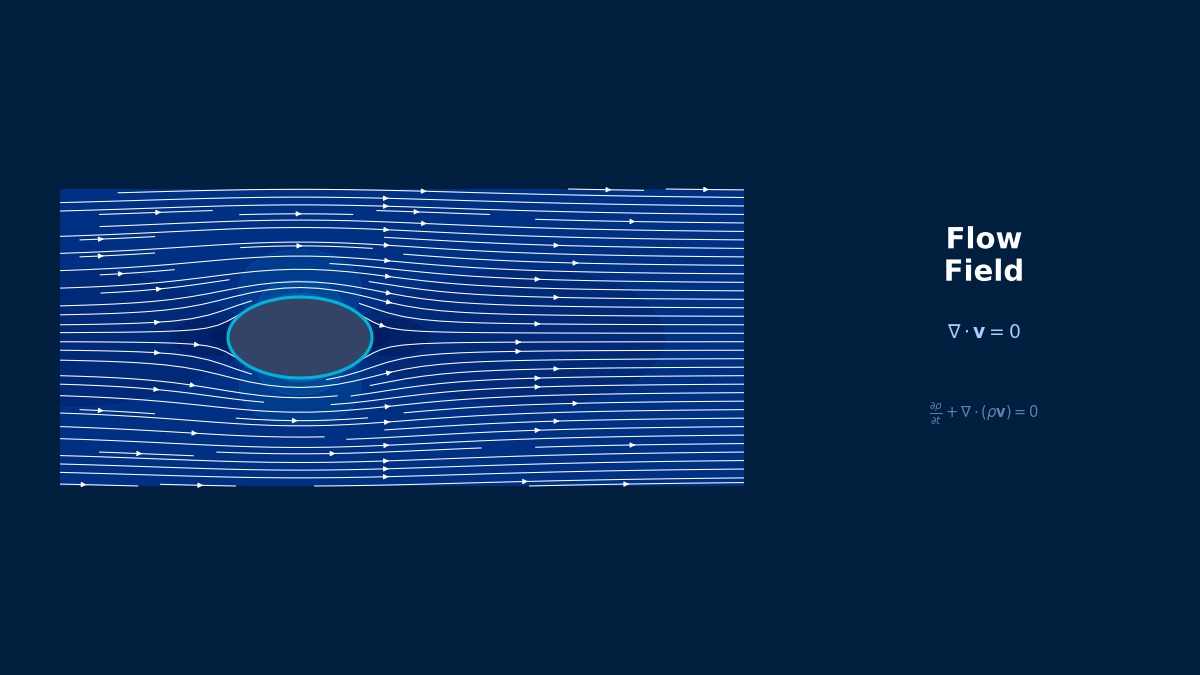
Aerodynamic Analysis of Sports Equipment: Theoretical Foundations
Overview
Professor, what kind of items are targeted for aerodynamic analysis of sports equipment?
Items where aerodynamics directly affect performance, such as golf balls, soccer balls, tennis balls, bicycle helmets, and ski jumping suits.
Especially for balls, surface texture (dimples, panel seams) has a dramatic impact on drag. Compared to a smooth sphere's $C_D \approx 0.47$, the dimples on a golf ball reduce $C_D$ to about 0.25, nearly halving it.
Does surface roughness really change drag that much?
Governing Equations and Drag Crisis
The aerodynamic drag on a sphere is expressed by the following equation.
Here $A = \pi d^2/4$ is the sphere's frontal projected area.
Sphere drag exhibits a dramatic phenomenon called the "drag crisis." When the Reynolds number exceeds a certain critical value, the boundary layer transitions from laminar to turbulent, causing the separation point to move downstream and the wake to shrink. As a result, $C_D$ drops sharply.
So the dimples on a golf ball promote turbulent transition, causing the drag crisis to occur at a lower Reynolds number.
Exactly. A golf ball's initial velocity is about 70 m/s, $Re \approx 2 \times 10^5$. A smooth sphere would still be in the high-drag regime, but thanks to the dimples, it enters the low-drag regime. This nearly doubles the flight distance.
Magnus Effect
A rotating sphere experiences a Magnus force.
Spin parameter:
Here $\omega$ is the angular velocity, $d$ is the sphere's diameter. Larger $S$ results in greater deflection.
| Sport | Typical $S$ | Effect |
|---|---|---|
| Golf (backspin) | 0.1--0.3 | Lift extends flight distance |
| Soccer (curve) | 0.1--0.5 | Lateral deflection (curve) |
| Tennis (topspin) | 0.2--0.6 | Downward force alters bounce |
| Baseball (slider) | 0.1--0.3 | Lateral movement |
Is the wobbling of a knuckleball (no-spin shot) in soccer also an aerodynamic phenomenon?
Yes. With no spin ($S \approx 0$), the Kármán vortex street behind the sphere becomes unstable, causing lateral forces to fluctuate randomly over time. This is the cause of the irregular trajectory change known as the "knuckle effect." LES is essential for reproducing this in CFD.
Sports Equipment-Specific Challenges
- Surface texture resolution: 10--20 cells per dimple required, tens of millions of cells for an entire golf ball
- Handling rotating bodies: Sliding Mesh or Overset Mesh
- Low-Re transition: Transition model ($\gamma$-$Re_\theta$) is essential
- Unsteady vortices: LES or DDES required
- Flight trajectory: Coupling of 6DOF motion model with CFD
The Fluid Dynamics of Baseball Seams Creating Magical Pitches
The seams on a baseball aren't just for decoration. The seams create asymmetric surface roughness, causing turbulent transition to occur earlier on one side. This asymmetric transition generates lateral force, creating the movement of "gyroballs" and "two-seam fastballs." Precise modeling of the seams in CFD can reproduce the phenomenon where changing the seam angle by just a few degrees reverses the direction of the lateral force. It's interesting that the baseball rule "the number and arrangement of seams are regulated" actually maintains an aerodynamically exquisite balance.
Computational Methods for Aerodynamic Analysis of Sports Equipment
Numerical Methods
Please tell me about the numerical methods used for aerodynamic analysis of balls.
Unsteady aerodynamic analysis of rotating spheres is computationally expensive. Proper selection of methods is crucial.
| Method | Cell Count | Application | Accuracy |
|---|---|---|---|
| Steady RANS | 5--20 million | Rough estimate of average $C_D$ | Medium |
| URANS | 10--30 million | Average aerodynamics of rotating balls | Medium--High |
| DDES | 30--100 million | Unsteady aerodynamics, vortex structures | High |
| LES | 50--300 million | Knuckle effect, drag crisis | Highest |
Resolving the dimples on a golf ball must require a huge number of cells.
LES for a golf ball (diameter 42.7mm, 300--500 dimples) requires 100--300 million cells. However, approaches that substitute the dimple effect with an equivalent roughness model are also being researched. This is a method that sets an equivalent sand-grain roughness $K_s$ in the wall function.
Mesh Strategy for Rotating Spheres
There are two approaches for CFD meshing of rotating spheres.
1. Sliding Mesh Method
- Set a rotating region around the sphere and physically rotate it
- High accuracy but computationally expensive
- Time step: $\Delta t \cdot \omega \cdot d < 1°$ (less than 1 degree rotation per step)
2. MRF + Wall Rotation Speed
- Steady approximation. Apply rotating wall condition to the sphere surface
- Only the steady component of the Magnus force can be predicted
- Cannot capture the dynamics of unsteady vortices
Is $y^+=1$ necessary for the boundary layer on the sphere surface?
$y^+ < 1$ is essential for predicting the drag crisis. Since the transition location in the boundary layer governs $C_D$, resolving the viscous sublayer determines accuracy.
Soccer Ball Analysis Example
Soccer ball panel seams affect aerodynamics.
- 32-panel (traditional): Many seams, strong surface roughness effect. Drag crisis occurs at low Re
- 6-panel (Jabulani type): Fewer seams, closer to smooth. Unstable behavior with no spin
- Analysis key point: Model seam grooves geometrically and capture unsteady vortices with LES
So the 2010 World Cup Jabulani ball was said to "wobble" precisely because of these aerodynamic characteristics.
Yes. Having fewer panels and shallower seams made the drag crisis transition sharper, destabilizing vortex shedding with no spin and generating large lateral force fluctuations.
Bicycle Aerodynamics
Bicycle aerodynamic analysis has also become popular recently. The rider's body accounts for 70--80% of the total drag.
- Helmet: Vent placement can cause a 5--10% difference in $C_D$
- Rider posture: Upper body angle causes large variation in $C_DA$, from 0.20--0.35 m^2
- Drafting: Entering the wake of a rider ahead reduces drag by 30--40%
So the rider's body is the biggest source of aerodynamic drag. That means form is more important than equipment.
Why Rider Body Orientation is Most Important for Road Bike Aerodynamics
The first surprise in CFD analysis of road bikes is the fact that "the rider's body accounts for about 70-80% of the total drag." No matter how aerodynamically refined the equipment (frame, wheels) becomes, it can be negated just by the rider lifting their helmet slightly. In pro team CFD, they scan the rider to create a life-size 3D model and search for the optimal position that minimizes CdA (drag area) by changing the riding posture angle in 1-degree increments. "Posture over equipment" is an answer quantitatively proven by CFD.
Experience the theory firsthand with the interactive simulator for this field
All Simulators