Cleanroom Airflow Analysis
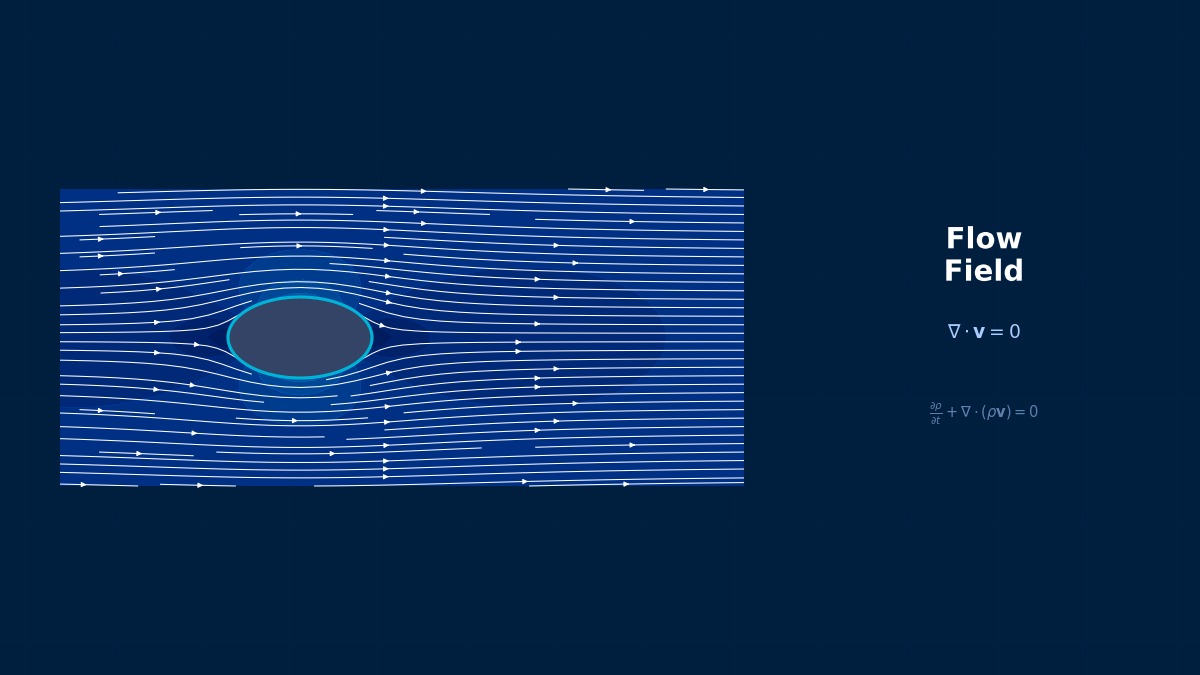
Cleanroom Airflow: Theoretical Foundations
Overview
Teacher! Cleanroom airflow analysis is the one used in semiconductor factories and such, right? What kind of physics is involved?
Cleanroom airflow analysis is a technology that uses CFD to predict airflow patterns like unidirectional flow (uniflow) and turbulent displacement methods to maintain indoor cleanliness. To achieve the cleanliness classes (Class 1 to Class 9) defined by ISO 14644-1, it analyzes how the supply airflow from FFUs (Fan Filter Units) transports and exhausts particles.
I see, so it means the cleanliness class can be verified numerically.
Governing Equations
The equation used in airflow analysis is the Navier-Stokes, right? How about particle tracking?
First, the continuous gas phase is solved using RANS-based Navier-Stokes equations. Incompressibility is often assumed.
The continuity equation and Navier-Stokes equations are as follows.
The filter part of the FFU is represented by a porous media model. Darcy-Forchheimer resistance is included.
$\alpha$ is the permeability and $C_2$ is the inertial resistance coefficient, right? Can these be back-calculated from filter catalog values?
For HEPA filters, a typical value is a pressure drop of about 250 Pa at a face velocity of 0.45 m/s. $\alpha$ and $C_2$ are calculated from this and the filter thickness. For particle tracking, the DPM (Discrete Phase Model) is used, solving the particle equation of motion.
You even include Brownian force? So for submicron particles, Brownian motion becomes significant, right?
Yes, for particles below 0.1 um, Brownian diffusion becomes dominant. The Cunningham correction factor $C_c$ is also needed.
Turbulence Model Selection
What turbulence model is suitable for cleanrooms?
In unidirectional flow cleanrooms, near-laminar and turbulent regions coexist, so the SST $k$-$\omega$ model is recommended. This is because it naturally handles low-Re near-wall treatment.
| Turbulence Model | Recommendation | Features |
|---|---|---|
| SST k-omega | High | Low-Re wall treatment, strong for separation prediction |
| Realizable k-epsilon | Medium | General-purpose but requires wall functions |
| RNG k-epsilon | Medium | Slightly better for swirling flows |
| LES (Smagorinsky) | Very High (High Computational Cost) | Directly resolves unsteady vortex structures |
So SST k-omega is common in actual semiconductor fab projects. Is LES for research purposes?
Exactly. However, recently LES is increasingly used for unsteady analysis of disturbances caused by human movement within cleanrooms.
Practical Considerations
Please tell me the key points to be careful about on-site.
- Simultaneous consideration of human body heat generation (approx. 75 W/person) and particle emission (approx. 5000 particles/min with Class 5 garments)
- Verification that FFU face velocity uniformity meets ISO standard requirements
- Modeling of the underfloor return plenum significantly affects pressure distribution
- Consideration of buoyancy-driven flow via Boussinesq approximation (when temperature difference is 5 K or more)
You even include human body particle emission models in the CFD. This is specific to cleanrooms, very informative.
The Truth Behind HEPA Filter's "99.97%" Number
When learning the theory of cleanroom airflow, one cannot avoid the collection efficiency of HEPA filters. "99.97% or more collection of 0.3μm particles" is a worst-case value, meaning this size is the most likely to pass through. Why 0.3μm? Sub-micron particles smaller than this are dominated by Brownian motion and collide easily with fibers, while larger particles are easily captured by inertia. Around 0.3μm is a transitional region where "inertia is small and Brownian motion is weak," making it the most challenging size. When performing particle tracking in cleanroom CFD, it is important to set the particle size range with an understanding of this distribution characteristic.
Computational Methods for Cleanroom Airflow
Details of Numerical Methods
When actually solving cleanroom CFD, it's the finite volume method, right? How do you choose the specific discretization scheme?
Cleanroom airflow is low-Mach number incompressible flow, so a pressure-based solver is used. Pressure-velocity coupling is solved using SIMPLE-family algorithms (SIMPLE, SIMPLEC, PISO).
Pressure-Velocity Coupling
Is there a distinction in when to use SIMPLE vs. SIMPLEC?
For steady-state analysis, SIMPLEC is recommended (no pressure correction under-relaxation needed, faster convergence). For unsteady analysis, PISO is recommended (fewer iterations per time step). The Coupled Solver is also an option but has high memory consumption.
| Algorithm | Steady/Unsteady | Features |
|---|---|---|
| SIMPLE | Steady | Basic method, requires adjustment of under-relaxation factors |
| SIMPLEC | Steady | Fast convergence, recommended for cleanrooms |
| PISO | Unsteady | Suitable for unsteady analysis of human movement |
| Coupled | Both | Robust but 2-3x memory usage |
Spatial Discretization
Which scheme is good for the convection term?
Cleanrooms involve low-speed flow (around 0.3~0.5 m/s), so numerical diffusion can easily become a problem. Second Order Upwind or higher is recommended.
- Convection Term: Second Order Upwind (minimum), QUICK (for hexahedral meshes)
- Diffusion Term: Central Differencing (second-order accuracy)
- Pressure Interpolation: PRESTO! (when Boussinesq buoyancy is present) or Second Order
- Gradient: Least Squares Cell-Based is stable
The QUICK scheme can't be used with tetrahedral meshes, right?
Exactly. QUICK assumes structured or hexahedral meshes. For polyhedral meshes, Second Order Upwind is a safe choice.
DPM Implementation Details
Please tell me the specific settings for particle tracking.
In DPM, particle trajectories are tracked via time integration. Typical settings for cleanroom analysis are as follows.
| Parameter | Recommended Value | Remarks |
|---|---|---|
| Particle Size Distribution | Rosin-Rammler (0.1~10 um) | Target particle sizes per ISO 14644-1 |
| Number of Particles | 10,000 or more / injection surface | Statistical reliability |
| Integration Method | Trapezoidal | Balance of accuracy and speed |
| Brownian Force | ON (dp < 1 um) | Essential for submicron particles |
| Saffman Lift Force | ON | Improves behavior near walls |
| Wall Condition | Trap/Reflect | Deposition vs. rebound |
10,000 or more particles is quite a lot. What's the impact on computation time?
For one-way coupling, DPM only tracks particles post-process after the gas phase calculation, so the additional cost is only about 10-20% of the total. Particle concentration in cleanrooms is low, so one-way coupling is sufficient.
Mesh Strategy
Cleanrooms are large spaces, but what's a rough guideline for mesh count?
For a typical semiconductor fab bay (10m x 20m x 3m), 5 million to 20 million cells is a guideline. Local refinement is essential for FFU supply surfaces and wafer surroundings, with minimum cell sizes around 5~10 mm.
- FFU Supply Surface: 5~10 mm (to capture face velocity distribution)
- Human Body Surroundings: 10~20 mm (heat/particle emission sources)
- Wafer/Work Surroundings: 5~15 mm (cleanliness evaluation points)
- Main Flow Region (Ceiling to Floor): 50~100 mm
- Underfloor Plenum: 30~80 mm
The underfloor plenum mesh also needs to be fairly fine, huh. Does it affect pressure loss?
The underfloor plenum has a grating floor with about 25% open area, causing significant pressure loss. It can sometimes be simplified with a porous jump condition, but full modeling is necessary when local flow maldistribution becomes a problem.
Related Topics
Experience the theory firsthand with the interactive simulator for this field
All Simulators