HVAC Air Conditioning CFD
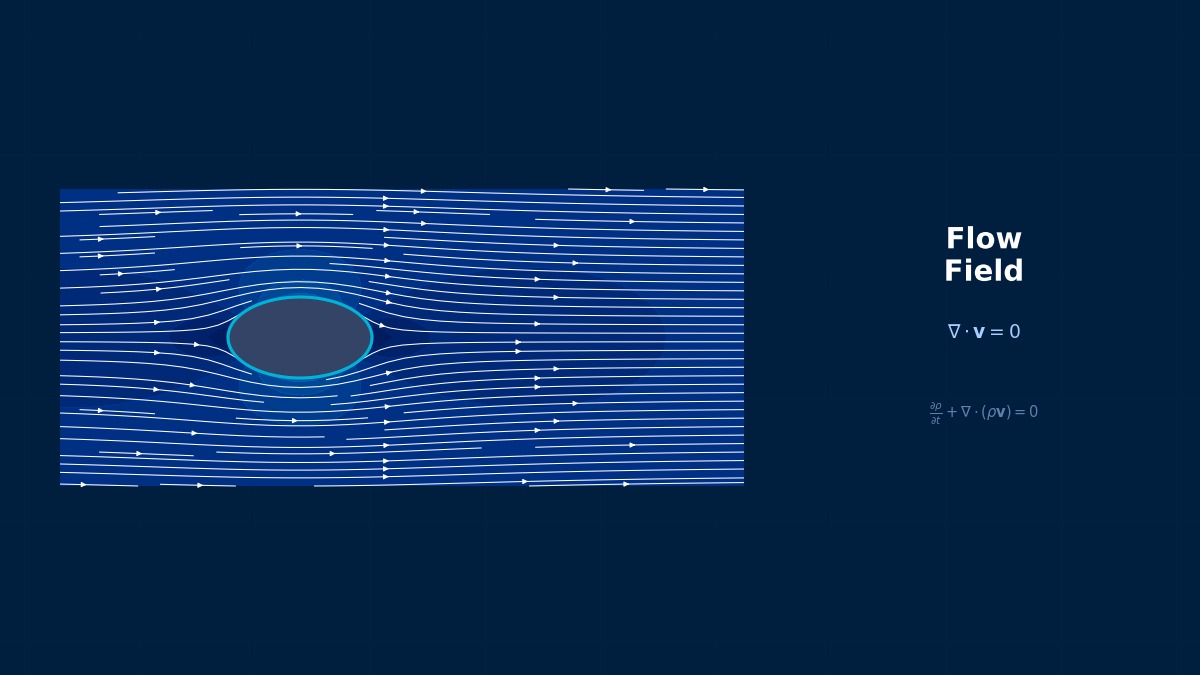
HVAC Air Conditioning CFD: Theoretical Foundations
Overview
Teacher! In what situations is CFD analysis used for HVAC air conditioning?
It's a technology that uses CFD to predict airflow distribution, temperature distribution, ventilation efficiency, and comfort (PMV/PPD) for indoor environments such as offices, commercial facilities, data centers, and hospitals. It is widely used from performance verification in the design stage of air conditioning equipment to renovation plans for existing buildings.
Governing Equations
Please tell me the governing equations for indoor airflow.
The basics are the incompressible Navier-Stokes equations + energy equation for low-speed flow (Mach number < 0.3). Buoyancy effects are incorporated using the Boussinesq approximation.
This term is added as a source term to the Navier-Stokes equations. $\beta$ is the volumetric expansion coefficient (for air, $\beta \approx 1/T_0$ [1/K]).
The Boussinesq approximation is for small temperature differences, right? For indoor air conditioning, up to what temperature difference is it acceptable?
The condition is $\beta \Delta T \ll 1$, so for air, it's reasonable for $\Delta T < 30$ K or so. For indoor air conditioning, it's usually within 10 K, so it's not a problem.
Comfort Indicators
How is PMV (Predicted Mean Vote) calculated in CFD?
PMV is a thermal comfort indicator defined in ISO 7730, calculated from six parameters.
| Parameter | Symbol | How to obtain from CFD |
|---|---|---|
| Metabolic rate | M | Set from activity level (office work: 1.2 met) |
| Clothing insulation | I_cl | Set from season/use (summer clothing: 0.5 clo) |
| Air temperature | T_a | Directly obtained from CFD results |
| Mean radiant temperature | T_r | Calculated from CFD + radiation model |
| Air velocity | v_a | Directly obtained from CFD results |
| Relative humidity | RH | Calculated via Species Transport, or assumed uniform |
If mean radiant temperature is needed, then the radiation model must also be turned ON, right?
Correct. Use the S2S (Surface-to-Surface) model or DO (Discrete Ordinates) model to calculate radiative heat transfer between wall surfaces and determine T_r at each point.
Ventilation Efficiency Evaluation Indicators
What kind of indicators are there for ventilation efficiency?
Here is a summary of typical indicators.
| Indicator | Definition | Meaning |
|---|---|---|
| ACH (Air Changes per Hour) | Q / V_room | Air change rate |
| AE (Air Exchange Efficiency) | τ_n / (2τ_mean) | Fresh air distribution efficiency |
| SVE (Contaminant Removal Effectiveness) | C_e / C_mean | Pollutant removal efficiency |
| Local Mean Age of Air | τ(x) | Air residence time at each point |
How is Local Mean Age of Air calculated in CFD?
Add a scalar transport equation to calculate the mean residence time of air. In Fluent, use UDS (User Defined Scalar).
Since the source term is $\rho$ (uniform), $\tau$ becomes larger the longer air stays in the room, right?
The Origin of HVAC CFD—Indoor Airflow Analysis Born from 1970s Building Energy Issues
CFD analysis of indoor airflow (Room CFD) became full-fledged after the 1970s oil crisis, when the need for energy-efficient building design increased. Initially, simple mixed-air models called Zone Models were mainstream, but with the spread of computers, Navier-Stokes solvers began to be applied to indoor airflow. Nielsen (1974) first published k-ε model analysis of indoor airflow, providing a scientific basis for supply/return outlet design. This was the starting point for modern CFD-HVAC analysis. 40 years later, unsteady LES analysis with millions of cells has become standard, enabling real-time prediction of ventilation efficiency and occupant thermal comfort (PMV indicator).
Computational Methods for HVAC Air Conditioning CFD
Details of Numerical Methods
Please tell me the specific implementation for HVAC CFD.
Turbulence Model Selection
For indoor airflow, SST k-omega or RNG k-epsilon is recommended. Especially for ceiling-supply mixing ventilation, SST k-omega is preferred because wall jet behavior is important.
| Ventilation Method | Recommended Turbulence Model | Reason |
|---|---|---|
| Mixing ventilation (ceiling supply) | SST k-omega | Captures wall jet separation |
| Displacement ventilation (floor supply) | RNG k-epsilon | Handling of laminar-turbulent transition region |
| Personal ventilation | SST k-omega | Accuracy for low-velocity jets |
| Natural ventilation | SST k-omega + Boussinesq | Compatible with buoyancy-driven flow |
Supply Outlet Modeling
Air conditioning supply outlets have complex shapes, right? Do you mesh them all?
Meshing the entire internal shape of a diffuser is inefficient. Instead, use the Simplified Diffuser Model (SDM). It's a method of directly applying a velocity profile (wind speed, angle, turbulence quantities) to the supply outlet surface.
Common settings by diffuser type:
| Diffuser | Supply Angle | Effective Area Ratio | Turbulence Intensity |
|---|---|---|---|
| 4-way ceiling cassette | Horizontal ~ 15° down | 50–70% | 10–15% |
| Anemostat | Radial, 45° | 60–80% | 15–20% |
| Linear diffuser | Horizontal | 70–90% | 10% |
| Pan louver | Variable (0–60°) | 80–95% | 5–10% |
| Floor supply outlet | Vertical upward | 20–40% | 20–30% |
What is the effective area ratio?
It's the ratio of the effective supply area to the diffuser neck area. It's the area excluding parts shadowed by louvers or fins. Verify CFD validity by cross-referencing with the Coanda effect reach distance listed in manufacturer catalogs.
Mesh Strategy
What is a guideline for mesh count in indoor spaces?
For a typical office (10m x 15m x 3m), 2 million to 10 million cells is a guideline.
| Region | Cell Size |
|---|---|
| Supply/Return outlet vicinity | 10–30 mm |
| Human body / furniture vicinity | 20–50 mm |
| Occupied zone (FL+0.1m ~ FL+1.8m) | 30–80 mm |
| Ceiling vicinity (jet region) | 20–50 mm |
| Other (space center) | 80–200 mm |
Radiation Model Settings
Which radiation model should I use?
For indoor environments, the S2S (Surface-to-Surface) model is recommended. It pre-calculates View Factors between wall surfaces to evaluate radiative heat transfer. The DO model can also be used, but for indoor environments with only opaque walls, S2S is sufficient.
Wall surface emissivity settings:
| Surface | Emissivity |
|---|---|
| Concrete wall | 0.90–0.95 |
| Glass window | 0.84–0.90 |
| Metal (painted) | 0.85–0.95 |
| Metal (unpainted) | 0.05–0.20 |
| Human body surface | 0.95–0.97 |
How is solar radiation through glass windows handled?
Enable the Solar Load Model to calculate solar heat gain from the sun's position (latitude, longitude, date, time) and the window's SHGC (Solar Heat Gain Coefficient). This feature is standard in Fluent.
Turbulence Model Selection for HVAC CFD—Limitations of Standard k-ε in Low Reynolds Number Environments
CFD analysis for indoor airflow (HVAC) is a special environment that is lower speed (Re=10³–10⁵) and more influenced by buoyancy than external fluid analysis. The standard k-ε model tends to overestimate buoyancy-driven flow in this low Reynolds number region, reducing prediction accuracy for thermal stratification. More appropriate choices are ① RNG k-ε (well-balanced) ② Low-Re k-ε model (Launder-Sharma, etc.) ③ LES (highest accuracy, high cost). According to verification reports from the Architectural Institute of Japan, for natural convection-dominated regions with supply velocities below 0.5m/s, RNG k-ε matches LES results within 10%.