Flow in Ducts
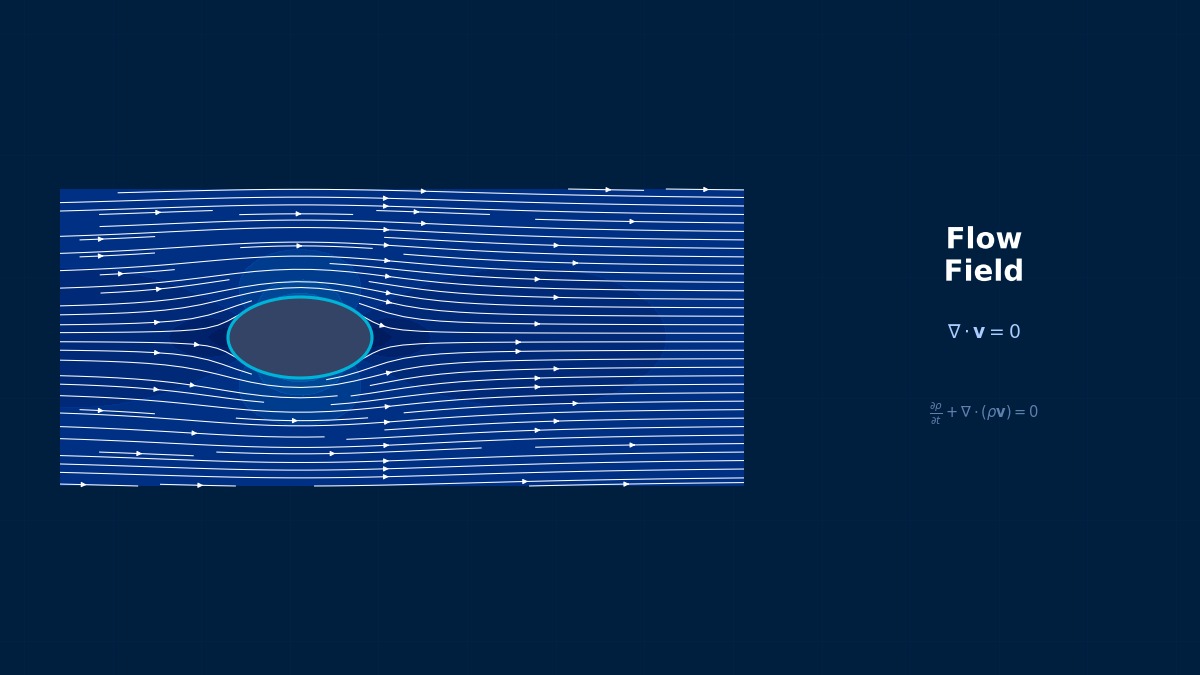
Flow in Ducts: Theoretical Foundations
Overview
Teacher! The analysis of flow inside ducts is the one used for HVAC piping and plant piping, right? Please teach me from the basics.
CFD analysis of duct flow aims to predict pressure loss, flow distribution, and flow maldistribution in piping and duct systems. At the design stage, it visualizes local losses and secondary flows that cannot be fully captured by hand calculations using the Darcy-Weisbach equation alone.
Governing Equations
The basic formula for pressure loss is the Darcy-Weisbach equation, right?
Yes. Frictional loss in straight pipes is described by the Darcy-Weisbach equation.
Here, $f$ is the pipe friction factor, $L$ is the pipe length, $D_h$ is the hydraulic diameter, and $V$ is the cross-sectional average velocity. For laminar flow, $f = 64/Re$, and for turbulent flow, it is obtained from the Colebrook equation.
The Colebrook equation is implicit, so iterative calculation is needed. In practice, is the Swamee-Jain approximation often used?
Exactly. Swamee-Jain is explicit and has sufficient accuracy for practical use.
Local losses (elbows, branches, expansions/contractions) are expressed using a loss coefficient $K$.
| Element | Loss Coefficient K (Guideline) |
|---|---|
| 90° Elbow (R/D=1.5) | 0.2~0.3 |
| 90° Miter (No Vanes) | 1.1~1.3 |
| T-Junction (Straight Through) | 0.3~0.5 |
| T-Junction (Branch) | 0.8~1.3 |
| Sudden Expansion | $(1 - A_1/A_2)^2$ |
| Sudden Contraction | $0.5(1 - A_2/A_1)$ |
Loss coefficients in hand calculations are from literature values, but with CFD, you can get accurate values specific to the geometry, right?
Yes. Especially for rectangular duct corner pieces and complex branch pipes, literature values are often unavailable, so it's valuable to obtain them via CFD.
Turbulence Model Selection
What turbulence model is suitable for duct flow?
For pipe flow, the Realizable $k$-$\varepsilon$ model is standard. For wall functions, Enhanced Wall Treatment (y+ ≒ 1) is ideal, but even with Standard Wall Function (y+ = 30~300), pressure loss prediction achieves practical accuracy.
| Turbulence Model | Recommended Application | Notes |
|---|---|---|
| Realizable k-epsilon | Straight pipes / Elbows | General purpose, fast calculation with wall functions |
| SST k-omega | Separation / Sudden expansion | Strong against adverse pressure gradients |
| RSM (Reynolds Stress) | Swirling flow / Secondary flow | High accuracy but high computational cost |
Secondary flow (corner vortices) occurs in rectangular ducts, can it be captured with k-epsilon?
Secondary flow in rectangular ducts originates from Reynolds stress anisotropy, so strictly speaking, RSM is needed. However, if the purpose is pressure loss prediction, k-epsilon can keep the error within about 5%.
The Theory of "Entry Length" — How Many D from the Duct Inlet Until Turbulent Flow is Fully Developed?
The first important concept learned in duct flow theory is the "hydrodynamic entry length." It refers to the distance from the inlet until the flow, influenced by the wall boundary layer, becomes a fully developed turbulent profile across the entire cross-section. For turbulent flow, approximately $x \approx 10 \sim 60 D$ (relative to diameter D) is required. A common mistake in practical CFD analysis is "setting the inlet condition as uniform flow while making the analysis domain just barely long enough." Unless sufficient entry length is secured or a measured velocity profile is set as the inlet condition, pressure loss downstream tends to be underestimated.
Computational Methods for Flow in Ducts
Details of Numerical Methods
When solving duct flow with CFD, what should I be careful about regarding mesh and boundary conditions?
Let's start by explaining the mesh.
Mesh Strategy
Does the mesh creation method change between circular pipes and rectangular ducts?
It changes significantly. For circular pipes, O-grid topology (bow-tie type) is recommended, as it easily ensures prism layers orthogonal to the wall. For rectangular ducts, use sweep mesh with prism layers.
The height of the first layer at the wall should match the wall model used.
| Wall Model | Required y+ | First Layer Height Guideline (Re=10⁵, D=300mm) |
|---|---|---|
| Enhanced Wall Treatment | ≒ 1 | Approx. 0.05 mm |
| Standard Wall Function | 30~300 | 1~10 mm |
| Scalable Wall Function | > 11.225 | > 0.4 mm |
Setting y+ = 1 increases the cell count considerably. From a pressure loss accuracy perspective, are wall functions sufficient?
For frictional loss in straight pipes alone, wall functions are sufficient. However, for sudden expansions with separation or behind valves, wall resolution (y+ ≒ 1) yields higher accuracy.
Boundary Condition Settings
How do you set the inlet/outlet boundary conditions?
Here are typical setting patterns.
| Boundary | Condition Type | Setting Value |
|---|---|---|
| Duct Inlet | Velocity Inlet | Design air velocity + Turbulence intensity 5%, Hydraulic diameter |
| Duct Outlet | Pressure Outlet | Gauge pressure 0 Pa |
| Fan Location | Fan BC (Pressure Jump) | Fan characteristic curve |
| Damper | Porous Jump | Resistance coefficient according to opening |
| Wall | No-Slip Wall | Roughness height (Steel pipe: 0.045 mm) |
So you input wall roughness into CFD. Where can I look up roughness height for each material?
Representative values are listed in ASHRAE Handbook Fundamentals and Crane TP-410.
| Material | Equivalent Roughness [mm] |
|---|---|
| Galvanized Sheet Metal Duct | 0.09~0.15 |
| Steel Pipe | 0.045 |
| PVC Pipe | 0.0015 |
| Concrete Duct | 0.3~3.0 |
| Flexible Duct | 1.0~4.6 |
Inlet Entry Length Treatment
When assuming fully developed flow, how do you handle the entry length?
The turbulent entry length is roughly $L_{entry} \approx 10 D_h$. If the purpose is not to evaluate pressure loss immediately after the inlet, either provide sufficient entry length or give a Fully Developed Profile as the inlet condition. In Fluent, another method is to use the Mapped condition at the inlet (a periodic condition that maps the outlet velocity profile to the inlet).
Solver Settings
Please tell me the recommended specific solver settings.
| Parameter | Recommended Setting |
|---|---|
| Solver | Pressure-Based, Steady |
| Pressure-Velocity Coupling | SIMPLEC |
| Convection Scheme | Second Order Upwind |
| Pressure Interpolation | Second Order |
| Gradient | Least Squares Cell-Based |
| Convergence Criterion | Residual below 1e-4 + Inlet/Outlet Flow Rate Balance < 0.1% |
Using the inlet/outlet flow rate balance for convergence judgment is practical. Relying on residuals alone might overlook...
Related Topics
Experience the theory firsthand with the interactive simulator for this field
All Simulators