Nozzle Flow
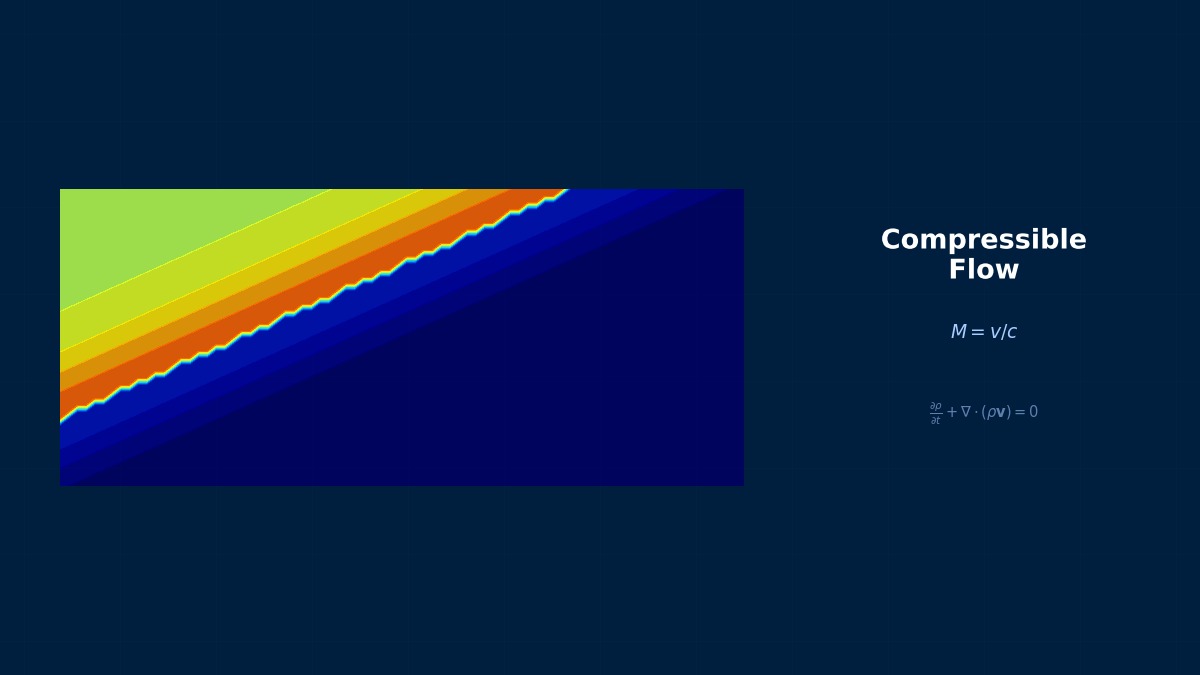
Nozzle Flow: Theoretical Foundations
Overview
Professor, a Laval nozzle is the convergent-divergent shape that produces supersonic flow, right? Why can that shape exceed the speed of sound?
Good question. According to the fundamental theorem of compressible fluid dynamics, the relationship between cross-sectional area change and velocity change is expressed as
In subsonic flow (M<1), narrowing the area accelerates the flow, while in supersonic flow (M>1), expanding the area accelerates it. Therefore, transitioning to supersonic flow is possible by passing through a throat (minimum cross-sectional area) where M=1 is achieved.
So M=1 is achieved exactly at the throat. Is this the choking condition?
Exactly. Choking refers to the state where the Mach number reaches 1 at the throat and the mass flow rate becomes maximum. This critical mass flow rate is determined by
No matter how much the back pressure is lowered, the mass flow rate passing through the throat cannot increase beyond this.
Area-Mach Number Relation
How do you find the Mach number from the nozzle's cross-sectional area?
Assuming isentropic flow, the relationship between the area ratio and the Mach number is
This yields two solutions for a given $A/A^*$: a subsonic solution and a supersonic solution. Which one is realized is determined by the back pressure condition.
It's a nonlinear equation, so it can't be solved analytically, right?
It can be easily solved using the Newton-Raphson method. By setting the initial value to either the subsonic side (M<1) or the supersonic side (M>1), it converges to the corresponding solution. Combined with the isentropic relations,
the temperature ratio and pressure ratio can be found. For air ($\gamma=1.4$) at M=2, $T_0/T=1.8$, $p_0/p=7.824$.
Shock Waves in the Nozzle
What happens if the back pressure is different from the design value?
If the back pressure is too high, a normal shock wave forms inside the diverging section. The pressure ratio across the shock wave is determined by the Rankine-Hugoniot relation
After the shock wave, the flow becomes subsonic, so it decelerates until the nozzle exit. If the back pressure is lowered further, the shock wave moves to the nozzle exit, eventually forming an expansion wave-compression wave pattern outside the nozzle.
Is that the diamond pattern visible in rocket engine exhaust?
Yes. In over-expansion (exit pressure < back pressure), oblique shock waves form; in under-expansion (exit pressure > back pressure), Prandtl-Meyer expansion waves form. The position of that Mach disk is determined by the back pressure ratio.
The Invention of the de Laval Nozzle—The Discovery of the "Constriction" that Saved the Steam Turbine
The convergent-divergent nozzle (de Laval nozzle) was devised by Swedish engineer Gustav de Laval. In the 1880s, while working on improving the efficiency of steam turbines, he experimentally discovered that to accelerate steam to supersonic speeds, it was necessary to first reach the speed of sound at the throat and then expand. Despite the fact that the theory of gas compressibility was not fully developed at the time, he arrived at this shape through trial and error. All modern rocket engine and jet engine nozzles operate on this principle. It is a good example of finding the "answer" through experiment before theory.
Computational Methods for Nozzle Flow
Numerical Solution for Quasi-1D Nozzle Flow
Quasi-one-dimensional nozzle flow is perfect as an introduction to CFD, isn't it?
Yes. It's the problem of solving the one-dimensional version of the Euler equations with an area change term, allowing you to try all the basic schemes of compressible CFD. In conservation form, it is
The $p \, dA/dx$ on the right-hand side acts as a source term.
What scheme is generally used to solve this?
Educationally, the MacCormack method (a two-step predictor-corrector explicit method) is a classic. It's a standard problem in Anderson's textbook. In practice, fluxes are calculated using the Roe or AUSM method, and second-order accuracy is achieved with MUSCL reconstruction.
2D/3D Nozzle Mesh Strategy
How do you create the mesh for 2D or 3D nozzle analysis?
For an axisymmetric nozzle, a 2D axisymmetric mesh is sufficient. Structured grids are preferable, and the throat section should have a dense grid.
| Region | Grid Policy | Reason |
|---|---|---|
| Convergent Section | 20+ layers normal to wall | Resolution of boundary layer |
| Near Throat | High density in axial direction | Accurate capture of sonic condition |
| Divergent Section | Adaptively dense at shock location | Sharp capture of shock wave |
| Center Axis | Avoid singularity (wedge cells, etc.) | Numerical stability for axisymmetric calculation |
In 3D, there are things like thrust vectoring nozzles (TVC), right?
For thrust vectoring nozzles or multi-nozzle clusters, 3D calculation is essential. In areas with high nozzle wall curvature, prism layers (inflation layers) are added to resolve the boundary layer, and the core is filled with polyhedral or hexahedral cells.
Boundary Condition Settings
How do you set the boundary conditions for nozzle calculations?
This is the core part of nozzle CFD.
- Inlet: Fix total temperature $T_0$ and total pressure $p_0$ (combustion chamber conditions). Flow direction is axial.
- Outlet: For supersonic outflow, all variables are extrapolated (information does not propagate upstream). If there is a subsonic region, specify back pressure $p_b$.
- Wall: Adiabatic wall or isothermal wall. No-slip condition.
- Symmetry Axis: Axisymmetric condition or symmetry plane condition.
In Fluent, set $p_0, T_0$ with "Pressure Inlet" and back pressure with "Pressure Outlet". For supersonic outlets, the back pressure value in "Pressure Outlet" is effectively ignored.
Numerical Treatment of Subsonic-Supersonic Transition
Does the M=1 transition at the throat cause numerical problems?
Good point. Since the hyperbolic nature of the Euler equations changes at M=1, some numerical schemes can cause issues near the transition point. Entropy fix for the Roe method or Harten-Hyman modification may be necessary. The AUSM family is inherently designed to be robust against this problem.
Can't pressure-based solvers handle supersonic flow?
Modern Pressure-Based Coupled Solvers (e.g., Fluent's coupled scheme) support the full speed range, but for nozzle flows involving shock waves, density-based solvers are more stable and accurate. Especially for accurately predicting the location and strength of shock waves inside the nozzle, density-based is the clear choice.
The Reason for Struggling with "Density-Based or Pressure-Based?" in Nozzle Numerical Solution
When numerically calculating the supersonic region of a Laval nozzle, beginners often wonder, "Should I use a density-based solver or a pressure-based solver?" In nozzle flow solved continuously from subsonic to supersonic, since the Mach number crosses 1, pressure-based solvers' Presto! or neighbor correction may not function well. Generally, if "supersonic/compressibility is dominant," density-based tends to be more stable, and using time-marching (density-based explicit) makes shock wave capture sharper. However, if Y+ management near the wall is loose, the boundary layer can become unstable, so the correct approach is to consider the mesh and solution method as a set.
Experience the theory firsthand with the interactive simulator for this field
All Simulators