Microfluidics
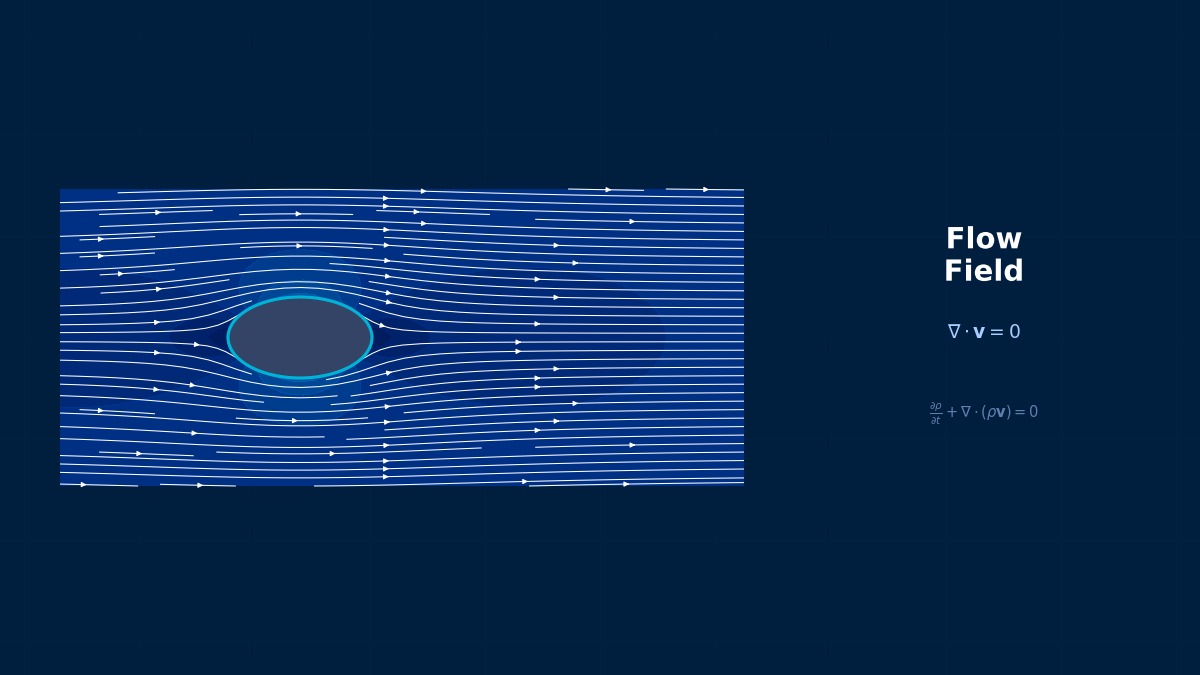
Microfluidics: Theoretical Foundations
Fundamentals of Microfluidics
Professor, what's the difference between microfluidics and macro-scale fluid dynamics? Is it just the smaller scale?
Changing the scale changes the "ruler" of physics. At the macro scale, inertial forces dominate, but at the micro scale (characteristic length $L \sim 1\text{--}100\,\mu\text{m}$), viscous forces and surface tension become dominant.
Let's compare with specific numbers. For water flow velocity $U = 1\,\text{mm/s}$ and channel width $D = 100\,\mu\text{m}$:
Since Re << 1, inertial forces can be neglected, and Stokes flow (creeping flow) dominates.
Re = 0.1 means it's completely viscosity-dominated. No worries about turbulence.
Correct. Furthermore, the importance of surface tension is indicated by the Capillary number:
Since Ca << 1, the shape of droplets/bubbles is determined by surface tension.
Stokes Equations
In the limit of Re << 1, the inertial term in the Navier-Stokes equations vanishes, leaving the Stokes equations.
The Stokes equations have the following important properties:
- Linear: Superposition of solutions is possible.
- Time-reversible: Reversing the applied force returns the fluid to its original state (the reason mixing is difficult).
- Instantaneous response: Without inertia, pressure changes propagate instantly throughout the domain.
Time-reversible means that at the micro scale, stirring doesn't cause mixing?
It won't mix with conventional methods. This is why designing micro-mixers is challenging. You must rely on diffusion or utilize chaotic advection (e.g., zigzag channel structures).
Physics Unique to Microfluidics
Let's organize the physical phenomena that become important at the micro scale.
| Phenomenon | Governing Parameter | Influence at Macro Scale | Influence at Micro Scale |
|---|---|---|---|
| Surface Tension | Ca, We, Bo | Usually negligible | Dominant |
| Electroosmotic Flow (EOF) | $\zeta$ potential, Debye length | Negligible | Used as a driving force |
| Slip Flow | Knudsen number Kn | no-slip | Slip occurs for Kn > 0.01 |
| Diffusive Mixing | Peclet number Pe | Convection-dominated | Diffusion-dominated |
| Contact Angle Hysteresis | Advancing/receding contact angle | Not critical | Governs device operation |
The Bond number $\text{Bo} = \rho g L^2 / \sigma$ also becomes very small at the micro scale ($\text{Bo} \sim 10^{-6}$ for $L = 100\,\mu\text{m}$). This means gravity is completely negligible, and behavior is the same whether in space or on Earth.
Gravity having no effect is counterintuitive, but it's a scale effect, right?
The Birth of Microfluidics—The μTAS Revolution and Lab-on-a-Chip in the 1990s
The dawn of microfluidics began in the early 1990s when Manz & Widmer (1990) at ETH Zurich proposed the concept of "μTAS (Micro Total Analysis System)". This involved fabricating channels tens to hundreds of micrometers wide on glass substrates using semiconductor manufacturing technology (photolithography), creating the concept of "Lab-on-a-Chip" where mixing, separation, and detection of reagents are completed on a single chip. At this channel scale, Stokes flow with Reynolds numbers less than 1 dominates, and since turbulent mixing cannot be used, passive mixing structures like T-junctions or helical shapes are necessary. Today, this technology is utilized in the microchannels of COVID-19 rapid test kits and DNA sequencers, with CFD-based channel design optimization being at the core of product development.
Computational Methods for Microfluidics
CFD Methods for Microfluidics
Can regular CFD solvers be used for microfluidics simulations?
Within the range where the continuum approximation holds (Kn < 0.01), standard Navier-Stokes-based CFD can be used. However, there are numerical challenges specific to the micro scale.
Two-Phase Flow (Droplet/Bubble) Interface Tracking
Droplet generation and T-junction merging are common in microfluidic devices. Let's compare the main interface tracking methods.
| Method | Advantages | Disadvantages | Application Examples |
|---|---|---|---|
| VOF (Volume of Fluid) | Good mass conservation, low cost | Interface diffusion, contact line issues | Droplet generation, slug flow |
| Level-Set | Smooth interface shape | Mass non-conservation | Merging, splitting |
| CLSVOF | Combines advantages of VOF+LS | Complex implementation | Problems requiring high accuracy |
| Phase-Field | Natural description of contact line | Strict mesh requirements | Wetting phenomena, contact angle control |
| Front-Tracking | Explicit interface tracking | Weak against topology changes | Single droplet deformation |
The CSF (Continuum Surface Force) model is standard for numerical calculation of surface tension, but at the micro scale, spurious currents become a problem. These are non-physical flows arising from the discretization of surface tension, becoming more pronounced as Ca decreases.
So if surface tension is large but the mesh is coarse, non-physical flow occurs.
Countermeasures include:
- Ensure at least 10 cells per interface for resolution.
- Curvature calculation via the Height Function method (significantly more accurate than CSF).
- Sharp Surface Force method.
- Using the Phase-Field model (reduces spurious currents via thermodynamic description of the interface).
Electroosmotic Flow (EOF) Calculation
Electroosmotic flow, where fluid is driven by an electric field, is often used in microchannels. The governing equations are:
$\rho_e$ is charge density, $\varepsilon$ is permittivity, $\mathbf{E} = -\nabla\phi$ is the electric field. The Debye length region $\lambda_D \sim 1\text{--}100\,\text{nm}$ must be resolved, requiring extremely fine meshing.
If the Debye length is on the order of nm, the mesh scale differs by more than 3 orders of magnitude from the entire channel.
Correct. In practice, the Helmholtz-Smoluchowski slip velocity condition:
is often applied as a wall boundary condition, using an approach that does not resolve the interior of the EDL (electrical double layer). $\zeta$ is the zeta potential, $E_t$ is the tangential electric field at the wall.
"Capillary Force" in Microchannels—A World Where Surface Tension Rules Over Gravity
When channel width falls below 100μm, gravity ceases to be a dominant force for flow. Instead, surface tension takes the lead, with capillary pressure ΔP=4γcosθ/D (D is channel diameter) drawing in liquid. In fact, in paper-based microfluidics for disease diagnosis, blood flows via capillary force without any pump. To handle this numerically, the usual Navier-Stokes equations must be combined with methods like "VOF" or "Lattice Boltzmann Method" to track the gas-liquid interface, and the choice of method greatly influences result accuracy.