噴霧・微粒化

Category: 流体解析(CFD) | Integrated 2026-04-06
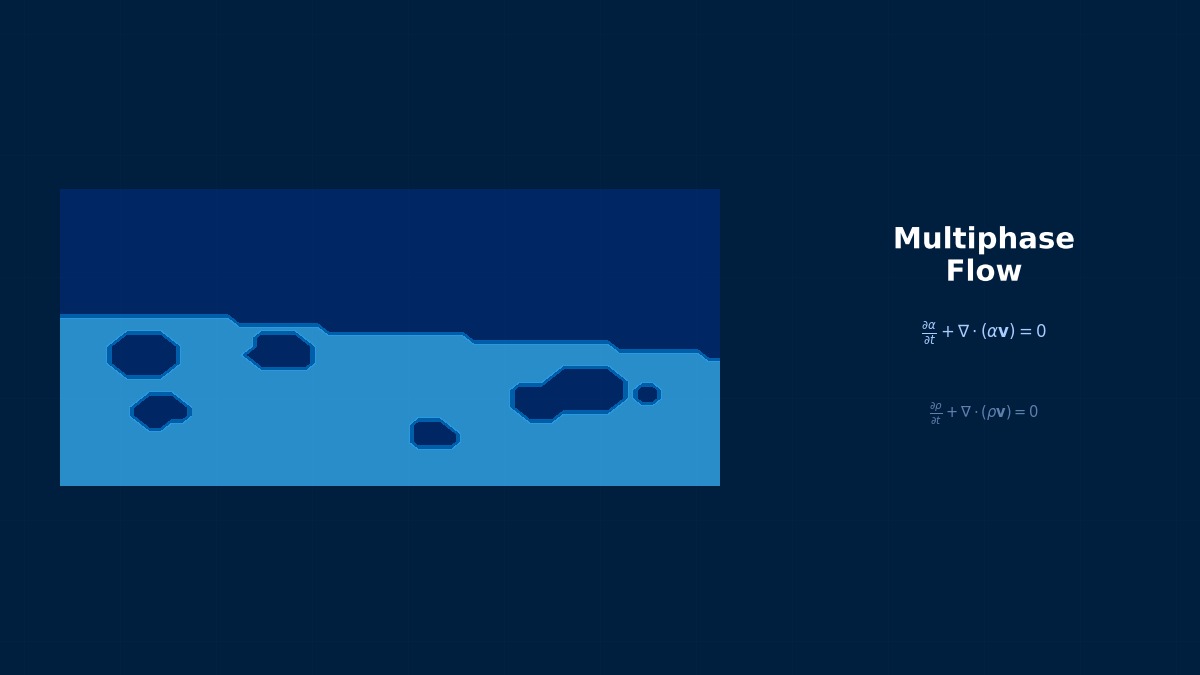
CAE visualization for spray atomization theory - technical simulation diagram
噴霧・微粒化

Theory and Physics

Overview

🧑‍🎓

Professor, what does CFD for spray/atomization actually calculate?


🎓

It simulates the process where liquid is injected from a nozzle and breaks up into fine droplets (atomization). It is used in the design of all spray processes such as diesel engine fuel injection, gas turbine fuel injection, spray painting, pesticide spraying, and fire extinguisher sprays.


🧑‍🎓

Is it different from droplet breakup models (secondary breakup)?


🎓

The spray process is divided into two stages. The breakup of the liquid column or sheet at the nozzle exit into droplets is primary atomization. The further breakup of the generated droplets into smaller ones is secondary breakup. This article deals with modeling the entire spray from primary atomization.


Basic Spray Parameters

🧑‍🎓

What parameters characterize a spray?


🎓

The following are the main parameters.


ParameterDefinitionMeaning
Weber number $We$$\rho_g U_{rel}^2 d / \sigma$Aerodynamic force vs Surface Tension
Ohnesorge number $Oh$$\mu_l / \sqrt{\rho_l \sigma d}$Viscosity vs Surface Tension
SMD $d_{32}$$\sum d_i^3 / \sum d_i^2$Sauter Mean Diameter
Injection pressure $\Delta p$$p_{inj} - p_{amb}$Injection energy
Spray angle $\theta$Cone angleSpray spread
🎓

SMD (Sauter Mean Diameter) is the most commonly used representative diameter for sprays. Since evaporation and reaction rates are proportional to surface area, a representative diameter based on the volume/surface area ratio is useful.


Primary Atomization Models

🧑‍🎓

How is primary atomization modeled in CFD?


🎓

Directly tracking liquid column breakup from the internal nozzle flow is computationally prohibitive, so engineering models are used.


ModelOverviewApplication
Blob injectionInjects droplets of nozzle diameter sizeDiesel injection
LISA (Linearized Instability Sheet Atomization)Instability of sheet-like liquid filmPressure spray nozzles
ELSA (Eulerian-Lagrangian Spray Atomization)Eulerian liquid phase → Lagrangian droplet transitionResearch use
🎓

The Blob injection method, proposed by Reitz (1987), is the most practical approach. It injects droplets (Blobs) of the same size as the nozzle diameter using DPM and then breaks them down further using secondary breakup models (e.g., KHRT).


Coffee Break Trivia

Rayleigh Breakup——Why Does a Liquid Column Become Droplets?

The reason water falling from a faucet separates into droplets rather than a continuous stream is due to "Rayleigh instability," explained by Rayleigh (1878). A cylindrical liquid column has an inherent instability where disturbances with wavelengths greater than πD are amplified by surface tension, eventually splitting into a nearly uniform droplet train. This instability growth rate is determined by the Weber number and Ohnesorge number of the liquid column and is directly applied to spray nozzle design. Inkjet printers, which generate monodisperse droplets, are a prime example of intentionally controlling Rayleigh breakup, enabling printing at 600 DPI or higher on A4 paper with droplet diameter control within ±1%.

Physical Meaning of Each Term
  • Temporal term $\partial(\rho\phi)/\partial t$: Think of the moment you turn on a faucet. At first, the water comes out unstable and splashing, but after a while, it becomes a steady flow, right? This "during the change" is described by the temporal term. The pulsation of blood flow from a heartbeat, or the flow fluctuation each time an engine valve opens and closes—all are unsteady phenomena. So what is steady-state analysis? Looking only at "after sufficient time has passed and the flow has settled"—in other words, setting this term to zero. Since computational cost is significantly reduced, starting with a steady-state solution is a basic CFD strategy.
  • Convection term $\nabla \cdot (\rho \mathbf{u} \phi)$: What happens if you drop a leaf into a river? It gets carried downstream by the flow, right? This is "convection"—the effect where fluid motion transports things. Warm air from a heater reaching the far side of a room is also because the air, as a "carrier," transports heat via convection. Here's the interesting part—this term contains "velocity × velocity," making it nonlinear. That is, as the flow becomes faster, this term rapidly strengthens, making control difficult. This is the root cause of turbulence. A common misconception: "Convection and conduction are similar" → They are completely different! Convection is carried by flow, conduction is transmitted by molecules. There is an order of magnitude difference in efficiency.
  • Diffusion term $\nabla \cdot (\Gamma \nabla \phi)$: Have you ever put milk in coffee and left it? Even without stirring, after a while, it naturally mixes. That's molecular diffusion. Now a question—honey and water, which flows more easily? Obviously water, right? Honey has high viscosity ($\mu$), so it flows poorly. Higher viscosity strengthens the diffusion term, making the fluid move "sluggishly." In low Reynolds number flows (slow, viscous), diffusion is dominant. Conversely, in high Re number flows, convection overwhelms, and diffusion becomes a minor player.
  • Pressure term $-\nabla p$: When you push the plunger of a syringe, liquid shoots out forcefully from the needle tip, right? Why? Because the plunger side is high pressure, the needle tip is low pressure—this pressure difference provides the force that pushes the fluid. Dam discharge works on the same principle. On a weather map, where isobars are tightly packed? That's right, strong winds blow. "Flow is generated where there is a pressure difference"—this is the physical meaning of the pressure term in the Navier-Stokes equations. A point of confusion here: "Pressure" in CFD is often gauge pressure, not absolute pressure. If results become strange immediately after switching to compressible analysis, it might be due to mixing up absolute/gauge pressure.
  • Source term $S_\phi$: Heated air rises—why? Because it becomes lighter (lower density) than its surroundings, so it is pushed up by buoyancy. This buoyancy is added to the equation as a source term. Other examples: chemical reaction heat generated by a gas stove flame, Lorentz force applied to molten metal by an electromagnetic pump in a factory... These are all actions that "inject energy or force into the fluid from the outside" and are expressed by source terms. What happens if you forget a source term? In natural convection analysis, forgetting buoyancy means the fluid doesn't move at all—a physically impossible result where warm air doesn't rise in a room with the heater on in winter.
Assumptions and Applicability Limits
  • Continuum assumption: Valid for Knudsen number Kn < 0.01 (mean free path ≪ characteristic length)
  • Newtonian fluid assumption: Shear stress and strain rate have a linear relationship (non-Newtonian fluids require viscosity models)
  • Incompressibility assumption (for Ma < 0.3): Treat density as constant. For Mach number ≥ 0.3, consider compressibility effects
  • Boussinesq approximation (Natural Convection): Consider density changes only in the buoyancy term, use constant density in other terms
  • Non-applicable cases: Rarefied gas (Kn > 0.1), supersonic/hypersonic flow (shock capturing required), free surface flow (VOF/Level Set, etc. required)
Dimensional Analysis and Unit Systems
VariableSI UnitNotes / Conversion Memo
Velocity $u$m/sWhen converting from volumetric flow rate for inlet conditions, pay attention to cross-sectional area units
Pressure $p$PaDistinguish between gauge and absolute pressure. Use absolute pressure for compressible analysis
Density $\rho$kg/m³Air: approx. 1.225 kg/m³ @20°C, Water: approx. 998 kg/m³ @20°C
Viscosity coefficient $\mu$Pa·sBe careful not to confuse with kinematic viscosity coefficient $\nu = \mu/\rho$ [m²/s]
Reynolds number $Re$Dimensionless$Re = \rho u L / \mu$. Criterion for Laminar/turbulent transition
CFL numberDimensionless$CFL = u \Delta t / \Delta x$. Directly related to time step stability

Numerical Methods and Implementation

Details of Numerical Methods

🧑‍🎓

Please tell me the key numerical points for spray simulation.


🎓

The biggest challenge in Lagrangian spray calculation is mesh dependency. A large number of parcels concentrate near the nozzle, so the CFD cell size affects the momentum source from the parcels.


Mesh Dependency Problem

🎓

Abraham's (1997) guidelines recommend that the liquid volume fraction occupied by each cell be low (ideally below 1%). In practice, mesh near the nozzle is set to 0.5–2 mm, often combined with AMR.


🧑‍🎓

Why is AMR particularly important for sprays?


🎓

The spray tip moves, so the region requiring fine mesh changes over time. Using AMR (Adaptive Mesh Refinement) to automatically refine only the regions where the spray exists can significantly reduce computational cost compared to a fixed mesh. CONVERGE has this AMR natively built-in, giving it an advantage in spray calculations.


Influence of Internal Nozzle Flow

🎓

In high-pressure injection nozzles, cavitation occurs inside the nozzle, which promotes spray atomization. A method that calculates the internal nozzle flow beforehand and uses the exit turbulence profile and liquid film distribution as inlet conditions for Lagrangian spray calculation is effective for improving accuracy.


Implementation by Tool

ToolPrimary AtomizationSecondary AtomizationAMRFeatures
CONVERGEBlob, KH-ACTKHRT, TABNativeBenchmark for spray calculation
Ansys FluentBlob, LISA, Flat FanTAB, KHRT, SSDGradient-basedVOF-to-DPM conversion
STAR-CCM+Blob, LISATAB, KHRT, Reitz-DiwakarTable-basedLagrangian/Eulerian hybrid
OpenFOAM (sprayFoam)BlobInjection, ConeInjectionTAB, ETAB, ReitzKHRTdynamicRefineFvMeshFully OSS
🎓

CONVERGE, with its combination of automatic mesh generation and AMR, can significantly reduce the effort of mesh design, making it a standard tool for spray and combustion calculations among engine manufacturers.


Coffee Break Trivia

Rosin-Rammler Distribution——The Standard for Droplet Size Setting in Spray CFD

The most common method for setting droplet size distribution in spray CFD is the Rosin-Rammler distribution F(d) = 1-exp(-(d/d_bar)^n). Two parameters, d_bar (characteristic diameter) and n (distribution width coefficient), can represent a wide range of spray characteristics. These parameters are determined from actual measurements using laser diffraction (Malvern, etc.), but they vary greatly depending on measurement conditions (liquid pressure, distance from nozzle), so recording "under which conditions the data was measured" is essential. When using CFD with Rosin-Rammler, calibrating d_bar and n so that D32 (Sauter mean diameter) matches actual measurements is the standard procedure in practice.

Upwind Scheme

1st-order upwind: Large numerical diffusion but stable. 2nd-order upwind: Improved accuracy but risk of oscillations. Essential for high Reynolds number flows.

Central Differencing

2nd-order accurate, but numerical oscillations occur for Pe number > 2. Suitable for low Reynolds number diffusion-dominated flows.

TVD Schemes (MUSCL, QUICK, etc.)

Maintain high accuracy while suppressing numerical oscillations via limiter functions. Effective for capturing shock waves or steep gradients.

Finite Volume Method vs Finite Element Method

FVM: Naturally satisfies conservation laws. Mainstream in CFD. FEM: Advantageous for complex shapes and multiphysics. Mesh-free methods like SPH are also developing.

CFL Condition (Courant Number)

Explicit methods: CFL ≤ 1 is the stability condition. Implicit methods: Stable even for CFL > 1, but affects accuracy and iteration count. LES: CFL ≈ 1 is recommended. Physical meaning: Information should not travel more than one cell per time step.

Residual Monitoring

Convergence is judged when residuals for the Continuity Equation, momentum, and energy drop by 3–4 orders of magnitude. The mass conservation residual is particularly important.

Relaxation Factor

Pressure: 0.2–0.3, Velocity: 0.5–0.7 are typical initial values. If diverging, lower the relaxation factor. After convergence, increase to accelerate.

Internal Iterations for Unsteady Calculations

Iterate within each time step until a steady solution converges. Internal iteration count: 5–20 iterations is a guideline. If residuals fluctuate between time steps, review the time step size.

Analogy for the SIMPLE Method

The SIMPLE method is an "alternating adjustment" technique. First, velocity is tentatively determined (predictor step), then pressure is corrected so that mass conservation is satisfied with that velocity (corrector step), and velocity is revised using the corrected pressure—this back-and-forth is repeated to approach the correct solution. It resembles two people leveling a shelf: one adjusts the height, the other balances it, and they repeat this alternately.

Analogy for the Upwind Scheme

The upwind scheme is a method that "stands in the river flow and prioritizes upstream information." A person in the river cannot tell the source of the water by looking downstream—it reflects the physics that upstream information determines downstream. Although it's first-order accurate, it is highly stable because it correctly captures the flow direction.

Practical Guide

Practical Guide

🧑‍🎓

Please explain the steps for spray simulation.


🎓

Let's take diesel injection (ECN Spray A conditions) as an example.


🎓

1. Gas phase in constant-volume vessel: Nitrogen atmosphere at 900 K, 60 bar

2. Mesh: 0.25 mm near nozzle (automatically refined by AMR), 2 mm far away

3. Injection conditions: n-dodecane, injection pressure 1500 bar, nozzle diameter 90 μm

4. Primary atomization: Blob injection (Blob diameter = nozzle diameter)

5. Secondary atomization: KHRT model

6

関連シミュレーター

この分野のインタラクティブシミュレーターで理論を体感しよう

シミュレーター一覧

関連する分野

熱解析V&V・品質保証構造解析
この記事の評価
ご回答ありがとうございます!
参考に
なった
もっと
詳しく
誤りを
報告
参考になった
0
もっと詳しく
0
誤りを報告
0
Written by NovaSolver Contributors
Anonymous Engineers & AI — サイトマップ
About the Authors