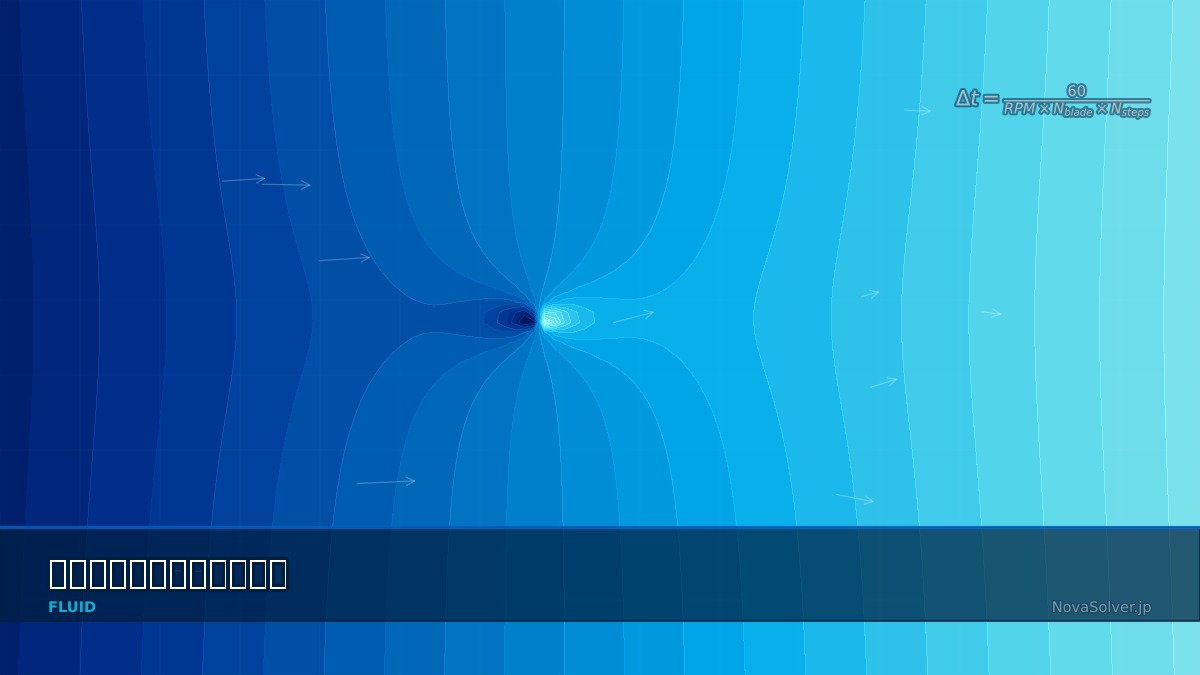
Sliding Mesh Method

Category: 流体解析(CFD) | Integrated 2026-04-06
CAE visualization for sliding mesh theory - technical simulation diagram
スライディングメッシュ法 — 非定常動静翼干渉の理論

Theory and Physics

Overview

🧑‍🎓

I often hear about Sliding Mesh in unsteady turbomachinery analysis, but how is it different from MRF?


🎓

MRF fixes the rotor position to obtain a pseudo-steady solution, while Sliding Mesh physically rotates the mesh in the rotating domain at each time step. It interpolates information at the non-conformal interface.


🧑‍🎓

So it's called Sliding Mesh because the mesh slides at the interface, right?


🎓

Correct. This allows physical capture of blade-to-blade interactions (wake passage, potential interference). It's an essential method for predicting pressure fluctuations and unsteady blade surface loads.


Interface Handling

🧑‍🎓

How is the interpolation at the interface done?


🎓

At each time step, the overlap between the rotating and stationary interface meshes is calculated, and fluxes are conservatively interpolated. CFX's Transient Rotor-Stator uses GGI-based weighted interpolation. Fluent's Sliding Mesh uses face-to-face intersection detection for interpolation.


Scope of Application

🧑‍🎓

In what cases is Sliding Mesh essential?


🎓
Analysis ObjectiveSliding Mesh Necessity
Design point efficiency predictionNot required (MRF/Mixing Plane is sufficient)
Pressure fluctuations due to blade passingEssential
Wake-blade interferenceEssential
Unsteady blade surface loads (vibration evaluation)Essential
Noise prediction (FW-H input)Essential
Surge/StallEssential (full annulus)
Coffee Break Trivia

The Birth of the Sliding Mesh Method—The Dawn of Unsteady Rotor-Stator Interference CFD

The industrial adoption of the Sliding Mesh method began in the late 1990s. Prior to that, turbomachinery CFD was limited to steady-state frozen rotor or mixing plane methods, unable to capture unsteady rotor-stator interactions (wake interference, potential interference). The turning point was when ANSYS Fluent, in version 5 (1998), first fully implemented the Sliding Interface feature as a commercial CFD tool. This enabled the transport of vortices from rotor to stator, calculation of BPF (Blade Passing Frequency) fluctuating forces, and prediction of acoustic pressure fluctuations. In modern turbomachinery development (stall analysis for jet engine compressors, hydraulic pulsation reduction in pumps), unsteady sliding mesh has become an indispensable tool, a method that changed the common sense of CFD over the 25 years since its 1998 implementation.

Physical Meaning of Each Term
  • Time Term $\partial(\rho\phi)/\partial t$: Think of the moment you turn on a faucet. At first, water comes out spluttering and unstable, but after a while, it becomes a steady flow, right? This "period of change" is described by the time term. The pulsation of blood flow from a heartbeat, or the flow fluctuation each time an engine valve opens and closes—all are unsteady phenomena. So what is steady-state analysis? It looks only at "after sufficient time has passed and the flow has settled down"—meaning this term is set to zero. Since computational cost is significantly reduced, starting with a steady-state solution is a basic CFD strategy.
  • Convection Term $\nabla \cdot (\rho \mathbf{u} \phi)$: What happens if you drop a leaf into a river? It gets carried downstream by the flow, right? This is "convection"—the effect where fluid motion transports things. Warm air from a heater reaching the far corner of a room is also due to air, the "carrier," transporting heat via convection. Here's the interesting part—this term contains "velocity × velocity," making it nonlinear. That is, as flow speed increases, this term rapidly strengthens, making control difficult. This is the root cause of turbulence. A common misconception: "Convection and conduction are similar" → They are completely different! Convection is transport by flow, conduction is transfer by molecules. There's an order of magnitude difference in efficiency.
  • Diffusion Term $\nabla \cdot (\Gamma \nabla \phi)$: Have you ever put milk in coffee and left it? Even without stirring, after a while, they naturally mix. That's molecular diffusion. Now a question—honey and water, which flows more easily? Obviously water, right? Honey has high viscosity ($\mu$), so it flows poorly. Higher viscosity strengthens the diffusion term, making the fluid move in a "thick" manner. In low Reynolds number flows (slow, viscous), diffusion dominates. Conversely, in high Re number flows, convection overwhelms, and diffusion plays a supporting role.
  • Pressure Term $-\nabla p$: When you push a syringe plunger, liquid shoots out forcefully from the needle tip, right? Why? Because the plunger side is high pressure, the needle tip is low pressure—this pressure difference provides the force pushing the fluid. Dam discharge works on the same principle. On a weather map, where isobars are tightly packed? That's right, strong winds blow. "Flow arises where there is a pressure difference"—this is the physical meaning of the pressure term in the Navier-Stokes equations. A point of confusion here: "Pressure" in CFD is often gauge pressure, not absolute pressure. If results go wrong immediately after switching to compressible analysis, it might be due to mixing up absolute/gauge pressure.
  • Source Term $S_\phi$: Warmed air rises—why? Because it becomes lighter (lower density) than its surroundings, so buoyancy pushes it up. This buoyancy is added to the equation as a source term. Other examples: chemical reaction heat from a gas stove flame, Lorentz force acting on molten metal in a factory electromagnetic pump... These are all actions that "inject energy or force into the fluid from outside," expressed by the source term. What happens if you forget the source term? In natural convection analysis, forgetting buoyancy means the fluid doesn't move at all—a physically impossible result where warm air doesn't rise in a heated room in winter.
Assumptions and Applicability Limits
  • Continuum assumption: Valid for Knudsen number Kn < 0.01 (mean free path ≪ characteristic length)
  • Newtonian fluid assumption: Shear stress and strain rate have a linear relationship (non-Newtonian fluids require viscosity models)
  • Incompressibility assumption (for Ma < 0.3): Density is treated as constant. For Mach number ≥ 0.3, compressibility effects must be considered
  • Boussinesq approximation (Natural convection): Density variation is considered only in the buoyancy term; constant density is used in other terms
  • Non-applicable cases: Rarefied gases (Kn > 0.1), supersonic/hypersonic flow (shock capturing required), free surface flow (VOF/Level Set, etc., required)
Dimensional Analysis and Unit Systems
VariableSI UnitNotes / Conversion Memo
Velocity $u$m/sWhen converting from volumetric flow rate for inlet conditions, pay attention to cross-sectional area units
Pressure $p$PaDistinguish between gauge and absolute pressure. Use absolute pressure for compressible analysis
Density $\rho$kg/m³Air: approx. 1.225 kg/m³ @20°C, Water: approx. 998 kg/m³ @20°C
Viscosity coefficient $\mu$Pa·sNote confusion with kinematic viscosity coefficient $\nu = \mu/\rho$ [m²/s]
Reynolds number $Re$Dimensionless$Re = \rho u L / \mu$. Indicator for laminar/turbulent transition
CFL numberDimensionless$CFL = u \Delta t / \Delta x$. Directly related to time step stability

Numerical Methods and Implementation

Determining the Time Step

🧑‍🎓

How do you decide the time step for Sliding Mesh?


🎓

A general guideline is 20 to 50 time steps per blade passage.


$$ \Delta t = \frac{60}{RPM \times N_{blade} \times N_{steps}} $$

Example: 3000rpm, 12 blades, 30 steps/blade passage → $\Delta t = 60/(3000 \times 12 \times 30) = 55.6 \mu s$


🧑‍🎓

What if a finer resolution is needed?


🎓

For noise prediction or DES/LES, resolution up to the 10th harmonic of BPF is required, demanding 100 to 200 steps per blade passage.


Determining Periodic Steady State

🧑‍🎓

How many revolutions should be calculated to be sufficient?


🎓

Judge by monitoring pressure fluctuations.


1. Place a pressure monitor at an appropriate point (e.g., near cutoff)

2. Overlay and compare pressure waveforms from two consecutive revolutions

3. If the amplitude change is within 2%, it's considered periodic steady state


Typically stabilizes in 5 to 15 revolutions. Using initial values from MRF or Frozen Rotor steady-state solutions can shorten this to 3 to 5 revolutions.


Handling Pitch Ratio

🧑‍🎓

What if the blade count ratio between rotor and stator is not an integer?


🎓

Ideally, a full annulus model is used, but computational cost becomes enormous. One method is to create a sector model based on the greatest common divisor of blade counts. For example, rotor 7 blades, stator 12 blades → greatest common divisor is 1, requiring full annulus. But rotor 6 blades, stator 12 blades → greatest common divisor is 6, allowing calculation with a 1/6 sector.


CFX's Time Transformation method and FINE/Turbo's NLH method are techniques that can approximate unsteady interference with a single pitch calculation even for non-integer pitch ratios.

Coffee Break Trivia

Numerical Implementation of the Sliding Mesh Method—The Role of AMI and Flux Correction

The Sliding Mesh method couples the boundary between the rotating rotor domain and the stationary stator domain using an "Arbitrary Mesh Interface (AMI)," updating the relative mesh positions at the boundary each time step to compute unsteady rotor-stator interference. Variable interpolation at the AMI is done via bilinear interpolation or weighted least squares (WLS), but when interface cells are non-conformal, "Flux Correction" is required for flux conservation. In OpenFOAM, AMI surface flux correction is automated, but it's known that mass conservation error can accumulate after more than two rotor revolutions, so periodic additional pressure correction settings are recommended.

Upwind Differencing (Upwind)

First-order upwind: Large numerical diffusion but stable. Second-order upwind: Improved accuracy but risk of oscillations. Essential for high Reynolds number flows.

Central Differencing (Central Differencing)

Second-order accurate, but numerical oscillations occur for Pe number > 2. Suitable for low Reynolds number diffusion-dominated flows.

TVD Schemes (MUSCL, QUICK, etc.)

Maintain high accuracy while suppressing numerical oscillations via limiter functions. Effective for capturing shock waves and steep gradients.

Finite Volume Method vs Finite Element Method

FVM: Naturally satisfies conservation laws. Mainstream in CFD. FEM: Advantageous for complex shapes and multiphysics. Mesh-free methods like SPH are also developing.

CFL Condition (Courant Number)

Explicit methods: CFL ≤ 1 is the stability condition. Implicit methods: Stable even for CFL > 1, but affects accuracy and iteration count. LES: CFL ≈ 1 recommended. Physical meaning: Information should not travel more than one cell per time step.

Residual Monitoring

Convergence is judged when each residual for continuity, momentum, and energy decreases by 3 to 4 orders of magnitude. The mass conservation residual is particularly important.

Relaxation Factors

Typical initial values: Pressure: 0.2–0.3, Velocity: 0.5–0.7. Reduce factors if diverging. Increase after convergence to accelerate.

Internal Iterations for Unsteady Calculations

Iterate within each time step until a steady solution converges. Guideline internal iterations: 5 to 20. If residuals fluctuate between time steps, review the time step size.

Analogy for the SIMPLE Method

The SIMPLE method is an "alternating adjustment" technique. First, velocity is tentatively determined (predictor step), then pressure is corrected so that mass conservation is satisfied with that velocity (corrector step), and then velocity is revised using the corrected pressure—this back-and-forth is repeated to approach the correct solution. It resembles two people leveling a shelf: one adjusts the height, the other balances it, and they repeat this alternately.

Analogy for Upwind Differencing

Upwind differencing is a method that "stands in the river flow and prioritizes upstream information." A person in the river looking downstream cannot tell where the water comes from—it's a discretization method reflecting the physics that upstream information determines downstream. Although first-order accurate, it is highly stable because it correctly captures flow direction.

Practical Guide

Extracting Pressure Fluctuations

🧑‍🎓

How do you evaluate pressure fluctuations from Sliding Mesh results?


🎓

Follow these steps.


1. Place pressure monitors at points of interest (volute wall, pipe connection, etc.)

2. Sample data from 2 to 5 revolutions after reaching periodic steady state

3. Perform spectral analysis via FFT (Fast Fourier Transform)

4. Evaluate peak amplitudes at BPF and its harmonics


🧑‍🎓

What is a normal amplitude for BPF?


🎓

It depends on the machine type, but for centrifugal pumps, a typical BPF pressure amplitude is 1–5% of the average head. Exceeding this poses a risk of pipe vibration or structural resonance.


Unsteady Blade Surface Loads

🧑‍🎓

Can unsteady forces on blade surfaces also be evaluated?


🎓

Output the time history of force components (x, y, z) acting on each blade surface and perform spectral analysis via FFT. If blade natural frequencies coincide with BPF harmonics, there is a risk of resonance (flutter).


Post-Processing Notes

🧑‍🎓

What should I be careful about in Sliding Mesh post-processing?


🎓
NoteDetails
Output FrequencySaving every time step creates enormous files. Thin out to a frequency satisfying the Nyquist condition for the frequencies needed for BPF analysis
Rotating/Stationary Frame ConversionConvert rotating frame data to stationary frame for display in CFD-Post
Phase AveragingAverage the same phase across multiple revolutions to obtain a phase-locked flow field
AnimationCreate videos of Mach number or Q-criterion isosurfaces in inter-blade passages to confirm vortex structure propagation
関連シミュレーター

この分野のインタラクティブシミュレーターで理論を体感しよう

シミュレーター一覧
この記事の評価
ご回答ありがとうございます!
参考に
なった
もっと
詳しく
誤りを
報告
参考になった
0
もっと詳しく
0
誤りを報告
0
Written by NovaSolver Contributors
Anonymous Engineers & AI — サイトマップ