Nonlinear Post-Buckling Analysis
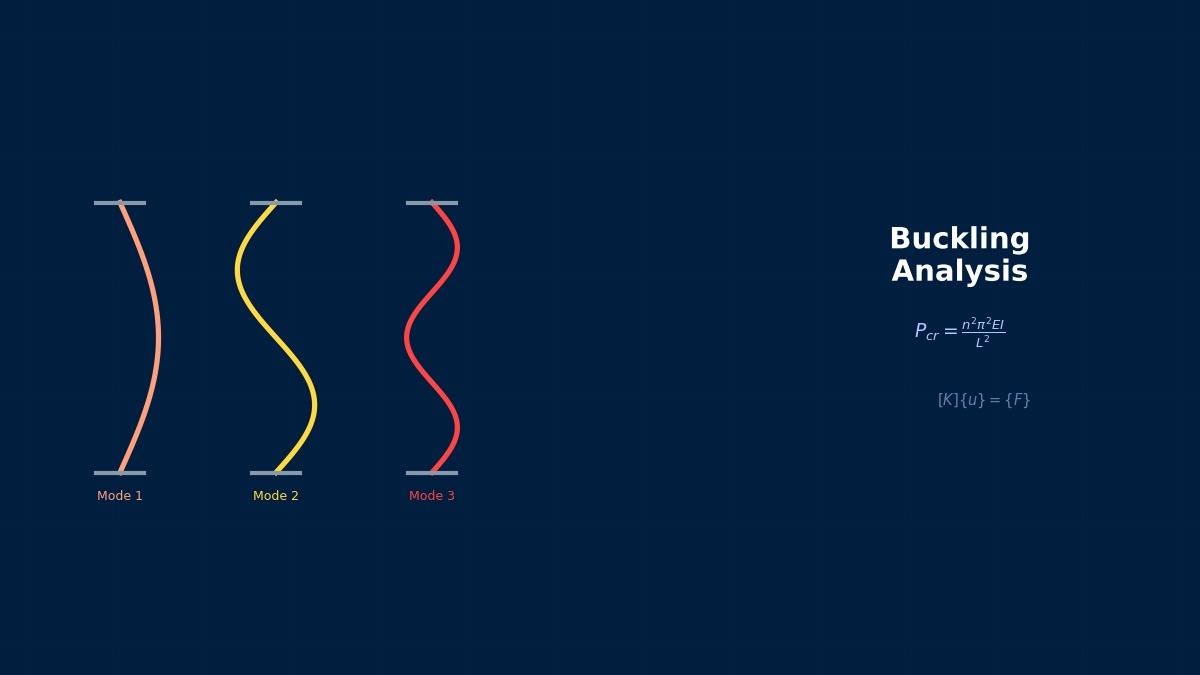
Nonlinear Post-Buckling Analysis: Theoretical Foundations
Overview — Why Pursue "Post-Buckling"?
If linear buckling analysis tells us the buckling load, why do we need to track what happens "after" buckling?
There are three reasons.
1. Real structures may not collapse immediately upon buckling. For example, the outer skin of an aircraft wing may experience local buckling under operational loads, yet the overall structure retains sufficient strength. This is called "utilization of post-buckling strength."
2. Eigenvalue buckling gives an upper bound and overestimates the actual collapse load. The actual collapse load, which includes initial imperfections and material nonlinearity, cannot be accurately evaluated without nonlinear analysis.
3. Identification of collapse mode. Knowing "how a structure fails" is fundamental to safe design. By tracking the entire load-displacement path, energy absorption capacity and ductility can also be evaluated.
The aircraft skin continues to be used even after buckling!?
Yes. Thin aluminum panels between stiffeners may buckle below the design load, but the stiffeners redistribute the load, allowing the overall structure to hold. If this post-buckling strength can be correctly evaluated, the structure can be further lightened. Conversely, ignoring post-buckling and designing everything not to buckle leads to excessive weight.
Load-Displacement Path and Singular Points
Can you explain "post-buckling" a bit more mathematically?
In nonlinear structural mechanics, the relationship between the load parameter $\lambda$ and the displacement vector $\{u\}$ is called the equilibrium path. There are two types of singular points on this path:
Bifurcation point — A point where the equilibrium path branches. Euler buckling in a perfect structure is an example.
Limit point — A point where the load reaches a maximum value. Snap-through buckling is an example.
So in both cases, the tangent stiffness matrix $[K_T]$ becomes singular.
Yes. However, their physical meanings are completely different. At a bifurcation point, the structure "transitions to a different deformation mode." At a limit point, the structure "can no longer carry additional load." Post-buckling analysis needs to correctly track both.
Koiter's Post-Buckling Theory
Someone laid the theoretical foundation for post-buckling, right?
Warner T. Koiter. In his 1945 doctoral dissertation at Delft University of Technology (written in Dutch and long unknown), he systematically classified the stability of post-buckling paths.
Expanding the post-buckling path near a bifurcation point as a power series:
Here $\xi$ is the mode amplitude parameter.
- $a \neq 0$ (Asymmetric bifurcation) — The post-buckling path tilts in one direction. Extremely sensitive to imperfections.
- $a = 0, b > 0$ (Stable symmetric bifurcation) — The load increases after buckling. Plate buckling is an example.
- $a = 0, b < 0$ (Unstable symmetric bifurcation) — The load decreases after buckling. Cylindrical shell buckling is an example.
$b < 0$ is "unstable" and highly imperfection-sensitive... So that's why experimental values for cylindrical shells are only 20% of the theoretical value!
Exactly. Koiter showed that the "shape of the post-buckling path" can predict "sensitivity to imperfections." This is one of the most important theoretical contributions in structural mechanics.
Tangent Stiffness Matrix Composition
How is $[K_T]$ in nonlinear analysis different from $[K_0] + \lambda[K_\sigma]$ in linear buckling?
In large deformation theory, the tangent stiffness matrix consists of three terms:
- $[K_0]$ — Elastic stiffness for small displacements (material stiffness)
- $[K_\sigma]$ — Geometric stiffness (influence of initial stress)
- $[K_L]$ — Large displacement stiffness (influence of shape change due to displacement)
So linear buckling ignores $[K_L]$.
Correct. Linear buckling assumes "deformation before buckling is small," so $[K_L] \approx 0$. However, in post-buckling, displacements become large, making $[K_L]$ non-negligible. Including $[K_L]$ is the core of "geometrically nonlinear analysis."
And when material nonlinearity (plasticity) is added, $[K_0]$ itself also becomes dependent on the stress state...
Yes. In elastoplastic post-buckling analysis, all three terms change depending on displacement and stress. That's why we need to trace the path step by step using an incremental-iterative method (a load-incremented version of the Newton-Raphson method).
Summary
Let me organize the theory of nonlinear post-buckling.
Key points:
- Post-buckling is necessary for "accurate evaluation of collapse load" and "identification of collapse mode."
- Bifurcation points and limit points on the equilibrium path — Two types of points where $[K_T]$ becomes singular.
- Koiter's theory — The shape of the post-buckling path (signs of $a, b$) determines imperfection sensitivity.
- $[K_T] = [K_0] + [K_\sigma] + [K_L]$ — The large displacement term $[K_L]$ is the core of nonlinear analysis.
- Some structures can still carry load after buckling — Utilizing post-buckling strength is key to weight reduction.
So if linear buckling tells us "when it buckles," nonlinear post-buckling tells us "what happens after it buckles."
That understanding is perfect. Next time, let's look at how to actually perform this path tracing — the numerical algorithm of the Riks method (arc-length method) in detail.
Discovery of Post-Buckling Behavior: von Kármán's Thin Plate Theory
The first person to theorize "post-buckling strength," where a structure can still carry load after buckling, was Theodore von Kármán (1932). Thin plates, after buckling, concentrate compressive loads at their edges and can carry loads up to 2-4 times the initial buckling load. This "effective width" concept is the foundation of modern cold-formed steel design codes (AISI S100) and is a crucial insight that can reduce the weight of thin-walled structures by 30-50%.
Computational Methods for Nonlinear Post-Buckling Analysis
Principle of the Riks Method (Arc-Length Method)
The Newton-Raphson method can't pass through buckling points, right? How is the Riks method different?
The fundamental difference is the control variable. The Newton-Raphson method uses load as the control variable. It increases the load step by step, seeking equilibrium at each increment. However, at the peak (limit point) of the load-displacement curve, two equilibrium solutions exist for the same load, causing the solver to become confused.
The Riks method uses arc length as the control variable. It treats both load $\lambda$ and displacement $\{u\}$ as unknowns, advancing along the equilibrium path based on "distance":
$\Delta s$ is the arc length, and $\psi$ is a scaling coefficient... So it treats load and displacement uniformly as "distance along a single curve."
Exactly. This allows passing through load peaks and tracking regions where the load decreases (snap-through, snap-back).
Implementation of the Modified Riks Method
What's the difference between the "modified Riks method" used in Abaqus and the standard Riks method?
It's an improvement on the methods by Crisfield (1981) and Riks (1979), differing in how the arc length constraint is applied. The key points are:
1. Predictor step — Predicts along the tangent direction from the previous increment.
2. Arc length constraint — Constrains the correction from the predictor using the arc length constraint.
3. Corrector iteration — Reduces the residual using the Newton-Raphson method.