Shell Buckling
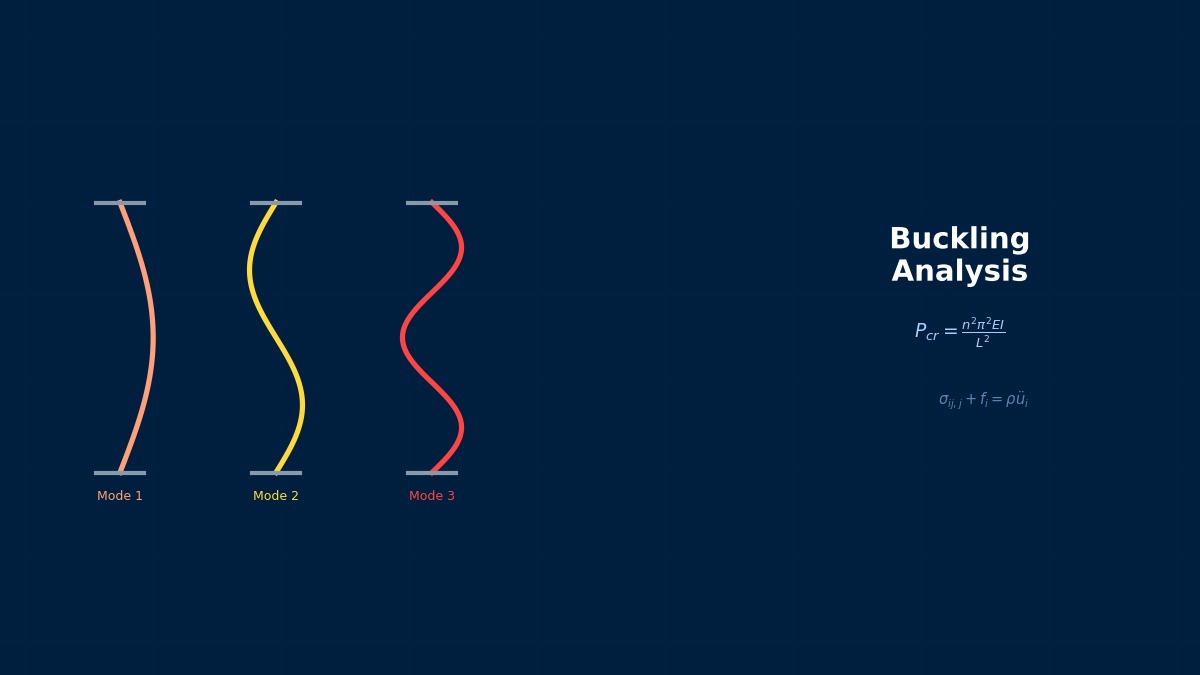
Shell Buckling: Theoretical Foundations
Uniqueness of Shell Buckling
Compared to plate buckling, what's different about shell (curved structure) buckling?
Shell buckling is the most dangerous and difficult-to-predict buckling phenomenon in structural mechanics. There are three fundamental differences from plate buckling.
1. Membrane-Bending Coupling. In plates, in-plane forces and out-of-plane bending are independent, but in shells, they are coupled due to curvature. This causes the curved surface itself to become a source of stiffness, resulting in a very high theoretical buckling stress.
2. Extreme Imperfection Sensitivity. For cylindrical shells under axial compression, experiments yield only 20-40% of the theoretical buckling load. This discrepancy was discovered in the 1930s and has been researched for over 70 years.
3. Unstable Post-Buckling Path. Plates can still carry load after buckling, but many shells experience a sudden drop in load the moment they buckle. This is what Koiter's theory calls "unstable symmetric bifurcation" ($b < 0$).
Experimental values being only 20% of theory... Does that mean using eigenvalue buckling analysis directly leads to a dangerously overestimated value by a factor of 5?
Exactly right. That's why in shell buckling, the knockdown factor (reduction factor from the theoretical value) becomes the central concept in design. From NASA's SP-8007 (1968) to the current ESA ECSS standards, the rational determination of this reduction factor has been the greatest challenge.
Classical Buckling Theory for Cylindrical Shells
Please tell me about the theoretical buckling stress for cylindrical shells.
The classical buckling stress for a thin-walled cylindrical shell under axial compression is:
(for $\nu = 0.3$)
Proportional to $t/R$... So it's determined solely by the ratio of thickness to radius. Length isn't involved!
This is the "classical solution" that holds widely from short to long cylinders. The buckling mode is a diamond-shaped pattern with many half-waves in the axial and circumferential directions. Because many modes cluster at the same eigenvalue ($0.605 Et/R$), mode clustering occurs.
Is mode clustering related to imperfection sensitivity?
They are directly related. Because many modes exist at the same energy level, slight imperfections cause interactions between modes, dramatically lowering the buckling load. This is the physical mechanism behind the imperfection sensitivity of shell buckling.
Cylindrical Shells Under External Pressure
What about under external pressure?
Buckling of long cylindrical shells under external pressure resembles column buckling. The critical external pressure is:
Here, $n$ is the number of circumferential waves. The $n$ that gives the minimum $p_{cr}$ is the buckling mode.
To the power of 3 for $t/R$! Compared to the power of 1 for axial compression, the sensitivity to thickness is incredibly high.
Yes. External pressure buckling is bending-dominated, hence the dependence on $t^3$. Even slight thinning (e.g., from corrosion) drastically reduces the buckling load, so thickness management is extremely important in pressure vessel inspections.
Knockdown Factor
Tell me about the knockdown factor in NASA SP-8007.
SP-8007 is a rocket structure design guideline issued by NASA in 1968. The recommended knockdown factor $\gamma$ for axially compressed cylinders is:
For a thin shell with $R/t = 500$, $\gamma \approx 0.25$... a quarter of the theoretical value.
It's quite conservative. Actually, SP-8007 is based on the lower bound envelope of experimental data from the 1930s-60s. Manufacturing precision was low and imperfections were large back then. With modern manufacturing techniques (precision rolling, machining), higher buckling loads are achievable, and SP-8007 has been criticized as "excessively conservative."
Are there any new standards?
There is ESA's ECSS-E-HB-32-24A (revised 2010) and the results of the NASA/ESA joint DESICOS project. These use individual assessment based on measured imperfection data, probabilistic buckling evaluation, and non-destructive buckling prediction via VCT (Vibration Correlation Technique) to derive knockdown factors more rational than SP-8007.
Summary
I understand the theory and the frightening nature of shell buckling now.
Key Points:
- Shell buckling is the most imperfection-sensitive buckling phenomenon — can drop to 20-40% of the theoretical value
- Classical solution $\sigma_{cr} \approx 0.605 Et/R$ — beautiful but cannot be used directly for real structures
- Mode clustering is the physical cause of imperfection sensitivity — many modes at the same energy level
- Knockdown factor is the core of design — SP-8007 is conservative, new standards are under development
- Eigenvalue buckling analysis alone is completely insufficient — nonlinear analysis considering imperfections is absolutely necessary
So, using eigenvalue buckling results directly as design values for shell buckling is absolutely unacceptable, right?
Absolutely unacceptable. If you give a design OK for shell buckling based solely on eigenvalue analysis, it signifies a lack of literacy in structural mechanics. Either a knockdown factor or nonlinear analysis is absolutely necessary.
The Knockdown Factor Problem for Thin-Walled Shell Buckling
The experimental buckling load for thin-walled cylindrical shells is only 25-80% of the linear theory value. This discrepancy has been known as the "knockdown factor" problem since the 1930s. The theoretical formulas by Lorenz, Timoshenko, and Southwell predict 3-4 times the experimental value, so NASA SP-8007 (1968) adopted an empirical correction formula that significantly reduces the design load by setting γ=0.6.
Computational Methods for Shell Buckling
FEM Analysis Strategy for Shell Buckling
When analyzing shell buckling with FEM, what's different from plate buckling?
It's significantly more difficult than plate buckling in three aspects.
1. Stricter mesh requirements. Buckling wavelength can be on the order of the plate thickness, requiring very fine meshes.
2. Modeling of initial imperfections dominates the results. In plates, the effect of initial imperfections is small, but in shells, buckling load can vary by several times depending on the imperfection pattern and amplitude.
3. Difficult convergence in nonlinear analysis. Due to snap-back behavior, tracking often fails even with the Riks method.
How to Use Eigenvalue Buckling Analysis
You said eigenvalue buckling can't be used for shells, but is it not used at all?
It's "not directly usable as a design value", but eigenvalue analysis itself plays an important role:
1. Confirm the upper bound of buckling load — If nonlinear analysis results exceed this, something is wrong
2. Use mode shapes as initial imperfections — Preprocessing for nonlinear analysis
3. Identify critical locations — Screening for where buckling is likely to occur
4. Starting point for knockdown factor — Rough estimate of design load via $P_{cr,FEM} \times \gamma$
Approaches to Imperfection Modeling
What's the best way to introduce initial imperfections for shells?
There are four approaches. Listed in order of reliability:
1. Measured Imperfections
Scan the actual structure's shape with a laser and directly input the difference from the ideal shape as initial imperfections. Most reliable, but cannot be used without a prototype.
2. Eigenvalue Mode Superposition (EIMP Method)
The most common method. Creates initial shape by superimposing lower linear buckling modes:
Amplitude is typically 0.5 to 2.0 times the thickness $t$. The problem is that the worst-case amplitude combination is unknown.
3. SPLA (Single Perturbation Load Approach)
Apply a concentrated load at one point on the shell to intentionally create a dent, then perform nonlinear analysis with that dent. Proposed by DLR (German Aerospace Center) Hühne (2008). Physically clear and highly reproducible.
4. Random Imperfections
Generate imperfections using random coefficients in a Fourier series. Used for probabilistic evaluation combined with Monte Carlo simulation.
Related Topics
Experience the theory firsthand with the interactive simulator for this field
All Simulators