Thermal Buckling Analysis
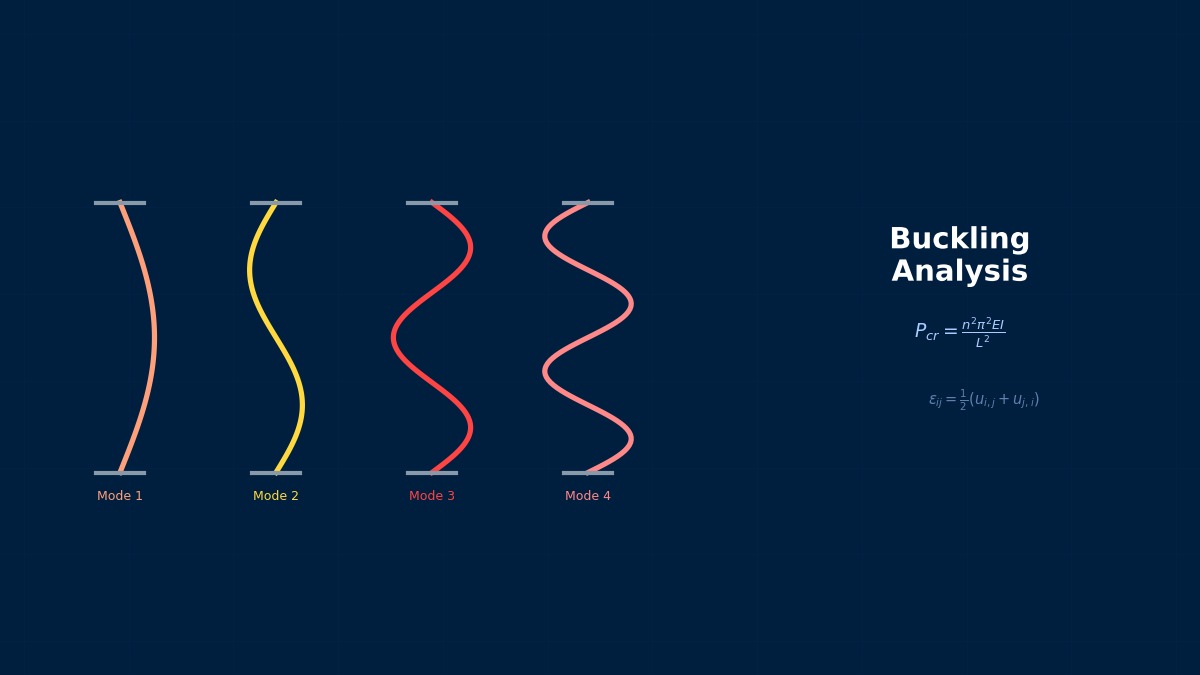
Thermal Buckling Analysis: Theoretical Foundations
What is Thermal Buckling?
Professor, can buckling occur due to heat? Even when no force is applied?
Good question. Thermal buckling is buckling caused by compressive stress generated by temperature changes. If a structure can expand freely, thermal stress does not occur, but if expansion is constrained, compressive stress is generated.
Is the bending of railroad rails on hot days also thermal buckling?
Exactly. Rails are constrained in axial expansion by the sleepers. The axial stress generated by a temperature rise $\Delta T$ is:
Here $\alpha$ is the coefficient of linear expansion. For steel ($\alpha \approx 12 \times 10^{-6}$ /°C, $E = 200$ GPa) with $\Delta T = 40$ °C, $\sigma_{th} = 96$ MPa. If this exceeds the buckling stress, the rail bends sideways.
96 MPa from a 40°C temperature difference... that's larger than I thought.
Yes. Thermal stress is proportional to the degree of constraint. Under full constraint, it is $E\alpha\Delta T$, but if expansion is partially allowed, the stress decreases. Correctly evaluating the degree of constraint in real structures is the first step in thermal buckling analysis.
Governing Equations for Thermal Buckling
Is the formulation of thermal buckling different from mechanical buckling?
The framework of eigenvalue buckling is the same. However, the reference load becomes the thermal load:
1. Perform a thermal stress analysis given a temperature distribution $\Delta T(x,y,z)$
2. Construct $[K_\sigma]$ from the obtained thermal stress
3. Solve the eigenvalue problem $([K_0] + \lambda [K_\sigma])\{\phi\} = \{0\}$
$\lambda$ is the buckling thermal load factor. $\lambda \cdot \Delta T$ is the critical temperature rise.
There are cases where the temperature distribution is not uniform, right?
In real structures, temperature distribution is usually non-uniform. For example, a beam during a fire has a hot bottom surface and a relatively cool top surface. If only one side of a plate is heated, a bending moment due to the temperature gradient also occurs.
There are two effects of temperature:
- Membrane stress (in-plane compression/tension) — The driving force for buckling
- Bending moment (temperature gradient through the thickness) — Induces additional deformation
Thermal Buckling of Plates
Is there a theoretical solution for thermal buckling of plates?
Critical temperature rise for a uniformly heated rectangular plate with four edges constrained:
The square of the ratio of plate thickness $t$ to width $b$ is included. Thinner plates buckle at lower temperature rises.
Moreover, Young's modulus $E$ is not in this formula! Under ideal constraint conditions, the critical temperature depends only on geometric parameters ($t/b$) and the coefficient of linear expansion $\alpha$, not on the material's stiffness.
Being independent of material is counterintuitive...
Under full constraint, thermal stress is $E\alpha\Delta T$, and buckling stress is $E \cdot f(t/b)$, so when taking the ratio, $E$ cancels out. However, real structures are not fully constrained, so the influence of $E$ appears.
Thermal Buckling Problems in Real Structures
Please give me examples of real-world problems where thermal buckling is an issue.
Typical examples:
| Structure | Situation | Characteristics |
|---|---|---|
| Railroad Rails | Summer temperature rise | Lateral buckling of continuously welded rails |
| Pipelines | Transport of high-temperature fluid | Lateral buckling (snaking) of subsea pipelines |
| Aircraft Skin Panels | Aerodynamic heating during supersonic flight | Buckling of thin panels |
| Space Structures | Temperature difference between sunlit/shaded areas | Solar panels, Antennas |
| Welded Structures | Local heating during welding | Welding distortion (angular distortion, buckling distortion) |
| Buildings during Fire | Heating of steel beams | Axial force buckling of beams with constrained ends |
Subsea pipeline buckling sounds interesting.
Thermal buckling of subsea pipelines is a critical issue in the oil and gas industry. When hot crude oil flows through, the pipe tries to expand but is constrained by seabed friction. When the temperature rises beyond a certain point, the pipe snakes laterally (lateral buckling). There is a design method called "designed lateral buckling" to intentionally control this.
Summary
Let me organize the theory of thermal buckling.
Key points:
- Thermal buckling is caused by compressive stress from "constrained thermal expansion" — No buckling if expansion is free
- $\sigma_{th} = E\alpha\Delta T$ — Thermal stress under full constraint
- Evaluation of the degree of constraint is key — Real structures are neither fully constrained nor completely free
- In FEM, a two-step process: thermal stress analysis → eigenvalue buckling analysis — Can handle non-uniform temperature distributions
- Temperature gradient generates both membrane stress and bending — One-sided heating is particularly dangerous
The scary part about thermal buckling is that "buckling can occur without applying force." Temperature management directly affects structural safety.
Exactly. Thermal buckling is easily overlooked in design because the "load" is invisible. Structures used in environments with large temperature changes should always consider the possibility of thermal buckling.
Thermal Buckling and the Bimetallic Strip
Buckling due to heat occurs when compressive thermal stress reaches the buckling load. The "bimetallic strip" (a two-layer metal plate with different thermal expansion coefficients) experimented by Johann Christoph Baugarten (Germany) in the 1780s is precisely the prototype of thermal buckling. Thermostats operating on this principle were industrialized in the 1900s and are still used for automatic cutoff in power and air conditioning systems.
Computational Methods for Thermal Buckling Analysis
Thermal Buckling Analysis by FEM
Please explain the procedure for analyzing thermal buckling with FEM.
It's a two-step (or three-step) procedure.
Step 1: Determination of Temperature Field
Determine the temperature distribution $T(x,y,z)$ via steady-state or transient heat conduction analysis. For simple uniform heating, temperature can be assigned manually.
Step 2: Thermal Stress Analysis
Input the obtained temperature field into structural analysis to calculate the stress distribution due to thermal expansion. Boundary conditions (constraint conditions) greatly influence the results at this stage.
Step 3: Eigenvalue Buckling Analysis
Construct the geometric stiffness matrix from the thermal stress in Step 2 and solve the eigenvalue problem. $\lambda$ is the critical thermal load factor.
What about cases combined with mechanical loads?
When mechanical and thermal loads act simultaneously, apply the mechanical load as a preload and evaluate buckling against the additional thermal load. If temperature and mechanical load vary independently, note that the "proportional load" assumption of eigenvalue buckling breaks down.
Nastran
```
SOL 105
CEND
SUBCASE 1
TEMPERATURE(LOAD) = 100
SPC = 1
METHOD = 10
```
Specify temperature distribution with the TEMPERATURE card. Define nodal temperatures with TEMP/TEMPD cards. Set the thermal expansion coefficient (A) in MAT1 correctly.
Abaqus
Related Topics
Experience the theory firsthand with the interactive simulator for this field
All Simulators