Effective Mass Ratio and Modal Participation Factor
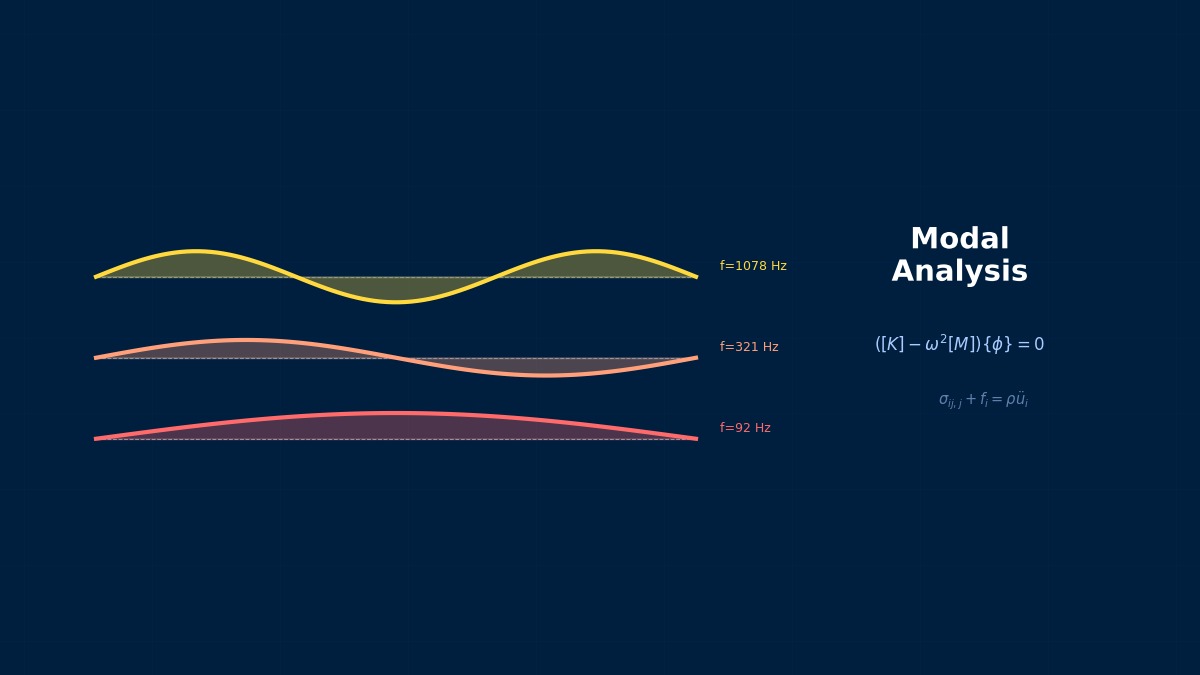
Effective Mass Ratio and Modal Participation: Theoretical Foundations
What is Effective Mass?
Professor, what is "effective mass" (modal effective mass)?
Effective mass is an indicator that shows how much each vibration mode responds to external inertial forces (earthquake, acceleration). Modes with large effective mass dominate the dynamic response of the structure.
So not all modes respond equally?
Correct. For example, the first bending mode of a cantilever beam has a large effective mass, but the second mode is smaller than the first. Effective mass quantifies the "importance" of each mode.
Mathematical Definition
Effective mass in the x-direction for the $i$-th mode:
Here $\{1_x\}$ is the unit vector in the x-direction (all x-direction degrees of freedom of all nodes are 1, others are zero).
The numerator is the inner product of the mode shape and the "entire structure moving in the x-direction" pattern... it's the "degree of similarity" between the mode and the inertial force, right?
Perfect understanding. Modes where the entire structure moves in one direction (translational modes) have large effective mass, while local modes or rotational modes have small effective mass.
Effective Mass Ratio
The sum of effective masses equals the total mass:
It is often expressed as the effective mass ratio (effective mass / total mass) for each mode.
So the sum of the effective mass ratios for all modes becomes 100%, right?
Yes. In practice, we find "the number of modes until the cumulative effective mass ratio reaches 90%". This is the criterion for determining the required number of modes.
Participation Factor
What is the "modal participation factor"?
It corresponds to the square root of the numerator of the effective mass:
In Nastran, output effective mass with PARAM,EFFMASS. In Abaqus, output with History Output's MODAL EFFECTIVE MASS.
Practical Usage
| Application | How to Use Effective Mass |
|---|---|
| Determining number of modes for seismic response analysis | Number of modes covering 90% in each direction |
| Identifying dominant modes | The mode with the largest effective mass is the primary response |
| Verifying accuracy of mode superposition method | Validity of number of modes based on effective mass coverage rate |
| Checking mass distribution | Modes with zero effective mass are symmetric modes (do not respond to asymmetric input) |
So for seismic response analysis, "90% coverage" is the standard, right?
The Building Standards Law and Eurocode 8 stipulate a 90% effective mass ratio for the mode superposition method. The number of modes that satisfies this is the minimum required number of modes.
Summary
Let me organize the effective mass ratio and participation factor.
Key points:
- Effective mass = Indicator of how much a mode responds to inertial force
- Sum of all modes = Total mass — The "ratio of importance" for each mode
- 90% coverage is the practical standard — Determining the required number of modes
- Modes with large effective mass are dominant — Modes to focus on in design
- Effective mass differs for each direction — Check separately for $x, y, z$ directions
Looking at the effective mass, you can immediately see "which modes are important". I'll get into the habit of looking at effective mass as well as natural frequency.
Effective mass is what you should look at "next" after natural frequency and mode shape. These three (frequency, mode shape, effective mass) are the three pillars of vibration analysis.
The "90% Rule" for Effective Mass Fraction
The effective mass fraction is used to confirm whether a sufficient number of modes have been obtained in modal analysis. ASME and European seismic codes require calculation up to the number of modes where the cumulative effective mass in each of the three principal directions reaches 90% or more of the total mass. This is called the "90% rule," a convention established from the 1970s NRC (U.S. Nuclear Regulatory Commission) standards.
Computational Methods for Effective Mass Ratio and Modal Participation
How to Output Effective Mass
How do you output effective mass in FEM?
Nastran
```
PARAM, EFFMASS, YES
```
The effective mass ratio and cumulative value for each mode are output to the f06 file.
Abaqus
```
*OUTPUT, HISTORY
*MODAL DYNAMIC
PARTICIPATION FACTOR, EFFECTIVE MODAL MASS
```
Ansys
```
MODOPT, LANB, 50
MXPAND, 50, , , YES ! Expand mode shapes and output effective mass
```
Or check with Workbench's "Effective Mass Summary".
How do you read the effective mass table in Nastran's f06 file?
```
MODE FREQ(HZ) T1 FRACTION T2 FRACTION T3 FRACTION R1 FRACTION ...
1 15.2 0.4521 0.0000 0.0000 0.0000
2 23.8 0.0000 0.3856 0.0000 0.0000
3 45.1 0.1823 0.0000 0.0000 0.0012
...
TOTAL 0.9234 0.9156 0.8912 ...
```
T1, T2, T3 are translational effective mass ratios in $x, y, z$ directions. R1, R2, R3 are rotational. The TOTAL row shows cumulative values.
If the cumulative in the $x$ direction is 0.92 (92%), that means 50 modes cover 92% of the $x$-direction response, right?
Yes. If it hasn't reached 90%, you need to increase the number of modes.
Interpreting Modes with Small Effective Mass
There are many modes with almost zero effective mass.
So just because the effective mass is zero doesn't mean you can ignore it, right?
They don't contribute to seismic response, but are related to resonance from mechanical vibration (e.g., imbalance of rotating parts). The "important modes" differ depending on the application.
Summary
Let me organize the numerical methods for effective mass.
Key points:
- Easy output with PARAM,EFFMASS (Nastran) — Check the table in f06
- Check effective mass ratio for each direction separately — $x, y, z, \theta_x, \theta_y, \theta_z$
- Cumulative 90% is the criterion for number of modes — Design code requirement
- Modes with zero effective mass = local modes — Do not contribute to overall response but watch for local resonance
Effective Mass Formula and Participation Factor
The effective mass of the n-th mode Mn,eff = (Γn)²/Mn (Γn=modal participation factor, Mn=generalized mass). It is theoretically guaranteed that the sum of effective masses of all modes equals the total mass, and this property can be used to estimate the "mass of modes missed in calculation". FEM software usually outputs this data automatically after eigenvalue analysis.