Floor Response Spectrum
Category: 構造解析 | Integrated 2026-04-06
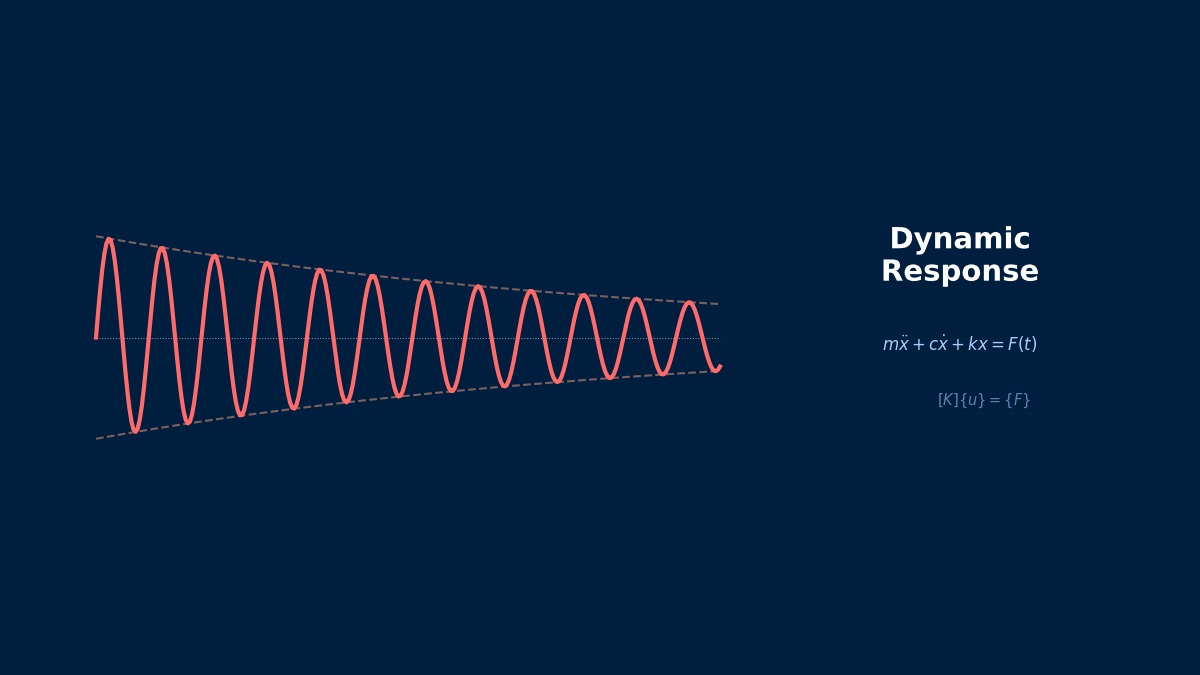
CAE visualization for floor response spectrum theory - technical simulation diagram
床応答スペクトル

Theory and Physics

What is a Floor Response Spectrum?

🧑‍🎓

Professor, what is a "floor response spectrum"?


🎓

It's the response spectrum at each floor level of a building. The seismic input from the ground passes through the building and is amplified at each floor. It's used for seismic evaluation of equipment.


🎓

Flow: Earthquake → Ground → Foundation → Building (amplification) → Floor acceleration at each level → Input to equipment


🧑‍🎓

So the building acts as a "filter" that amplifies the earthquake.


🎓

Components near the building's natural frequency are amplified. The amplification is larger on higher floors.


Calculation Method

🎓

1. Time history response analysis with the building's FEM model — Seismic wave input → Acceleration time history at each floor

2. Calculate SRS (Response Spectrum) from each floor's acceleration time history — Input spectrum for equipment

3. Seismic evaluation of equipment — Calculate equipment response using the floor response spectrum as input


🧑‍🎓

So it's a three-stage process: building analysis → floor response spectrum → equipment analysis?


🎓

In nuclear power plants, the standard workflow is: building (RC structure) seismic response analysis → floor response spectrum → seismic evaluation of equipment (piping, valves, electrical panels, etc.).


Summary

🎓

Key Points:


  • Response spectrum at each floor of the building — Seismic input for equipment
  • Building amplifies the earthquake — Near the natural frequency. Larger on higher floors
  • Building time history → SRS → Equipment evaluation — Three stages
  • Most important in nuclear seismic design — Complies with NRC Reg Guide

Coffee Break Yomoyama Talk

Floor Response Spectrum is the "Earthquake Inside the Building"

The Floor Response Spectrum (FRS) is an index indicating the severity of input that each floor of a building imparts to a single-degree-of-freedom oscillator (equipment) during an earthquake. The concept of a "two-stage analysis," where building analysis results using ground spectrum as input are recalculated at each floor, was proposed by G.W. Housner in 1956. In nuclear facilities, using building FRS for seismic design of equipment and piping has become the world standard (ASCE 4-98, etc.).

Physical Meaning of Each Term
  • Inertia Term (Mass Term): $\rho \ddot{u}$, i.e., "mass × acceleration". Have you ever experienced being thrown forward when a car brakes suddenly? That "feeling of being carried away" is precisely the inertial force. Heavier objects are harder to set in motion and harder to stop once moving. Buildings shake during earthquakes because the ground moves suddenly while the building's mass "gets left behind." In static analysis, this term is set to zero, which assumes "forces are applied slowly enough that acceleration can be ignored." It absolutely cannot be omitted for impact loads or vibration problems.
  • Stiffness Term (Elastic Restoring Force): $Ku$ or $\nabla \cdot \sigma$. When you stretch a spring, you feel a "force trying to return it," right? That's Hooke's law $F=kx$, the essence of the stiffness term. So here's a question——an iron rod and a rubber band, which stretches more when pulled with the same force? Obviously the rubber. This "resistance to stretching" is the Young's modulus $E$, which determines stiffness. A common misconception: "High stiffness = strong" is incorrect. Stiffness is "resistance to deformation," strength is "resistance to failure"—they are different concepts.
  • External Force Term (Load Term): Body force $f_b$ (gravity, etc.) and surface force $f_s$ (pressure, contact force, etc.). Think of it this way——the weight of a truck on a bridge is a "force acting on the entire volume" (body force), while the force of the tires pushing on the road is a "force acting only on the surface" (surface force). Wind pressure, water pressure, bolt tightening force... all are external forces. A typical mistake here: getting the load direction wrong. Intending "tension" but modeling "compression"—sounds like a joke, but it actually happens when coordinate systems are rotated in 3D space.
  • Damping Term: Rayleigh damping $C\dot{u} = (\alpha M + \beta K)\dot{u}$. Try plucking a guitar string. Does the sound continue forever? No, it gradually fades. That's because vibration energy is converted to heat by air resistance and internal friction in the string. Car shock absorbers work on the same principle—they intentionally absorb vibration energy to improve ride comfort. What if damping were zero? The building would keep shaking forever after an earthquake. Since that doesn't happen in reality, setting appropriate damping is crucial.
Assumptions and Applicability Limits
  • Continuum assumption: Treats material as a continuous medium, ignoring microscopic heterogeneity
  • Small deformation assumption (for linear analysis): Deformation is sufficiently small compared to initial dimensions, and the stress-strain relationship is linear
  • Isotropic material (unless specified otherwise): Material properties are independent of direction (anisotropic materials require separate tensor definitions)
  • Quasi-static assumption (for static analysis): Ignores inertial and damping forces, considering only the balance between external and internal forces
  • Non-applicable cases: For large deformation/large rotation problems, geometric nonlinearity is required. For nonlinear material behavior like plasticity or creep, constitutive law extensions are needed
Dimensional Analysis and Unit Systems
VariableSI UnitNotes / Conversion Memo
Displacement $u$m (meter)When inputting in mm, unify loads and elastic modulus to MPa/N system
Stress $\sigma$Pa (Pascal) = N/m²MPa = 10⁶ Pa. Be careful of unit inconsistency when comparing with yield stress
Strain $\varepsilon$Dimensionless (m/m)Note the distinction between engineering strain and logarithmic strain (for large deformation)
Elastic modulus $E$PaSteel: ~210 GPa, Aluminum: ~70 GPa. Note temperature dependence
Density $\rho$kg/m³In mm system: tonne/mm³ (= 10⁻⁹ tonne/mm³ for steel)
Force $F$N (Newton)Unify as N in mm system, N in m system

Numerical Methods and Implementation

Floor Response Spectrum Calculation

🎓

Calculate building time history with Nastran SOL 112 (modal transient) or SOL 109 (direct transient), then generate SRS from acceleration at each floor node.


🎓

Direct method: Automatic SRS output using Nastran's PARAM,SRS.


Or calculate SRS from acceleration time history using Python/MATLAB.


Broadening (Peak Broadening)

🎓

A process to widen the peaks of the floor response spectrum by approximately ±15%. Accounts for uncertainties in building modeling. Specified in NRC Reg Guide 1.122.


🧑‍🎓

So you widen the peaks to be on the conservative side.


🎓

The FEM model of the building has about ±10% uncertainty in its natural frequencies. Broadening the peaks ensures the equipment evaluation remains conservative even if the actual peak location shifts.


Summary

🎓
  • FEM time history → SRS post-processingNastran PARAM,SRS or Python
  • Peak Broadening — ±15%. NRC Reg Guide 1.122
  • Nuclear standard workflow — Building analysis → Floor spectrum → Equipment evaluation

  • Coffee Break Yomoyama Talk

    FRS Broadening Standard is 15% per US NRC

    "Broadening," which widens the spectrum left and right to account for uncertainties (model errors in building natural frequencies, soil-structure interaction, etc.), is standardized at ±15% (i.e., a total width of 30%) in NRC Regulatory Guide 1.122. A similar concept is adopted in Japan's seismic design review guidelines, reducing the risk that actual peak acceleration is evaluated lower than the analysis value.

    Linear Elements (1st Order Elements)

    Linear interpolation between nodes. Low computational cost but lower stress accuracy. Beware of shear locking (mitigated with reduced integration or B-bar method).

    Quadratic Elements (with Mid-side Nodes)

    Can represent curved deformation. Stress accuracy improves significantly, but degrees of freedom increase by about 2-3 times. Recommended: when stress evaluation is important.

    Full Integration vs Reduced Integration

    Full Integration: Risk of over-constraint (locking). Reduced Integration: Risk of hourglass modes (zero-energy modes). Choose appropriately.

    Adaptive Mesh

    Automatic refinement based on error indicators (e.g., ZZ estimator). Efficiently improves accuracy in stress concentration areas. Includes h-method (element subdivision) and p-method (order increase).

    Newton-Raphson Method

    Standard method for nonlinear analysis. Updates tangent stiffness matrix each iteration. Quadratic convergence within convergence radius, but high computational cost.

    Modified Newton-Raphson Method

    Updates tangent stiffness matrix using initial value or every few iterations. Lower cost per iteration, but convergence is linear.

    Convergence Criteria

    Force residual norm: $||R|| / ||F_{ext}|| < \epsilon$ (typically $\epsilon = 10^{-3}$〜$10^{-6}$). Displacement increment norm: $||\Delta u|| / ||u|| < \epsilon$. Energy norm: $\Delta u \cdot R < \epsilon$

    Load Increment Method

    Applies total load not all at once, but in small increments. The arc-length method (Riks method) can trace beyond limit points on the load-displacement curve.

    Analogy: Direct Method vs Iterative Method

    The direct method is like "solving simultaneous equations accurately with pen and paper"—reliable but takes too long for large-scale problems. The iterative method is like "repeatedly guessing to approach the correct answer"—starts with a rough answer but improves accuracy with each iteration. It's the same principle as looking up a word in a dictionary: it's more efficient to open it at an estimated location and adjust forward/backward (iterative) than to search sequentially from the first page (direct).

    Relationship Between Mesh Order and Accuracy

    1st order elements are like "approximating a curve with a ruler"—represented by straight line segments, so accuracy is limited. 2nd order elements are like a "flexible curve"—can represent curved changes, dramatically improving accuracy even at the same mesh density. However, computational cost per element increases, so judge based on total cost-effectiveness.

    Practical Guide

    Floor Response Spectrum in Practice

    🎓

    Seismic evaluation of equipment in nuclear power plants is the primary application.


    Practical Checklist

    🎓
    • [ ] Does the building model's natural frequency align with the site response analysis?
    • [ ] Are the seismic waveforms (SSE, OBE) correct?
    • [ ] Is the acceleration time history for each floor output?
    • [ ] Is the SRS calculated correctly (damping ratio, frequency range)?
    • [ ] Is peak broadening (±15%) applied?
    • [ ] Is the correct floor selected for use as seismic input for equipment?

    • Coffee Break Yomoyama Talk

      Top Floor FRS of Reactor Buildings Can Be 10 Times Ground Input

      In nuclear power plant reactor buildings, the amplification effect can cause the top floor FRS acceleration to reach 5 to 15 times the ground input. Analysis by the Central Research Institute of Electric Power Industry after the 1995 Great Hanshin-Awaji Earthquake found cases where FRS back-calculated from actual seismograph records exceeded the design FRS by up to 3 times. This experience prompted the 2006 NRC guideline revision and the formulation of Japan's new seismic design review guidelines.

      Analogy for Analysis Flow

      The analysis flow is actually very similar to cooking. First, you buy ingredients (prepare CAD model), do the prep work (mesh generation), apply heat (solver execution), and finally plate it (post-processing visualization). Here's an important question——in cooking, which step is most prone to failure? Actually, it's the "prep work." If mesh quality is poor, the results will be a mess no matter how good the solver is.

      Pitfalls Beginners Often Fall Into

      Are you checking mesh convergence? Do you think "the calculation ran = the result is correct"? This is actually the most common trap for CAE beginners. The solver will always return "some answer" for the given mesh. But if the mesh is too coarse, that answer can be far from reality. Confirm that results stabilize across at least three levels of mesh density—neglecting this leads to the dangerous assumption that "the computer gave the answer, so it must be correct."

      Thinking About Boundary Conditions

      Setting boundary conditions is like "writing the problem statement" for an exam. If the problem statement is wrong? No matter how accurately you calculate, the answer will be wrong. "Is this surface really fully fixed?" "Is this load really uniformly distributed?"—Correctly modeling real-world constraints is often the most critical step in the entire analysis.

      Software Comparison

      Tools for Floor Response Spectrum

      🎓
      • Nastran SOL 109/112 — Building time history. Automatic SRS output
      • Abaqus *DYNAMIC — Time history analysis → Post-process with Python
      • SASSI (System for Analysis of SSI) — Dedicated code for soil-structure coupling
      • ACS SASSI — Integrated SSI + floor spectrum

      • Selection Guide

        🎓
        • Nuclear seismicNastran + SASSI (industry standard)
        • Building equipment seismic → Integrated building calculation software +

          Related Topics

          関連シミュレーター

          この分野のインタラクティブシミュレーターで理論を体感しよう

          シミュレーター一覧

          関連する分野

          この記事の評価
          ご回答ありがとうございます!
          参考に
          なった
          もっと
          詳しく
          誤りを
          報告
          参考になった
          0
          もっと詳しく
          0
          誤りを報告
          0
          Written by NovaSolver Contributors
          Anonymous Engineers & AI — サイトマップ