Modal Transient Response Analysis (Modal Transient)
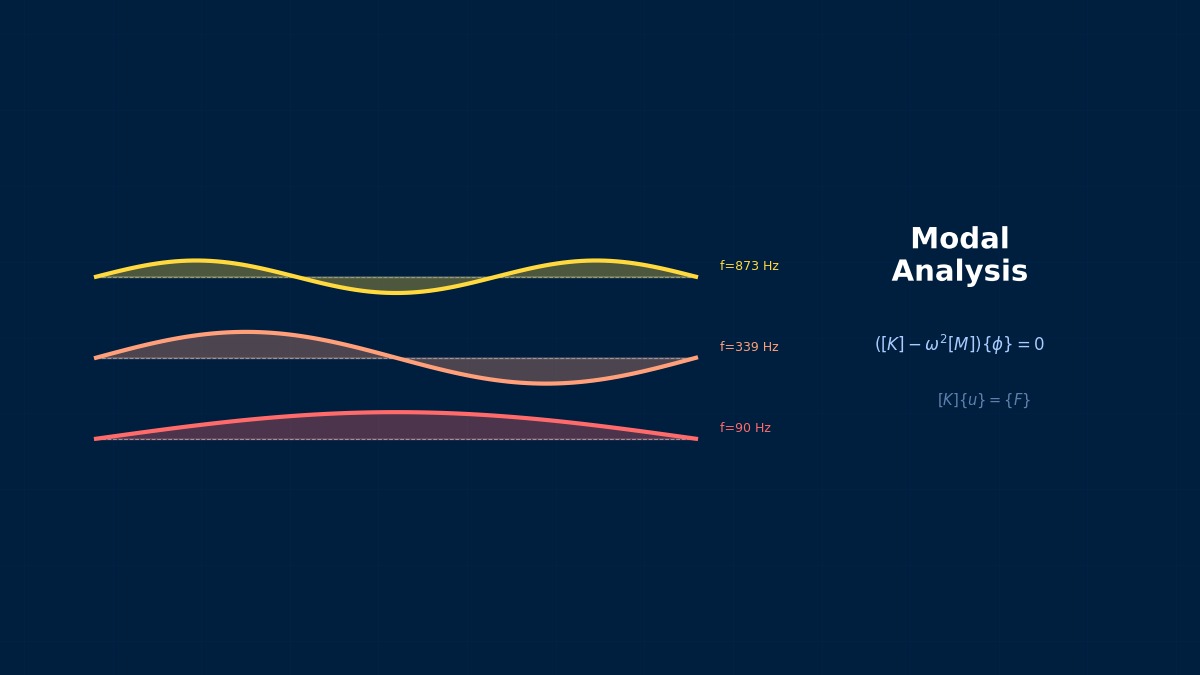
Modal Transient Response Analysis (Modal Transient): Theoretical Foundations
What is Modal Transient Response?
Professor, how is "Modal Transient Response Analysis" different from the modal method for frequency response? The names sound similar, but I'm not sure if what they do is different or the same.
Good question. The common point is "expanding into eigenmodes to reduce the problem size." The difference lies in the domain of input and output. Frequency response finds the "steady-state response under continuous excitation at a constant frequency." Transient response finds the time-history response to arbitrary time-varying external forces—impact, seismic waves, step loads.
Specifically, in what situations is it used?
Let me give three typical examples. (1) Satellite vibration during rocket launch—engine thrust fluctuations excite the structure over several seconds. (2) Automotive door slam shock—the transient response of the impulse at the moment of door closure propagating through the entire body. (3) Seismic response of buildings—for the elastic range, the behavior of base-isolated buildings can be predicted with tens of modes. All are "linear problems where the load changes over time," where the modal method excels.
Governing Equation and Modal Expansion
The starting point is the equation of motion for a multi-degree-of-freedom system:
$[M]$: mass matrix, $[C]$: damping matrix, $[K]$: stiffness matrix, $\{F(t)\}$: time-varying external force vector. For $N$ degrees of freedom, this requires solving an $N \times N$ system of equations at every time step. This is the direct method.
For 1 million DOF and 10,000 steps, you'd solve a 1 million x 1 million matrix each time? That sounds tough...
That's where the Mode Superposition Method comes in. Expand the displacement in terms of eigenmodes:
$\{\phi_i\}$ is the $i$-th eigenmode shape, $q_i(t)$ is the modal coordinate (generalized coordinate), $m$ is the number of modes used ($m \ll N$). Substituting this expansion into the equation of motion and multiplying from the left by $[\Phi]^T$ gives—
The system of equations decouples using modal orthogonality, right?
Exactly. For mass-normalized modes, $[\Phi]^T[M][\Phi] = [I]$ and $[\Phi]^T[K][\Phi] = \mathrm{diag}(\omega_i^2)$ hold. If damping is proportional (Rayleigh type), $[\Phi]^T[C][\Phi] = \mathrm{diag}(2\zeta_i\omega_i)$ is also diagonalized. As a result, each mode becomes an independent single-degree-of-freedom system:
$f_i(t) = \{\phi_i\}^T\{F(t)\}$ is the modal load (generalized force). 1 million DOF is reduced to 30 single-degree-of-freedom systems—computation time is dramatically shortened.
Modal Participation Factor and Effective Mass
How do you judge "how many modes are sufficient"?
The key is the modal participation factor and effective mass. The participation factor for the $i$-th mode in a certain direction $\{d\}$ (e.g., X-direction = [1,0,0,…]) is:
The effective mass is $M_{\mathrm{eff},i} = \Gamma_i^2$. Summing the effective mass of all modes gives the total mass: $\sum_{i=1}^{N} M_{\mathrm{eff},i} = M_{\mathrm{total}}$. In practice, the basic rule is to adopt the number of modes where the cumulative effective mass reaches 90% or more of the total mass. This 90% criterion is also specified in nuclear standards (NQA-1) and space standards (ECSS-E-ST-32C).
About how many modes are needed to reach 90%?
It depends on the structure, but roughly: buildings: 10–30 modes, equipment/satellites: 50–200 modes, piping systems: sometimes 300+ modes. Piping has many local modes, so effective mass is dispersed. However, increasing the number of modes only increases computation time linearly, so it's still overwhelmingly faster than the direct method.
Comparison with Direct Method
| Item | Modal Method (Modal Transient) | Direct Method (Direct Transient) |
|---|---|---|
| Governing Equation | $m$ independent SDOF systems | Solve $N \times N$ system of equations every step |
| Speed (1M DOF) | Very fast (proportional to # of modes) | Slow (strongly depends on $N$) |
| Nonlinear Capability | No (contact, plasticity, large deformation) | Possible |
| Frequency Range | Up to highest natural frequency of used modes | Full bandwidth determined by time step |
| Output Flexibility | Can evaluate contribution of each mode individually | Direct output of physical quantities |
| Damping Treatment | Modal damping (assumes proportional damping) | Can apply arbitrary damping matrix |
How much faster is the modal method compared to the direct method? I'd like to know specific numbers.
For a 1 million DOF model reduced to 100 modes, the time integration cost becomes less than 1/10,000. Of course, there is the added pre-computation cost of eigenvalue analysis, but overall it often takes about 1/50 to 1/100 of the time of the direct method. However, note that for problems dominated by high-frequency components like impact loads, the required number of modes becomes enormous, diminishing the speed advantage. In such cases, consider the direct method or an explicit method.
The Mode Superposition Method Nurtured by NASA
The modal superposition method was first applied to large-scale structures in earnest during NASA's Apollo program and Saturn V rocket development in the 1960s. Direct method for 1 million DOF was impossible with computers of that era, but vibration analysis became practical by reducing the structure to tens to hundreds of modes. Nastran's SOL 112 (Modal Transient Response) has its origins in the solver architecture born in that era and is still used as a standard method in the aerospace industry over 60 years later.
Computational Methods for Modal Transient Response Analysis (Modal Transient)
Duhamel Integral and Analytical Solution
Once the equations of motion for each mode are decoupled, how do you solve that single-degree-of-freedom system?
Analytically, it can be solved by the Duhamel integral (convolution integral):
Here, $\omega_{di} = \omega_i\sqrt{1-\zeta_i^2}$ is the damped natural angular frequency. Physically, it represents "the force $f_i(\tau)$ applied at every past moment $\tau$ influencing the present $t$ while decaying exponentially."
The cases where the integral can be calculated analytically are limited, right? For complex waveforms like seismic waves...
Exactly. Simple waveforms like step loads or triangular waves can be solved in closed form, but actual load waveforms are usually integrated numerically.
Implementation of Numerical Time Integration
Since the time integration for each mode is a single-degree-of-freedom system, the Newmark-$\beta$ method or central difference method is executed as scalar operations. For $m$ modes × $n_t$ time steps, each calculation involves only scalar addition, subtraction, multiplication, and division. Applying the Newmark method ($\beta=1/4, \gamma=1/2$, trapezoidal rule):
This is scalar computation since it's a single degree of freedom—no matrix decomposition is needed at all.
Each mode can be computed in parallel, right? Can it be accelerated with GPU?
In principle, it's fully parallelizable. Each mode is independent. In fact, Nastran 2023 and later supports GPU acceleration for the modal method. However, in practice, the bottleneck is often not the time integration but the eigenvalue analysis and output transformation to physical coordinates.
Role of Residual Vectors (RESVEC)
I understand that increasing the number of modes improves accuracy, but what are "residual vectors"? They often appear in solver manuals.
It's a very important concept. Since the modal method uses only $m$ modes, the components of the load vector $\{F\}$ that cannot be represented by the adopted modes are discarded. Residual Vectors (RESVEC) add these "discarded components" as pseudo-modes.
How is it calculated specifically?
Calculate the residual by subtracting the contribution of the adopted modes from the load vector and solve it as the inverse of the stiffness matrix (static displacement):
Normalize this $\{r\}$ and add it as an extra mode. The effect is dramatic, especially local response near load application points is significantly improved. Nastran's PARAM,RESVEC,YES and Abaqus's RESIDUAL MODES option correspond to this. Always enable it for shock analysis.
Output Transformation to Physical Coordinates
After obtaining the modal coordinates $q_i(t)$, how do you find the actual displacements and stresses?
Transformation to physical coordinates is:
Stress is obtained by superimposing the stress component of each mode multiplied by the modal coordinate: $\{\sigma(t)\} = \sum_{i=1}^{m} \{\sigma_i\}\, q_i(t)$. Here's an important practical technique—transforming to physical coordinates for all nodes and all time steps results in enormous data volume, so it's standard practice to transform only at points of interest (stress evaluation points or sensor locations). In Nastran, use the SET card to limit output nodes.
The Battle Against Output Data Explosion
1 million DOF × 10,000 steps × 6 stress components = 60 billion floating-point numbers. That's 480 GB in double precision. Even if the modal method finishes computation quickly, it can fail due to output. An engineer at a spacecraft manufacturer lamented, "Analysis: 3 minutes, post-processing: 30 minutes, copying output files: 2 hours." A reasonable approach is to save only the modal coordinates $q_i(t)$ and transform to physical coordinates only for necessary locations during post-processing.
Modal Transient Response Analysis (Modal Transient) in Practice
How to Determine the Number of Modes
I understand the 90% effective mass is a guideline, but could you be more specific about how to decide the number of modes in practice?
There are three criteria. (1) Effective mass 90% or more—this is the minimum line. (2) Frequency band of the load—perform FFT on the input load, find the highest frequency $f_{\max}$ containing 99% of the energy, and adopt modes up to $1.5\sim2$ times that natural frequency. (3) Comparative verification with direct method—compare results with the direct method on a small-scale model to estimate the required number of modes beforehand.
For example, for shock analysis of satellite fairing separation on a rocket?
Fairing separation requires a bandwidth up to about 2000 Hz. The natural frequencies of satellite structures are low-order, around 5–50 Hz, so all modes up to 2000 Hz—potentially thousands of modes—are needed. At this level, the speed advantage of the modal method diminishes, so consider using RESVEC or switching to the direct method. On the other hand, for launch vehicle sine vibration tests (5–100 Hz), 50–100 modes are sufficient.
Time Step Setting
Are there guidelines for setting the time step $\Delta t$?
The basic rule is to set it to 1/20 or less of the period of the highest frequency of interest $f_{\max}$:
Another important point is that it must be fine enough to capture changes in the load waveform. If the rise time of a step load is 0.001 seconds, $\Delta t = 0.0001$ seconds is roughly necessary. The modal method often uses the Newmark method (unconditionally stable), so there is no stability constraint, but there is an accuracy constraint.
Damping Setup and Precautions
How do you set damping in the modal method? You use Rayleigh damping, right?
One of the big advantages of the modal method is that you can set individual damping ratios $\zeta_i$ for each mode. With Rayleigh damping, $\zeta_i = \frac{\alpha}{2\omega_i} + \frac{\beta\omega_i}{2}$, which distorts the damping ratio at low and high frequencies. With the modal method, you can directly specify physically reasonable values like "2% for the 1st mode, 5% for the 5th mode."
How do you decide the damping ratio values? There often isn't measured data, right?
Use empirical values if no measurements exist. Steel structures: 0.5–2%, Concrete: 3–5%, Bolted structures: 2–4%, Rubber/Resin: 5–15%. However, these are just guidelines and are amplitude-dependent. They are lower for small amplitudes and higher for large amplitudes. The spacecraft design standard (NASA-HDBK-7005) has a list of recommended values by material.
SRS (Shock Response Spectrum) Evaluation
Is SRS (Shock Response Spectrum) related to the modal method?
SRS is a convenient tool that shows the maximum response of a single-degree-of-freedom system with frequency $f$ and damping $\zeta$ subjected to a given shock waveform. Since the modal method also decomposes into single-degree-of-freedom systems, you can directly compare the response of each mode with its SRS value. If the modal response $q_i(t)$ exceeds the SRS threshold at frequency $\omega_i/2\pi$, the mode is likely to cause problems. In spacecraft design, the SRS specification itself serves as input to the modal method.