Direct Method Frequency Response Analysis
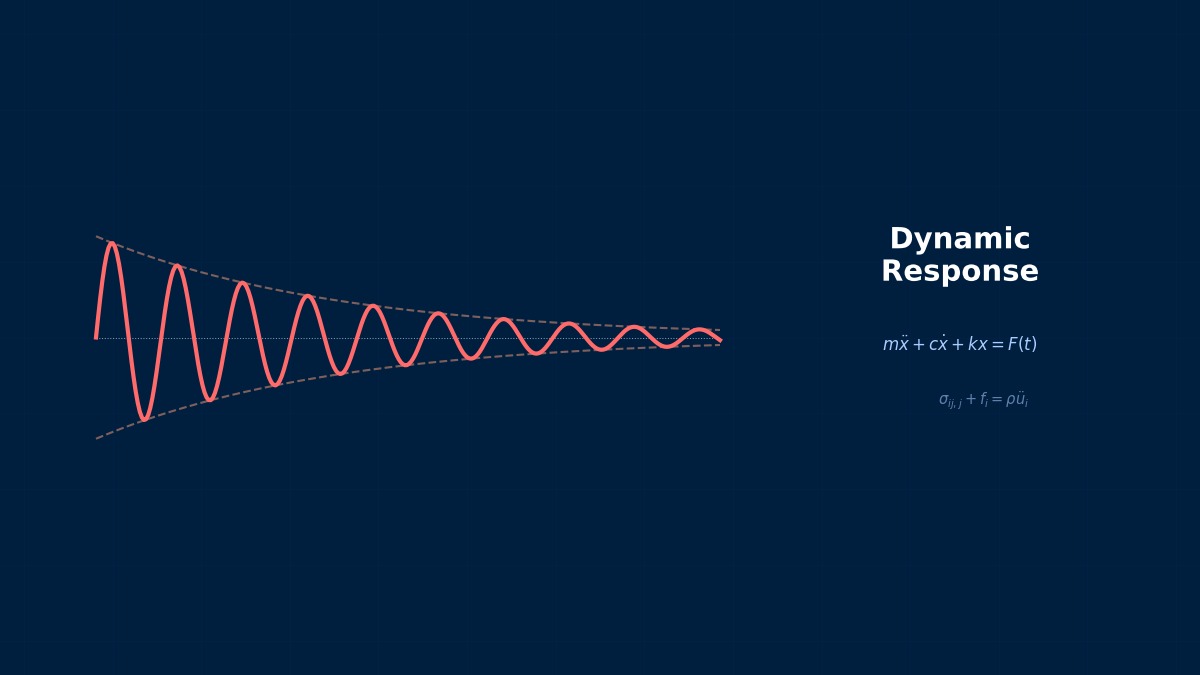
Direct Method Frequency Response Analysis: Theoretical Foundations
What is the Direct Method?
Professor, how does the "Direct Method" frequency response analysis differ from the modal method?
The Direct Method solves the equations of motion directly at each frequency without expanding into natural modes.
This is a complex system of equations for each frequency $\omega$.
So it's computationally heavy because it solves a system of equations at each frequency?
Yes. It solves a complex system of equations of size $n \times n$ ($n$ = number of DOFs) for each frequency point. The modal method only solves $N$ scalar equations for a single-degree-of-freedom system, so it's orders of magnitude faster.
When the Direct Method is Necessary
So why does the Direct Method exist? It's used for cases that cannot be accurately handled by the modal method:
| Case | Reason |
|---|---|
| Non-proportional Damping | The damping matrix cannot be diagonalized by the modes |
| Frequency-Dependent Material Properties | Viscoelastic materials. $E(\omega), \eta(\omega)$ |
| Structural Damping (Hysteresis) | Complex stiffness $K^* = K(1+ig)$ |
| Systems with Large Damping | Rubber mounts, damping materials |
| External Impedance Boundaries | Soil-structure interaction, etc. |
So the modal method can't be used for materials like viscoelastic ones whose properties "change with frequency".
The modal method uses natural modes (frequency-independent) as a basis, so frequency-dependent materials cannot be naturally incorporated into the modal expansion. The Direct Method can update material properties at each frequency.
Handling Structural Damping
Structural Damping (hysteretic damping) is most naturally handled by the Direct Method:
$g$ is the structural damping coefficient. It is a frequency-independent damping and is often physically more accurate than viscous damping.
Structural damping can't be used in the time domain, right?
Exactly. Structural damping is physically meaningful only in the frequency domain (Direct Method). Using structural damping in the time domain violates causality.
Nastran
```
SOL 108 $ Direct Method Frequency Response
CEND
FREQUENCY = 20
BEGIN BULK
FREQ1, 20, 1., 500., 1.
```
Abaqus
```
*STEP
*STEADY STATE DYNAMICS, DIRECT
1., 500., 500, 1.
*END STEP
```
Ansys
```
/SOLU
ANTYPE, HARMONIC
HROPT, FULL ! Direct Method
HARFRQ, 1., 500.
NSUBST, 500
SOLVE
```
Summary
Let me summarize the Direct Method frequency response.
Key Points:
- Solves the system of equations directly at each frequency — No modal expansion
- Computational cost is 10 to 100 times that of the modal method — Number of frequency points × Number of DOFs
- Handles non-proportional damping, frequency-dependent materials, structural damping — Overcomes limitations of the modal method
- SOL 108 (Nastran), *SSD DIRECT (Abaqus), HARMONIC FULL (Ansys)
- The modal method is sufficient for most problems — The Direct Method is only for special cases
Direct Method Matrix Size is 3 Times the Number of Degrees of Freedom
In Direct Method harmonic response analysis, the complex stiffness matrix [K + iωC − ω²M] is factorized sequentially at each frequency step. Separating the real and imaginary parts of the matrix doubles the effective degrees of freedom, and considering the fill-in from LU decomposition, memory capacity of 3 to 5 times the theoretical degrees of freedom is required. For a 1 million DOF model, it takes several minutes per frequency point, so the choice of sparse solver (e.g., PARDISO) changes the order of magnitude of computation time.
Computational Methods for Direct Method Frequency Response Analysis
Improving Direct Method Computational Efficiency
Are there ways to reduce the computational cost of the Direct Method?
There are several techniques:
1. Reusing LU Decomposition of Dynamic Stiffness Matrix
LU decomposition of $[D(\omega)] = -\omega^2[M] + i\omega[C] + [K]$ is the most costly. Decompose the frequency-independent part ($[K]$) only once and treat the frequency-dependent part as an increment using an iterative method.
2. Parallel Computing
Calculations for each frequency point are independent, so full parallelism between frequency points is possible. If 100 frequency points are calculated simultaneously on 100 cores, it effectively takes the time of calculating one frequency point.
3. Reduction Method (Reduced Method)
In Nastran SOL 108, it can be combined with Guyan Reduction or CMS reduction to reduce DOFs before applying the Direct Method. Different from the modal method, but improves efficiency by reducing DOFs.
Modeling Viscoelastic Materials
How are viscoelastic materials handled in the Direct Method?
Complex elastic modulus of viscoelastic materials:
$E'$ is the storage modulus (stiffness), $E''$ is the loss modulus (damping), $\eta = E''/E'$ is the loss factor.
In Abaqus, define Prony series parameters with *VISCOELASTIC, FREQUENCY. Automatically calculates $E^*(\omega)$ at each frequency. In Nastran, define frequency-dependent materials with TABLEM1.
This frequency dependence is crucial in designing damping materials (constrained layer damping), right?
The loss factor $\eta$ of rubbers and viscoelastic polymers depends heavily on frequency and temperature. This dependence cannot be accurately handled without the Direct Method.
Summary
Let me summarize the numerical methods for the Direct Method.
Key Points:
- Improve efficiency with parallel computing across frequency points — Full parallelism is possible
- Complex elastic modulus of viscoelastic materials — $E^*(\omega) = E'(1+i\eta)$
- Model viscoelasticity with Prony series — Abaqus *VISCOELASTIC
- Combine with reduction methods — Reduce computational cost by reducing DOFs
Householder Organized Complex Eigenvalues in 1958
The complex matrix tridiagonalization algorithm, which forms the numerical foundation of the Direct Method, was published by A.S. Householder in 1958. Subsequently, EISPACK, implemented for the IBM System/360 in the 1960s, became a common CAE solver library, and MSC Nastran's SOL 108 directly inherits this lineage. Even in modern Direct Method solvers, the core algorithm remains essentially unchanged from Householder's original insight.
Experience the theory firsthand with the interactive simulator for this field
All Simulators