Modal Frequency Response Analysis
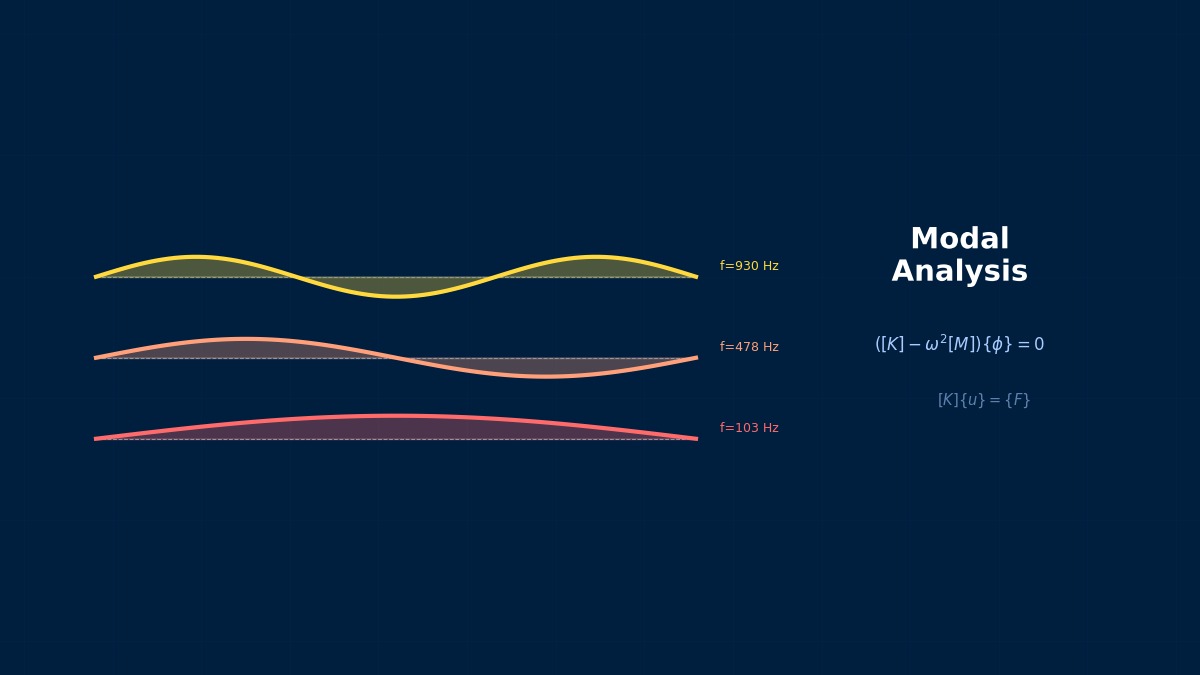
Modal Frequency Response: Theoretical Foundations
What is Frequency Response Analysis?
Professor, what is "Frequency Response Analysis"?
It's an analysis to determine the steady-state response of a structure to a harmonic (sinusoidal) external force. It calculates displacement, acceleration, and stress at each frequency by varying the excitation frequency.
Input: $\{F\} e^{i\omega t}$ (harmonic force with frequency $\omega$)
Output: $\{u\} e^{i\omega t}$ (steady-state response at the same frequency)
So you can see where the resonance peaks are and how large the amplitudes become.
Exactly. The main result is the graph of the FRF (Frequency Response Function) $H(\omega) = u / F$. It shows resonance peaks, anti-resonance valleys, and phase changes.
Mode Method vs. Direct Method
There are two methods for frequency response analysis:
| Method | Principle | Advantages | Disadvantages |
|---|---|---|---|
| Mode Method | Expands in eigenmodes and solves in modal coordinates | Fast. Efficiently calculates many frequency points. | Possible accuracy loss due to insufficient number of modes. |
| Direct Method | Directly solves the system of equations at each frequency | High accuracy. Independent of the number of modes. | High computational cost. Solves for each frequency point. |
The Mode Method uses the results of the natural frequency analysis, right?
Yes. First, perform an eigenvalue analysis to obtain $N$ modes, then transform the equation of motion into modal coordinates $\{q\}$:
The response of each mode can be solved independently (thanks to modal orthogonality). It's just solving $N$ single-degree-of-freedom systems.
Results of Mode Superposition
Steady-state response in modal coordinates:
Response in physical coordinates:
The denominator has $\omega_i^2 - \omega^2$... resonance occurs when $\omega = \omega_i$ and the denominator approaches zero.
Exactly. The damping term $2i\zeta_i \omega_i \omega$ keeps the amplitude finite at resonance. With $\zeta = 0$ (no damping), the amplitude becomes infinite at resonance.
Nastran
```
SOL 111 $ Mode method frequency response
CEND
METHOD = 10
FREQUENCY = 20
BEGIN BULK
EIGRL, 10, , , 50
FREQ1, 20, 1., 500., 1. $ 1 to 500 Hz, 1 Hz increment
```
Abaqus
```
*STEP
*FREQUENCY
50, ,
*END STEP
*STEP
*STEADY STATE DYNAMICS, DIRECT=NO
1., 500., 500, 1.
*END STEP
```
Ansys
```
/SOLU
ANTYPE, HARMONIC
HROPT, MSUP ! Mode superposition method
HARFRQ, 1., 500.
NSUBST, 500
SOLVE
```
Summary
Let me summarize the mode method frequency response.
Key points:
- Steady-state response to harmonic force — FRF (Frequency Response Function) is the main result.
- Mode Method — Expands in eigenmodes for efficient calculation.
- Resonance peaks occur at $\omega = \omega_i$ — Amplitude is proportional to $1/(2\zeta)$.
- SOL 111 (Nastran), *STEADY STATE DYNAMICS (Abaqus), HARMONIC MSUP (Ansys)
- Number of modes determines accuracy — Need enough modes to cover 90% effective mass.
So it's a two-step workflow: natural frequency analysis → frequency response analysis.
The natural frequency analysis reveals the "inherent characteristics of the structure," and the frequency response analysis predicts the "response to external forces." This pair forms the basic dynamic analysis workflow.
Mode Superposition is the Same Idea as Fourier Expansion
The mode superposition method represents structural displacement as a linear combination of mode shapes (eigenvectors). Mathematically, this is exactly the same idea as Fourier series expansion. This principle was first applied to structural mechanics by Lord Rayleigh (1877, 'Sound Theory'). Due to the mathematical property that eigenmodes form an orthogonal basis, the N-degree-of-freedom system of equations decomposes into N independent single-degree-of-freedom equations, dramatically speeding up computation.
Computational Methods for Modal Frequency Response
Computational Efficiency of the Mode Method
Please explain why the Mode Method is faster than the Direct Method.
The Direct Method solves an $n \times n$ (where $n$ = number of DOFs) system of equations at each frequency point. The Mode Method performs one eigenvalue analysis + solves a $N \times N$ (where $N$ = number of modes << $n$) diagonal system at each frequency point.
| Computational Cost | Direct Method | Mode Method |
|---|---|---|
| Per frequency point | $O(n \cdot bw)$ or $O(n^2)$ | $O(N)$ |
| For $M$ frequency points | $M \times O(n \cdot bw)$ | Eigenvalue + $M \times O(N)$ |
With $N = 100$ modes and $n = 1{,}000{,}000$ DOFs, the Mode Method is 10,000 times faster!
That's why the Mode Method is overwhelmingly advantageous for cases like NVH analysis that require calculating many frequency points (500~1000 points).
Importance of Residual Modes
What about the influence of higher-order modes that are not included?
Corrected with Residual Modes (Residual Vectors). Approximates the contribution of higher-order modes using static force-displacement relationships. Automatically added in Nastran with RESVEC=YES.
Without residual modes, do results deviate at low frequencies?
Not at low frequencies, but at high frequencies (near the upper limit of the range of interest). Residual modes correct the "truncation error of the modal expansion". In practice, RESVEC should always be enabled.
FRF Output
Main types of FRF (Frequency Response Function):
| FRF Type | Definition | Usage |
|---|---|---|
| Compliance | $u/F$ | Displacement response |
| Mobility | $v/F = i\omega \cdot u/F$ | Velocity response |
| Inertance | $a/F = -\omega^2 \cdot u/F$ | Acceleration response |
Which one is used in experiments?
In experimental modal analysis, inertance (acceleration/force) is common because accelerometers are most widely used. When comparing FEM results with experiments, output in the same format.
Summary
Let me summarize the numerical methods for mode method frequency response.
Key points:
- The Mode Method is overwhelmingly faster than the Direct Method — Advantageous for many frequency points.
- Correct higher-order effects with Residual Modes (RESVEC) — Should always be enabled.
- FRF format — Choose compliance, mobility, or inertance depending on the application.
- Experimental validation — Use inertance for comparison with accelerometer measurements.