Axisymmetric Analysis
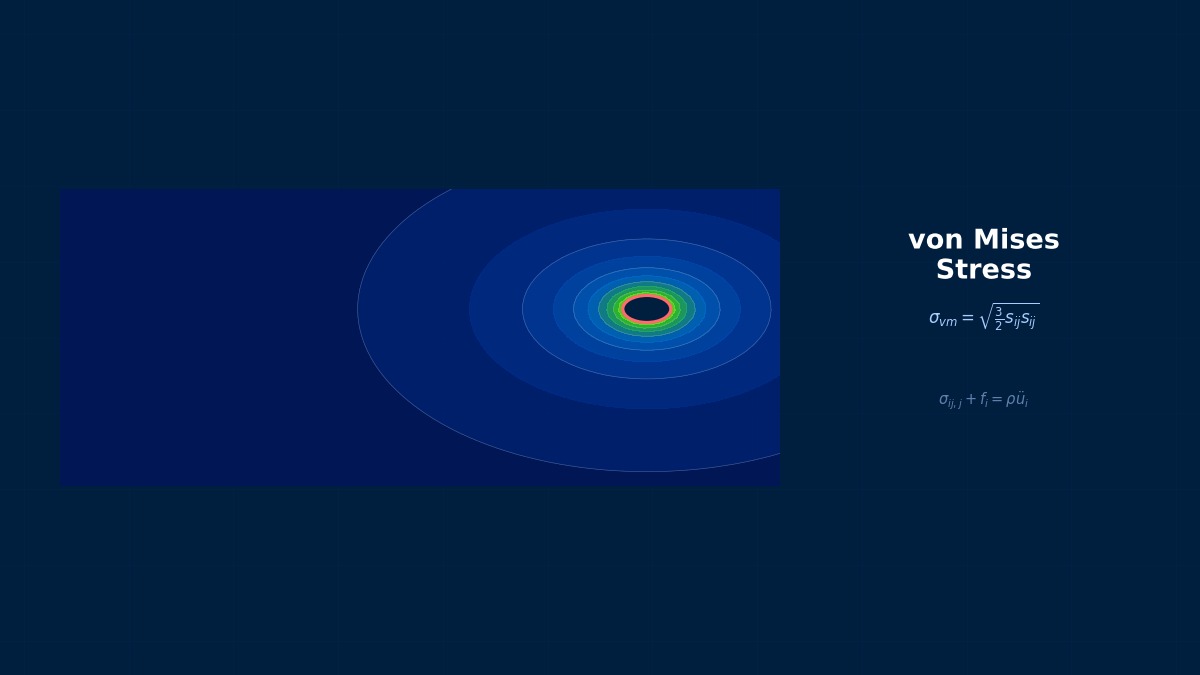
Axisymmetric Analysis: Theoretical Foundations
What is an Axisymmetric Problem?
Professor, what is "axisymmetric" analysis? Can you solve a 3D problem in 2D?
Yes. When the geometry, material, loads, and boundary conditions are all symmetric about an axis of rotation, a 3D problem can be reduced to an analysis of a 2D cross-section. It's the assumption that there is no variation in the $\theta$ direction in cylindrical coordinates $(r, \theta, z)$.
What kind of structures are axisymmetric?
Actually, there are a huge number:
- Pressure Vessels — Cylindrical shells, heads, nozzles (when uniform in the circumferential direction)
- Flanges & Bolts — Analysis of axial force in fastened assemblies
- Bearings — Contact of inner/outer rings and rolling elements
- Pistons & Cylinders — Pressure analysis in internal combustion engines
- Internal Pressure in Pipes — Lamé's problem for thick-walled cylinders
- Rotating Bodies — Centrifugal force in disks, flywheels, turbine rotors
It's essential for pressure vessel design then.
Axisymmetric analysis is also recognized in ASME standards for pressure vessels. Compared to modeling an entire pressure vessel in 3D, axisymmetric cross-section analysis achieves equal or better accuracy with less than 1/100th the DOF.
Governing Equations
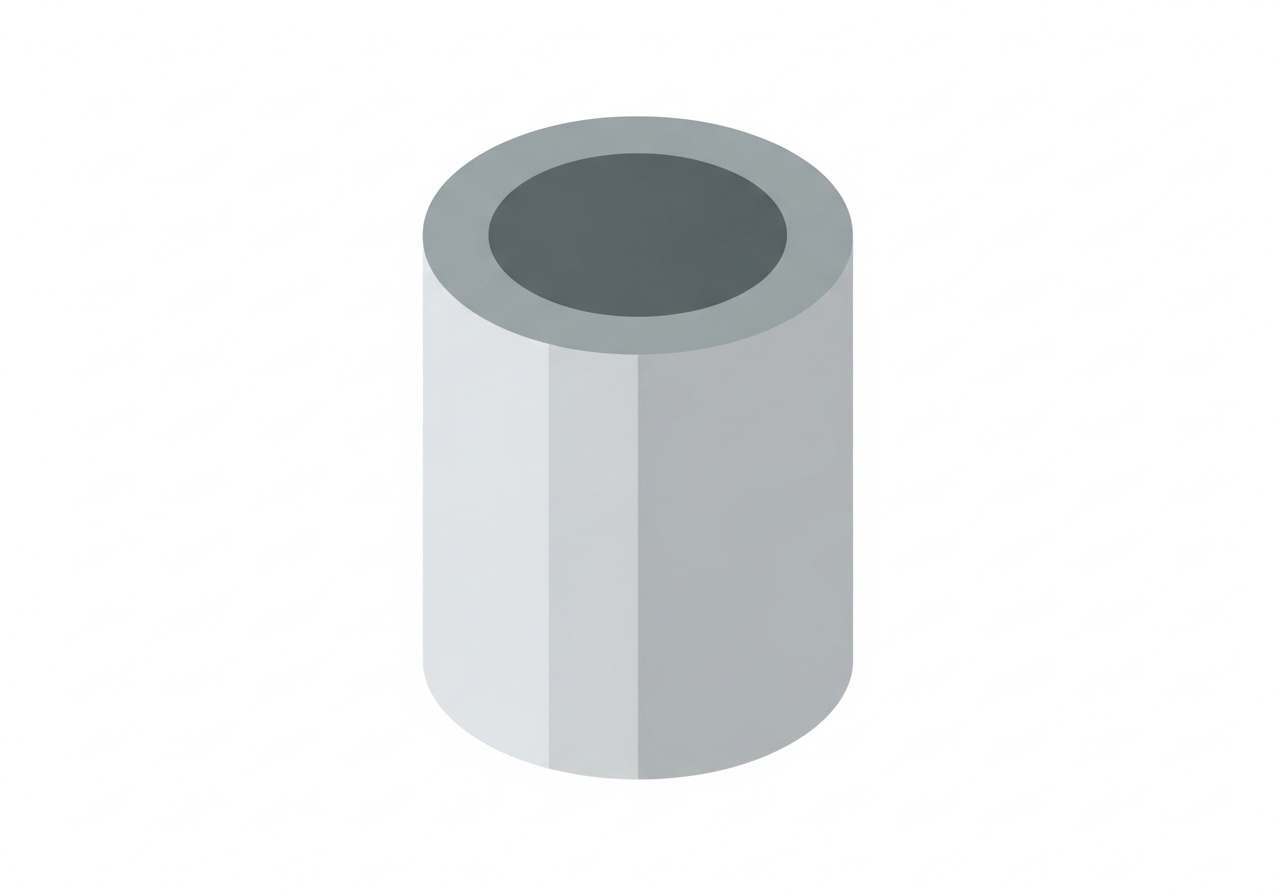
What are the stress components in an axisymmetric problem?
In cylindrical coordinates, there are four stress components:
Plane stress and plane strain had 3 components, but axisymmetric has 4?
Correct. A characteristic of axisymmetry is the existence of hoop stress $\sigma_\theta$. When there is a radial displacement $u_r$, the circumferential strain is:
$u_r / r$! So strain is simply displacement divided by radius. Is this a geometric effect?
Perfect understanding. The circumference of a circle with radius $r$ is $2\pi r$, so if the radius increases by $u_r$, the circumference becomes $2\pi(r + u_r)$. The strain is $\Delta L / L = u_r / r$. This $1/r$ term is the core of axisymmetric analysis and is a feature not present in plane stress/strain.
Constitutive Law
Hooke's law for axisymmetry:
$$ \begin{Bmatrix} \sigma_r \\ \sigma_\theta \\ \sigma_z \\ \tau_{rz} \end{Bmatrix} = \frac{E}{(1+\nu)(1-2\nu)} \begin{bmatrix} 1-\nu & \nu & \nu & 0 \\ \nu & 1-\nu & \nu & 0 \\ \nu & \nu & 1-\nu & 0 \\ 0 & 0 & 0 & \frac{1-2\nu}{2} \end{bmatrix} \begin{Bmatrix} \varepsilon_r \\ \varepsilon_\theta \\ \varepsilon_z \\ \gamma_{rz} \end{Bmatrix} $$
It has the same form as the 3D Hooke's law. 4 components, but essentially 3D.
Yes. Axisymmetry is "2D in appearance, 3D in essence." The stress state is fully 3D, and $\sigma_\theta$ is never zero (except at $r = 0$).
Thick-Walled Cylinder (Lamé's Problem)
Is there a theoretical solution for a thick-walled cylinder under internal pressure?
Lamé's problem is the most fundamental theoretical solution for axisymmetry. For inner radius $a$, outer radius $b$, and internal pressure $p$:
$$ \sigma_r = \frac{p a^2}{b^2 - a^2} \left(1 - \frac{b^2}{r^2}\right) $$
$$ \sigma_\theta = \frac{p a^2}{b^2 - a^2} \left(1 + \frac{b^2}{r^2}\right) $$
The hoop stress is maximum at the inner surface ($r = a$) and decreases towards the outer surface. The inner surface is in tension, and the tension decreases as you approach the outer surface.
Maximum hoop stress at the inner surface:
$$ \sigma_{\theta,max} = p \frac{a^2 + b^2}{b^2 - a^2} $$
Hooke's law for axisymmetry:
It has the same form as the 3D Hooke's law. 4 components, but essentially 3D.
Yes. Axisymmetry is "2D in appearance, 3D in essence." The stress state is fully 3D, and $\sigma_\theta$ is never zero (except at $r = 0$).
Is there a theoretical solution for a thick-walled cylinder under internal pressure?
Lamé's problem is the most fundamental theoretical solution for axisymmetry. For inner radius $a$, outer radius $b$, and internal pressure $p$:
The hoop stress is maximum at the inner surface ($r = a$) and decreases towards the outer surface. The inner surface is in tension, and the tension decreases as you approach the outer surface.
Maximum hoop stress at the inner surface:
For thin walls ($b \approx a$), this approaches $\sigma_\theta \approx pD/(2t)$ (the thin-walled cylinder formula). This is the best benchmark problem for verifying FEM axisymmetric analysis.
Summary
Let me organize the theory of axisymmetric analysis.
Key points:
- If geometry, loads, and materials are rotationally symmetric, it can be solved in 2D — DOF reduced to less than 1/100th.
- Four stress components — $\sigma_r, \sigma_\theta, \sigma_z, \tau_{rz}$. Hoop stress $\sigma_\theta$ is unique.
- $\varepsilon_\theta = u_r / r$ — Geometric circumferential strain.
- Essentially a 3D stress state — 2D in appearance but 3D in essence.
- Verify with Lamé's problem — Internal pressure in a thick-walled cylinder is the best benchmark.
For pressure vessel design, there's no reason not to use axisymmetric analysis. Equivalent accuracy at 1/100th the cost of 3D.
Exactly. However, non-axisymmetric loads (nozzle loads, seismic loads) or non-axisymmetric geometry (holes, discontinuities) require 3D analysis. An efficient approach is to screen with axisymmetric analysis and perform detailed 3D analysis only on necessary parts.
Historical Origin of Axisymmetry
The theoretical foundation of axisymmetric analysis dates back to the 1850s when G.B. Airy introduced stress functions. In the 1960s, Clough & Rashid formulated ring elements, reducing flop counts to about 1/10th of 3D analysis. It remains an active technique in the design of pressure vessels and nuclear reactor containment vessels.
Computational Methods for Axisymmetric Analysis
Axisymmetric Analysis by FEM
What are the characteristics of FEM elements for axisymmetry?
Axisymmetric elements are 2D elements in the $(r, z)$ plane, but their internal formulation includes a weight of $2\pi r$. This corresponds to the volume obtained by rotating the element 360° around the axis.
Element Formulation
Integration of the axisymmetric element stiffness matrix:
The $2\pi r$ (circumference) replaces the $t$ (thickness) in plane problems.
At $r = 0$ (on the axis of rotation), $2\pi r = 0$. Is that okay?
That's a very good question. Integration at $r = 0$ has a singularity. In practice, the following measures are taken:
- Gauss integration points are not placed on $r = 0$ (integration points are inside the element).
- At nodes on $r = 0$, $\varepsilon_\theta = u_r / r$ becomes $0/0$, but by L'Hôpital's rule, $\varepsilon_\theta = \varepsilon_r$.
- Practically, it's not a problem, but using extremely fine mesh near $r = 0$ can sometimes cause numerical instability.
Element Names by Solver
| Element | Nastran | Abaqus | Ansys |
|---|---|---|---|
| 4-node quadrilateral | CQUADX4 / CTRIAX | CAX4, CAX4R, CAX4H | PLANE182 (KEYOPT3=1) |
| 8-node quadrilateral | CQUADX8 | CAX8, CAX8R | PLANE183 (KEYOPT3=1) |
| 3-node triangle | CTRIAX6 | CAX3 | PLANE182 (degenerated) |
Abaqus's CAX is short for "Continuum AXisymmetric", right? CPS is plane stress, CPE is plane strain, CAX is axisymmetric.
Related Topics
Experience the theory firsthand with the interactive simulator for this field
All Simulators