Pressure Vessel Linear Analysis
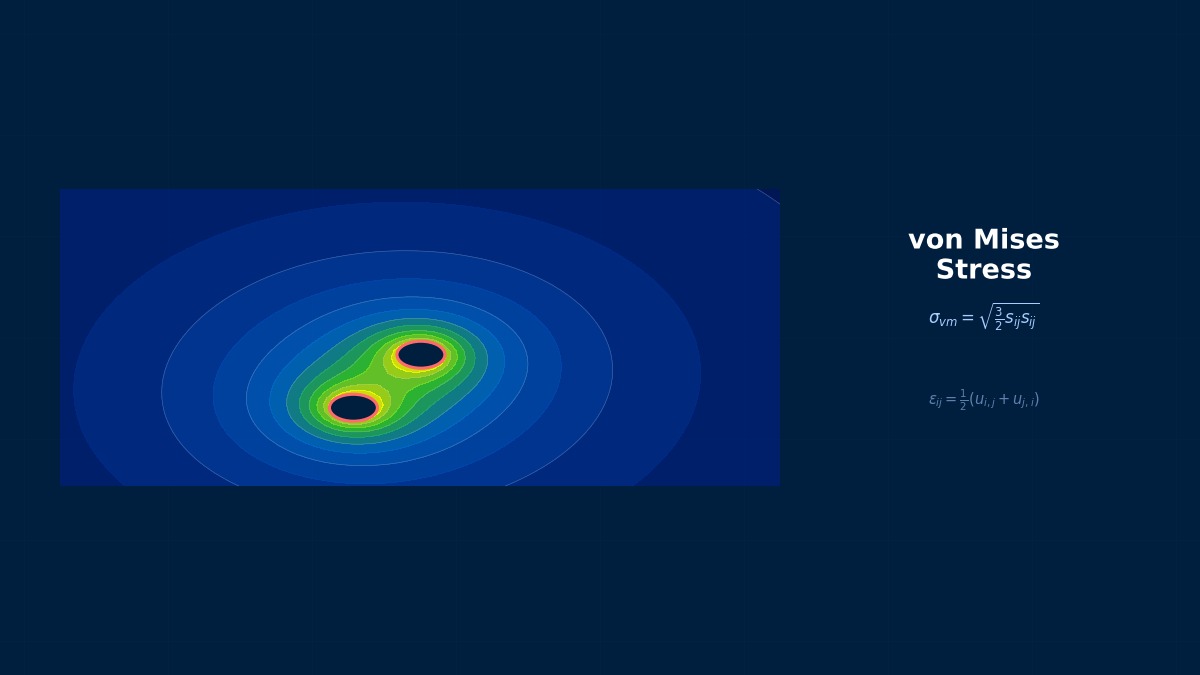
Pressure Vessel Linear: Theoretical Foundations
Mechanics of Pressure Vessels
Professor, does stress analysis of pressure vessels require special theories?
The mechanics of rotating shells form the foundation for pressure vessels. For problems involving internal pressure on thin-walled cylinders or spherical shells, we consider it in two stages: membrane theory and bending theory.
Thin-Wall Theory (Membrane Theory)
Please tell me the stress formula for a thin-walled cylinder.
For a thin-walled cylinder with internal pressure $p$, inner diameter $D$, and wall thickness $t$:
The hoop stress is twice the axial stress! So that's why pressure vessels crack in the circumferential direction.
Exactly. It's the same principle as a sausage splitting lengthwise when boiled. In pressure vessel design, hoop stress is dominant, and the wall thickness is primarily determined by the hoop stress.
For a thin-walled spherical shell:
Spherical shells have lower stress (half of the cylinder's hoop stress). Therefore, spherical tanks are more efficient than cylindrical ones, but they are more difficult to manufacture.
Thick-Wall Theory (Lamé's Problem)
Up to what wall thickness can the thin-wall formula be used?
A guideline is $D/t > 20$. For $D/t < 20$, thick-wall theory (Lamé's equations) is required:
So $\sigma_r$ cannot be ignored in thick walls. At the inner surface, $\sigma_r = -p$ (compression).
Correct. Thin-wall theory assumes $\sigma_r \approx 0$, but in thick walls, the stress gradient through the wall thickness becomes important. The hoop stress at the inner surface becomes higher than predicted by the thin-wall formula.
Discontinuity Stresses
What are "discontinuity stresses" in pressure vessels?
This is the core of pressure vessel analysis. Membrane theory alone is sufficient for uniform cylinders or spherical shells, but actual pressure vessels have:
- Connections between the shell and heads
- Nozzle connections
- Changes in wall thickness
- Support locations
At these geometric discontinuities, local bending stresses occur to satisfy compatibility conditions that cannot be met by membrane theory alone. These are discontinuity stresses.
So local bending stresses superimpose on top of the membrane stresses.
Yes. Discontinuity stresses decay rapidly away from the discontinuity. The decay distance is roughly on the order of $\sqrt{Rt}$ ($R$: radius, $t$: wall thickness). Within this "zone of influence," membrane theory alone is inaccurate, and FEM-based bending analysis is necessary.
ASME Code Stress Classification
How does the ASME code classify stresses?
Stress classification according to ASME BPVC Section VIII Div. 2 Part 5:
| Stress Category | Symbol | Meaning | Allowable Value |
|---|---|---|---|
| General Primary Membrane Stress | $P_m$ | Membrane stress acting over the entire vessel | $S$ (Allowable Stress) |
| Local Primary Membrane Stress | $P_L$ | Local membrane stress at discontinuities | $1.5S$ |
| Primary Bending Stress | $P_b$ | Bending stress required for load equilibrium | $1.5S$ (for $P_L + P_b$) |
| Secondary Stress | $Q$ | Self-limiting stress due to displacement | $3S$ (for $P_L + P_b + Q$) |
| Peak Stress | $F$ | Local stress concentration | Used for fatigue evaluation |
Membrane stress has the strictest limit, and secondary stress is allowed up to three times that?
Secondary stresses are "self-limiting." Even if local yielding occurs, plastic collapse does not occur because deformation is constrained. Therefore, a higher allowable value is set compared to membrane stress. Most discontinuity stresses are classified as secondary stresses.
Summary
Let me organize the theory of pressure vessels.
Key points:
- Thin-wall formula — $\sigma_\theta = pD/(2t)$. Hoop stress is twice the axial stress.
- Thick walls use Lamé's equations — Required for $D/t < 20$. Stress gradient through the wall thickness.
- Discontinuity stresses — Local bending at geometric discontinuities. FEM is essential.
- ASME stress classification — Five categories: $P_m, P_L, P_b, Q, F$.
- Secondary stress allowed up to 3S — Self-limiting stress.
So the key to pressure vessel design is correctly classifying "what is membrane stress and what is secondary stress."
Exactly. Misclassifying stresses can lead to results that are either overly conservative or unsafe. For a pressure vessel engineer, the required skill is not just obtaining stresses from FEM, but the ability to classify them correctly.
History of Pressure Vessel Design Codes
The safety design standards for pressure vessels were systematized when AMSE (American Society of Mechanical Engineers) published the first edition of the "Boiler and Pressure Vessel Code (BPVC)" in 1914. The trigger was the 1905 boiler explosion accident in Brockton, Massachusetts (58 fatalities). The current ASME BPVC Section VIII Division 2 (2017 edition) formally recognizes "Design by Analysis (DBA)" based on the finite element method.
Computational Methods for Pressure Vessel Linear
FEM Analysis of Pressure Vessels
When analyzing pressure vessels with FEM, which elements are used?
There are three modeling choices.
| Model | Element Type | Application Scenario |
|---|---|---|
| Axisymmetric | CAX8R, etc. | Cylindrical shell, heads, axial nozzles |
| Shell | S4R, S8R, etc. | Nozzle connections, full model |
| Solid | C3D20R, etc. | Detailed nozzle connections, weld regions |
Axisymmetric is the most efficient if it can be used.
Yes. Since most of a pressure vessel is axisymmetric, the standard approach is to first analyze with an axisymmetric model, and then analyze only the non-axisymmetric parts (nozzles, support legs) with a 3D model.
Stress Classification Line (SCL)
How do you perform ASME stress classification from FEM results?
Set a Stress Classification Line (SCL) and separate the stress on that line into membrane and bending components. An SCL is a straight line drawn through the wall thickness, and the stress distribution on it is integrated.
For the stress distribution through the wall thickness $\sigma(y)$ ($y$: position through thickness, $-t/2$ to $t/2$):
Peak stress is what remains after subtracting membrane and bending from the total stress. Stress concentrations and notch effects go here.
The analyst decides the SCL location. Draw a line perpendicular to the wall thickness near the discontinuity. ASME guidelines (Div. 2, Part 5, Annex 5-A) specify how to set SCLs.
Mesh Requirements
What mesh considerations are needed for pressure vessel analysis?
Mesh through the wall thickness is most important. To accurately capture the stress gradient for stress classification, sufficient resolution is needed.
- Axisymmetric model — Minimum 4 elements through thickness (2 elements if using quadratic elements)
- Solid model — Same as above
- Shell model — Thickness direction is automatically considered (stress output at integration points)
Mesh density at discontinuities:
- Knuckle region (head-to-shell connection): Element size ≤ 1/2 of wall thickness
- Nozzle connection: Element size ≤ 1/2 of nozzle wall thickness
- Weld region: Element size ≤ 1/3 of weld leg length
Related Topics
Experience the theory firsthand with the interactive simulator for this field
All Simulators