Gap Element
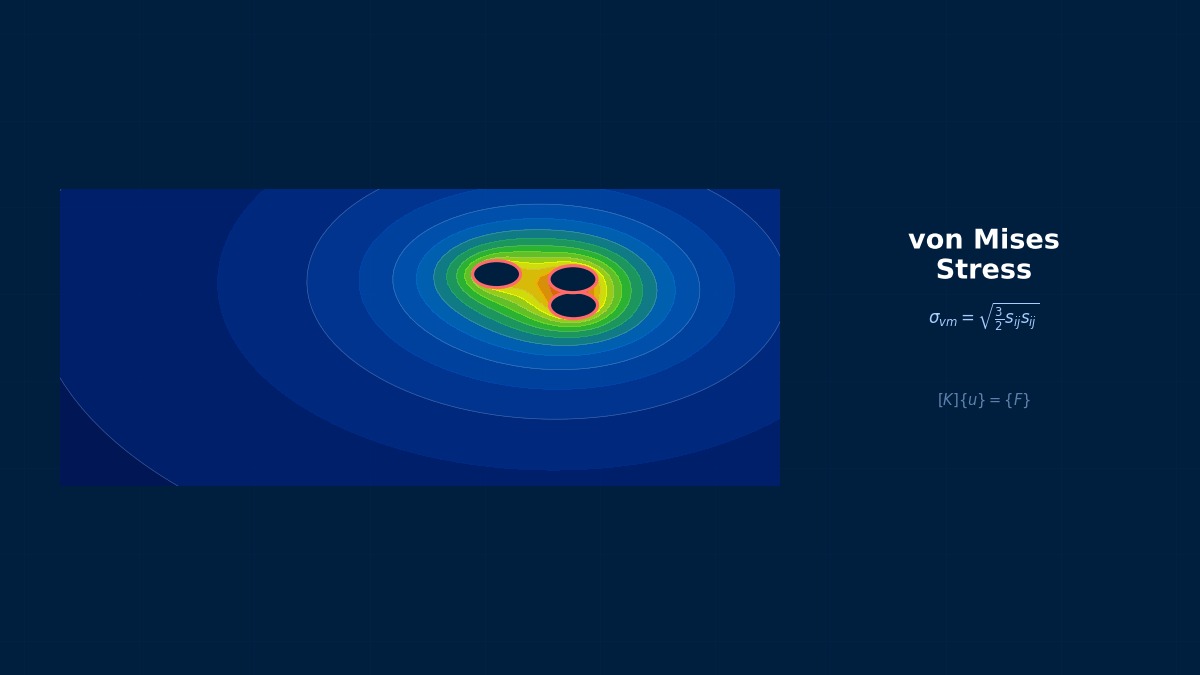
Gap Element: Theoretical Foundations
What is a Gap Element?
Professor, what is a "gap element"?
A gap element is an element that has a gap (clearance) between two points and transmits force only when they are in contact. It is used as a simplified model for contact problems.
Physical Image
A gap element is a "one-dimensional contact element":
- Gap is open ($\delta < g$) → Force is zero
- Gap is closed ($\delta \geq g$) → Transmits force as a compression spring (stiffness $k$)
Here, $\delta$ is the relative displacement between the two nodes, and $g$ is the initial gap.
It's a simple nonlinearity: "when the gap closes, it becomes a spring."
Correct. Force-displacement relationship:
Applications
| Application | Explanation |
|---|---|
| Bolt hole clearance | Load transfer when a bolt contacts the hole |
| Bearing stopper | Contact beyond a certain displacement |
| Pipe support | Unidirectional support only (lift-off) |
| Contact due to thermal expansion | Gap closes with temperature rise |
What do you mean by pipe support being unidirectional only?
When a pipe deflects downward, it rests on the support; when it deflects upward, it lifts off from the support. It transmits force only in the downward direction and is free in the upward direction. This is a typical application of gap elements.
Element Names by Solver
| Solver | Element Name | Notes |
|---|---|---|
| Nastran | CGAP | Specify direction, gap amount, closure stiffness |
| Abaqus | *GAP / GAPUNI | 1D gap. ITT element |
| Ansys | CONTA178 | Node-to-node contact element |
Does Abaqus have ITT (Interface) elements separate from GAP elements?
In Abaqus, the general contact definition (*CONTACT PAIR / *GENERAL CONTACT) is more flexible and recommended than gap elements (*GAP). Gap elements are used only for simplified 1D contact.
Gap Element vs. Contact Definition
| Comparison | Gap Element | Surface Contact Definition |
|---|---|---|
| Degrees of Freedom | One direction only | Entire surface |
| Setup Effort | Low | High |
| Accuracy | 1D approximation | Accurate contact pressure distribution |
| Nonlinearity | Weak | Strong |
| Friction | Supported only by Nastran CGAP | Fully supported |
So, use gap elements for simplicity and full contact definition for precision.
Exactly. Gap elements are used when a simple binary judgment of "contact/no contact" is sufficient. If contact pressure distribution or sliding is important, a general contact definition is necessary.
Summary
Let me organize the theory of gap elements.
Key points:
- Transmits force only when the gap is closed — A one-dimensional contact element
- Force = 0 (open) or $k(\delta - g)$ (closed) — Simple nonlinearity
- Modeling of pipe supports, stoppers, clearances — Widely used in practice
- Nastran CGAP is the most widely used — The standard for simplified contact
- Use full contact definition for precise contact — Gap elements are a simplified model
Theoretical Origin of Gap Elements
The first attempt to handle contact problems with FEM was in 1963, extending Hertz's contact theory with the matrix method. The formulation as a gap element was pioneered by Wilson & Parkes in their 1972 paper, establishing the binary contact method that treats the opening/closing between two nodes as an "ON/OFF switch." This method became the prototype for the current ANSYS CONTA171 element.
Computational Methods for Gap Element
Nonlinear Solution Method for Gap Elements
Gap elements are nonlinear, right? Can't they be used in linear analysis?
The opening/closing of a gap is a state change, so it is inherently nonlinear. However, many solvers process it pseudo-linearly using iterative methods.
Procedure:
1. Perform linear analysis assuming all gap elements are "open."
2. Check the relative displacement of each gap. Change elements that should close to "closed."
3. Re-analyze with the updated stiffness.
4. Iterate until the state of all gaps stabilizes.
Is it thanks to this iteration that CGAP can be used even in Nastran's SOL 101 (linear static analysis)?
In Nastran, using CGAP in SOL 106 (nonlinear static analysis) is the formal way, but SOL 101 also has a "linear contact" feature that performs gap opening/closing iterations. It's faster than full nonlinear analysis but cannot handle complex contact.
Closure Stiffness Setting
How do you set the stiffness $k$ when the gap closes?
Ideally, it would be "infinite" (perfectly rigid contact), but numerically, a finite large stiffness is used via the penalty method.
Guidelines:
- $k \approx 10 \sim 100$ × the stiffness of the contact surface (equivalent to $EA/L$)
- Too large → condition number worsens, convergence becomes difficult
- Too small → excessive penetration
Finding the "just right $k$" seems difficult.
Abaqus's *CONTACT definition automatically calculates the penalty stiffness, but with gap elements, manual setting is required. Start with $k$ = 10 times the structural stiffness and adjust so that penetration is less than 1% of the plate thickness.
Summary
Let me organize the numerical methods for gap elements.
Key points:
- Converge gap opening/closing with iterative methods — Treated as iterations of linear analysis
- Closure stiffness is 10~100 times the structural stiffness — Neither too large nor too small
- Simplified contact possible even in Nastran's SOL 101 — But SOL 106 is the formal method
- Full contact definition recommended for precise contact — Gap elements are a simplified model
Penalty Method vs. Lagrange Method
There are two main approaches to the numerical implementation of gap elements: the penalty method and the Lagrange multiplier method. The penalty method can be implemented without changing the dimension of the stiffness matrix and is easier to implement, but the choice of penalty coefficient directly affects accuracy. In 1974, Bathe and Wilson showed that the Lagrange method provides more stable condition numbers, which became a guideline for subsequent high-precision contact solver development.
Experience the theory firsthand with the interactive simulator for this field
All Simulators