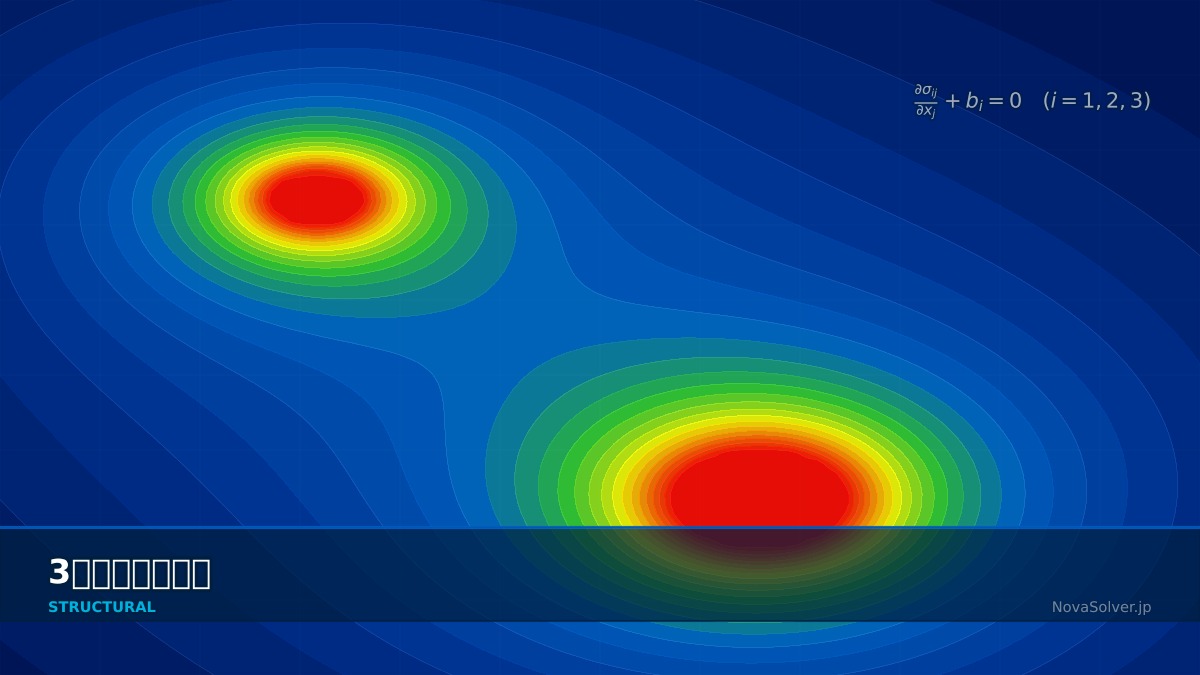
3次元弾性体解析

Category: 構造解析 | Integrated 2026-04-06
CAE visualization for solid 3d elasticity theory - technical simulation diagram
3次元弾性体解析

Theory and Physics

Fundamentals of 3D Elasticity Theory

🧑‍🎓

Professor, in the end, FEM structural analysis is solving "3D elasticity theory," right?


🎓

Yes. Plane stress, plane strain, axisymmetric, shell, beam... all structural elements are special cases of 3D elasticity theory. 3D elasticity theory is the foundation of everything, the "full model" without approximations.


Governing Equations

🧑‍🎓

Please tell me the governing equations of 3D elasticity theory.


🎓

There are three fundamental equations.


1. Equilibrium Equations (Force Balance)

$$ \frac{\partial \sigma_{ij}}{\partial x_j} + b_i = 0 \quad (i = 1,2,3) $$

2. Strain-Displacement Relations (Compatibility Conditions)

$$ \varepsilon_{ij} = \frac{1}{2}\left(\frac{\partial u_i}{\partial x_j} + \frac{\partial u_j}{\partial x_i}\right) $$

3. Constitutive Law (Hooke's Law)

$$ \sigma_{ij} = C_{ijkl} \varepsilon_{kl} $$
🧑‍🎓

6 stress components ($\sigma_x, \sigma_y, \sigma_z, \tau_{xy}, \tau_{yz}, \tau_{xz}$), 6 strain components, 3 displacement components. That's 15 equations for 15 unknowns, right?


🎓

Perfect understanding. Consolidating these 15 equations with displacement as the only unknown gives the Navier equations (Lamé–Navier equations):


$$ (\lambda + \mu) \frac{\partial^2 u_j}{\partial x_i \partial x_j} + \mu \frac{\partial^2 u_i}{\partial x_j \partial x_j} + b_i = 0 $$

Here $\lambda, \mu$ are Lamé constants. $\mu = G$ (shear modulus), $\lambda = \frac{E\nu}{(1+\nu)(1-2\nu)}$.


D Matrix for Isotropic Elastic Materials

🧑‍🎓

What about the $[D]$ matrix used in FEM?


🎓

3D constitutive law for isotropic elastic materials (Voigt notation):


$$ [D] = \frac{E}{(1+\nu)(1-2\nu)} \begin{bmatrix} 1-\nu & \nu & \nu & 0 & 0 & 0 \\ \nu & 1-\nu & \nu & 0 & 0 & 0 \\ \nu & \nu & 1-\nu & 0 & 0 & 0 \\ 0 & 0 & 0 & \frac{1-2\nu}{2} & 0 & 0 \\ 0 & 0 & 0 & 0 & \frac{1-2\nu}{2} & 0 \\ 0 & 0 & 0 & 0 & 0 & \frac{1-2\nu}{2} \end{bmatrix} $$

🧑‍🎓

So this 6×6 matrix is the foundation of everything. The $[D]$ for plane stress or plane strain is a contraction of this.


🎓

Correct. From the 3D $[D]$, plane stress contracts under the condition $\sigma_z = 0$, and plane strain under the condition $\varepsilon_z = 0$. Shells and beams are also derived from the 3D $[D]$ based on their respective assumptions.


Anisotropic Materials

🧑‍🎓

What about non-isotropic materials?


🎓

For general anisotropic elastic materials, $[D]$ has 21 independent constants (6×6 symmetric matrix). However, in practice, the following special cases are common:


Material SymmetryIndependent ConstantsExamples
Isotropic2 ($E, \nu$)Steel, Aluminum
Transversely Isotropic5Unidirectional reinforced CFRP layer, sedimentary soil
Orthotropic9Wood, woven CFRP
General Anisotropy21Crystals
🧑‍🎓

Is CFRP (carbon fiber composite) transversely isotropic?


🎓

A single layer of unidirectional material (UD material) is transversely isotropic. It is symmetric about the fiber direction and the plane orthogonal to it. When multiple layers are laminated, the whole becomes orthotropic or exhibits more complex symmetry.


Scenarios Where 3D Analysis is Essential

🧑‍🎓

What are scenarios where 2D approximations cannot be used and 3D analysis is necessary?


🎓
  • 3D Stress Concentration — Interference between holes, fillet corners
  • Through-Thickness Stress is Important — Bending of thick plates, interlaminar shear
  • Contact Problems — Bolt head and flange, gear tooth surfaces
  • Complex Shapes — Castings, 3D printed parts
  • Asymmetric Loading — Local loading on axisymmetric structures

  • 🧑‍🎓

    There are surprisingly many problems that "cannot be solved without 3D," aren't there?


    🎓

    With the improvement of computer performance, 3D analysis has become commonplace. However, solving in 3D does not guarantee correctness. If mesh quality, boundary conditions, and material models are not correct, you'll get garbage even in 3D.


    Summary

    🧑‍🎓

    Let me organize the theory of 3D elastic body analysis.


    🎓

    Key Points:


    • Three Fundamental Equations — Equilibrium, compatibility, constitutive law. Total 15 unknowns, 15 equations.
    • The $[D]$ Matrix is the Foundation of Everything — 2D elements are contracted versions of this.
    • 2 Constants for Isotropic, Up to 21 Constants for Anisotropic
    • Scenarios Where 3D Analysis is Essential — 3D stress concentration, through-thickness stress, contact, complex shapes.
    • 3D ≠ Accurate — The quality of input governs the results.

    🧑‍🎓

    All FEM element theories boil down to 3D elasticity theory. Understanding this, it seems I can naturally judge which element to use.


    🎓

    Exactly. 3D elasticity theory is the "trunk," and each element type is a "branch." If you understand the trunk, you naturally know how to choose the branches.


    Coffee Break Yomoyama Talk

    Governing Equations of 3D Elasticity

    The equilibrium equations for three-dimensional elastic bodies were independently derived by Navier and Cauchy in the 1820s. The generalized Hooke's law (σ=Cε, where C is the fourth-order elasticity tensor) connecting the 9-component stress tensor σij and the 6-component strain tensor εij has a maximum of 21 independent components C11 to C66. For isotropic materials, this reduces to the two parameters of Lamé constants λ and μ, which can be converted using Young's modulus E=μ(3λ+2μ)/(λ+μ).

    Physical Meaning of Each Term
    • Inertia Term (Mass Term): $\rho \ddot{u}$, i.e., "mass × acceleration". Have you ever experienced being thrown forward when slamming on the brakes? That "feeling of being carried away" is precisely the inertial force. Heavier objects are harder to set in motion and harder to stop once moving. Buildings shake during earthquakes because the ground moves suddenly while the building's mass "gets left behind." In static analysis, this term is set to zero, which is the assumption that "acceleration can be ignored because forces are applied slowly." It absolutely cannot be omitted for impact loads or vibration problems.
    • Stiffness Term (Elastic Restoring Force): $Ku$ or $\nabla \cdot \sigma$. When you pull a spring, you feel a "force trying to return it," right? That is Hooke's law $F=kx$, the essence of the stiffness term. Now a question — an iron rod and a rubber band, which stretches more when pulled with the same force? Obviously the rubber. This "resistance to stretching" is Young's modulus $E$, which determines stiffness. A common misconception: "High stiffness ≠ strong." Stiffness is "resistance to deformation," strength is "resistance to failure" — they are different concepts.
    • External Force Term (Load Term): Body forces $f_b$ (e.g., gravity) and surface forces $f_s$ (e.g., pressure, contact forces). Think of it this way — the weight of a truck on a bridge is a "force acting on the entire volume" (body force), while the force of the tires pressing on the road surface is a "force acting only on the surface" (surface force). Wind pressure, water pressure, bolt tightening force... all are external forces. A common mistake here: getting the load direction wrong. Intending "tension" but it becomes "compression" — it sounds like a joke, but it actually happens when coordinate systems are rotated in 3D space.
    • Damping Term: Rayleigh damping $C\dot{u} = (\alpha M + \beta K)\dot{u}$. Try plucking a guitar string. Does the sound continue forever? No, it gradually fades. That's because the vibration energy is converted to heat by air resistance and internal friction in the string. Car shock absorbers work on the same principle — they deliberately absorb vibration energy to improve ride comfort. What if damping were zero? Buildings would continue shaking forever after an earthquake. Since that doesn't happen in reality, setting appropriate damping is important.
    Assumptions and Applicability Limits
    • Continuum Assumption: Treats material as a continuous medium, ignoring microscopic heterogeneity.
    • Small Deformation Assumption (for linear analysis): Deformation is sufficiently small compared to initial dimensions, and the stress-strain relationship is linear.
    • Isotropic Material (unless otherwise specified): Material properties are independent of direction (anisotropic materials require separate tensor definitions).
    • Quasi-Static Assumption (for static analysis): Ignores inertial and damping forces, considering only the balance between external and internal forces.
    • Non-Applicable Cases: For large deformation/large rotation problems, geometric nonlinearity is required. For plasticity, creep, and other nonlinear material behaviors, constitutive law extensions are needed.
    Dimensional Analysis and Unit Systems
    VariableSI UnitNotes / Conversion Memo
    Displacement $u$m (meter)When inputting in mm, unify loads and elastic modulus to MPa/N system.
    Stress $\sigma$Pa (Pascal) = N/m²MPa = 10⁶ Pa. Be careful of unit system inconsistency when comparing with yield stress.
    Strain $\varepsilon$Dimensionless (m/m)Be careful to distinguish between engineering strain and logarithmic strain (for large deformation).
    Elastic Modulus $E$PaSteel: ~210 GPa, Aluminum: ~70 GPa. Note temperature dependence.
    Density $\rho$kg/m³In mm system: tonne/mm³ (= 10⁻⁹ tonne/mm³ for steel).
    Force $F$N (Newton)Unify as N in mm system, N in m system.

    Numerical Methods and Implementation

    3D Solid Elements

    🧑‍🎓

    What kinds of 3D solid elements are there?


    🎓

    There are three basic shapes: hexahedron (hex), tetrahedron (tet), and pentahedron (wedge/prism).


    Element1st Order2nd OrderAccuracyMesh Generation
    TetrahedronTET4 (4 nodes)TET10 (10 nodes)TET4: Low / TET10: HighEasy automatic meshing
    HexahedronHEX8 (8 nodes)HEX20 (20 nodes)HEX8: Medium / HEX20: Very HighDifficult automatic meshing
    PentahedronWEDGE6WEDGE15Medium to HighUsed for transition between hex and tet
    🧑‍🎓

    Is TET4 low accuracy?


    🎓

    TET4 is a constant strain element (the 3D version of CST). Strain is constant within the element, so it cannot represent stress gradients. TET4 should not be used in practice. TET10 (quadratic tetrahedron) provides sufficient accuracy.


    🧑‍🎓

    But automatic meshing generates TET4 more easily, right?


    🎓

    That's true, but TET4 for accurate...


    関連シミュレーター

    この分野のインタラクティブシミュレーターで理論を体感しよう

    シミュレーター一覧

    関連する分野

    熱解析製造プロセス解析V&V・品質保証
    この記事の評価
    ご回答ありがとうございます!
    参考に
    なった
    もっと
    詳しく
    誤りを
    報告
    参考になった
    0
    もっと詳しく
    0
    誤りを報告
    0
    Written by NovaSolver Contributors
    Anonymous Engineers & AI — サイトマップ
    About the Authors